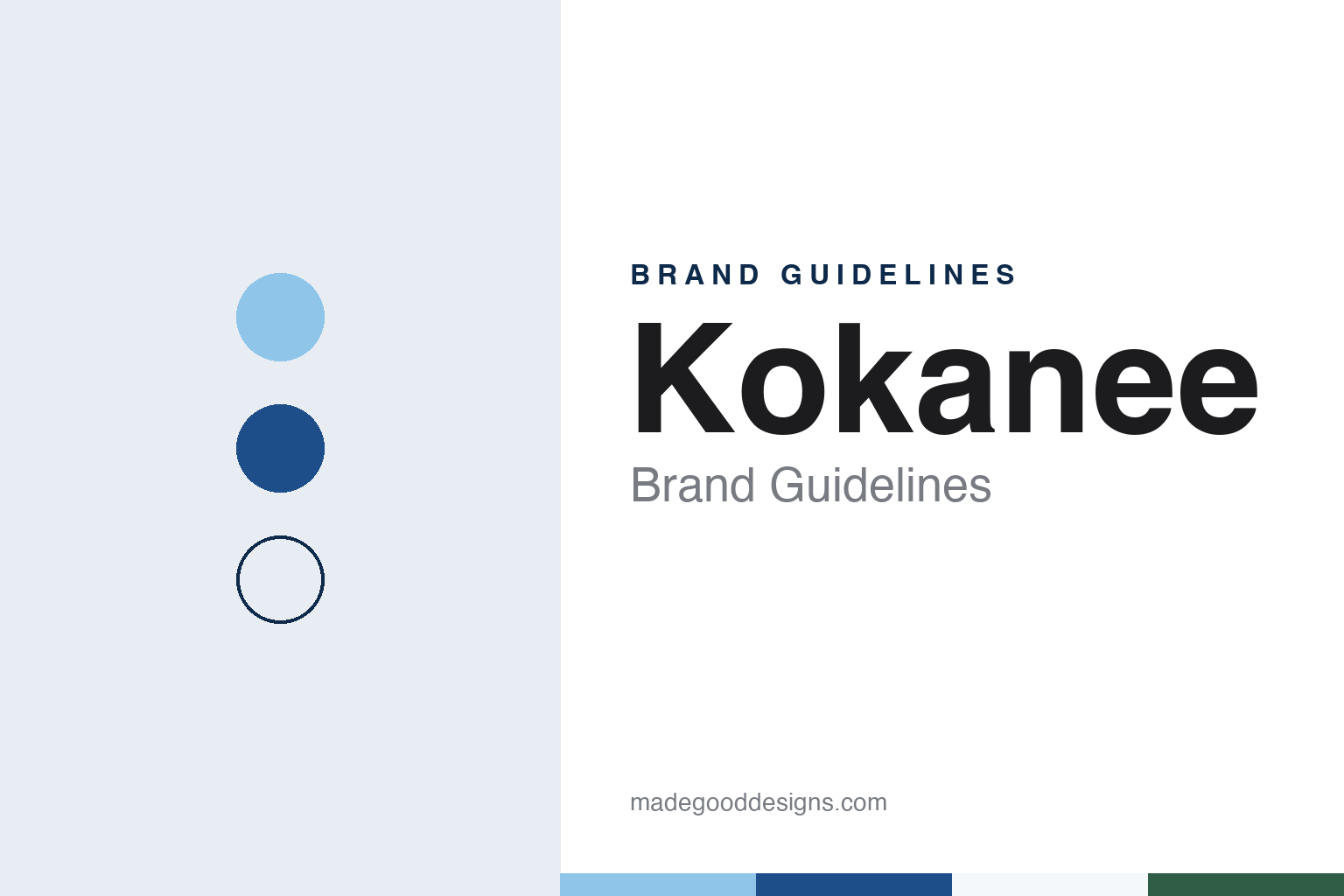
Kokanee Brand Guidelines
The Creston lager named after a Kootenay glacier.
Aa
Two constants: a glacier blue, Kootenay navy and snowfield palette and a condensed sans register. Abstract homage — not a Kokanee product or mark; no label, logo, can or bottle is reproduced.
Creston, 1959
A brewery in the Kootenays and a glacier for a name.
Kokanee is a lager brewed at the Columbia Brewery in Creston, a town in the Kootenay region of south-eastern British Columbia. Labatt’s own website said in 2002 that the brewery was built in 1959, that it began brewing Kokanee lager the same year, and that it traces its heritage to the Fort Steele Brewery, established in 1898. English Wikipedia gives the same 1959 start for the beer.
Ownership changed in 1974, when Labatt bought the Columbia Brewery, according to both Labatt’s 2002 website and English Wikipedia. Labatt itself later passed into international hands: English Wikipedia records its purchase by the Belgian brewer Interbrew in 1995, Interbrew’s merger with AmBev to form InBev in 2004, and InBev’s merger with Anheuser-Busch in 2008, which made Labatt, and with it Kokanee, part of AB InBev. The trademark notice on the beer’s current website, kokaneebeer.ca, names Columbia Brewing Company.
The name comes from the landscape. English Wikipedia says the beer is named after the Kokanee Glacier, in the Kootenays, the region in which Creston sits. The word itself is older than the beer: English Wikipedia traces “kokanee” to the Okanagan language, where it refers to landlocked populations of sockeye salmon, and the name is shared by a provincial park, a mountain range, a creek and several lakes and settlements.
The mountain on the label is specific too. English Wikipedia, citing the mountaineering database Bivouac.com, identifies it as Grays Peak, a summit in Kokanee Glacier Provincial Park. The peak was named after two brothers from Nelson, British Columbia, John Balfour Gray and the naval pilot Robert Hampton Gray, a Victoria Cross recipient, both of whom were killed in the Second World War; the Geographic Board of Canada adopted the name in March 1946, English Wikipedia says.
Colour
A lager, a glacier and a Sasquatch.
Labatt described Kokanee in 2002 as a 5.0% lager brewed in the Kootenays with a blend of Pacific Northwest hops. The company said then that Kokanee had been one of British Columbia’s best-selling beers for more than ten years and that it had won a silver medal at the 1996 Brewing Industry International Awards. English Wikipedia lists a wider family brewed at Creston, including Kokanee Gold and Kokanee Light, and says the beer is sold mostly in western Canada and the Pacific Northwest of the United States. In July 2009, Anheuser-Busch added Kokanee to its US import portfolio, according to a company press release cited by English Wikipedia.
The advertising is what most people remember. English Wikipedia says that after Labatt bought the brewery it hired the agency WestCan, later known as Scali McCabe Sloves, whose Vancouver office produced radio and television campaigns introducing the Sasquatch, who became the brand’s mascot. Its long-running slogans, the same article says, are “Glacier Fresh”, a reference to mountain water, and “It’s the Beer Out Here.”
The packaging carries the same idea. English Wikipedia says Labatt hired Beakbane Marketing of Toronto in 1992 to redesign it, replacing an icon of the glacier with a photographic montage of the mountains, and that a small Sasquatch was hidden in each design; on bottles and cans the figure appears in different positions on the peaks.
The Sasquatch ads grew into a cast. English Wikipedia describes the Kokanee Ranger, played by the actor John Novak, whose attempts to catch the beer-stealing Sasquatch ran for years, and a 2008 campaign in which viewers voted online on whether the Ranger should live or die; the vote ended with the character written out in an advert spoofing the final episode of The Sopranos. The agency Grip worked on that campaign and later ones, English Wikipedia says.
Typography
Western Canada’s beer brands.
The seven brands in this group are all Canadian beer and whisky names: Molson Canadian, Labatt Blue, Sleeman, Moosehead, Kokanee, Alexander Keith’s and J.P. Wiser’s. Beer and whisky brands in general sit at many different points in the trade, from family companies that still carry a founder’s name to labels that now belong to much larger drinks groups, and a single brand can be sold everywhere from a corner store to a bar rail.
A beer or whisky brand’s identity is usually carried less by a single bottle than by a label, a name and the place it promises, because the company behind the name may have changed hands, moved its production or grown far beyond the place where it started. That makes the questions behind each name worth asking plainly: who started it, who owns it now, and where its beer or whisky is actually made.
Each guide separates what independent sources record from what the company says about itself — its founding story, its owners over time, where its beer or whisky is made and how its labels have changed — and marks plainly what rests only on the company’s own word.
Aa
A condensed sans for a mountain brand. (Specimen set in Barlow Condensed, a sans STAND-IN; NOT the Kokanee logo.)
Kokanee
A beer brand that made its own feature film.
In 2012 the brand took its advertising further than a thirty-second spot. Kokanee financed The Movie Out Here, a buddy comedy set in Fernie, British Columbia, which The Globe and Mail reported in February 2013 had been written by Kokanee’s Toronto agency, Grip Limited, and distributed by Alliance Films on about 30 screens in British Columbia, Alberta, Saskatchewan and Manitoba. The film’s title played on the slogan “The Beer Out Here.” The newspaper described a nine-month campaign around it, in which fans could audition for small roles, submit music for the soundtrack and register to have their names included in the closing credits.
The film premiered at the Whistler Film Festival on 30 November 2012 and opened in western Canadian cinemas on 1 March 2013, according to English Wikipedia. In July 2013 Kootenay Business reported that it had won a Gold Lion in the branded-content category at the Cannes Lions festival.
Creston’s brewery also makes beer for its sister brands. In July 2009 the Columbia Brewery began brewing Alexander Keith’s India Pale Ale, the Nova Scotia beer that Labatt also owns, according to a local news report of that month cited by English Wikipedia.
The name needs a little care online. Kokanee is also the common name of landlocked sockeye salmon, and of Kokanee Glacier Provincial Park in the Kootenays; searches for the beer bring up all three. The brand’s own site is kokaneebeer.ca.
For a design guide, Kokanee shows how a regional lager can build its whole identity on a single local landscape — a named peak, a glacier and a folkloric creature hidden on the label — and carry it from one Kootenay brewery to the rest of western Canada. Compare Labatt Blue, the lager of the company that bought the Columbia Brewery in 1974, and Alexander Keith’s, its Nova Scotia stablemate. For this guide we use glacier blue, Kootenay navy and snowfield with a condensed sans, an unofficial interpretation; no product or logo is reproduced.
Explore & save
Keep Kokanee’s identity on hand — save it to a board in the Made Good inspiration library.
Kokanee identity set
Pin the Kokanee glacier blue, Kootenay navy and snowfield palette and the condensed mountain sans register to your own board.


