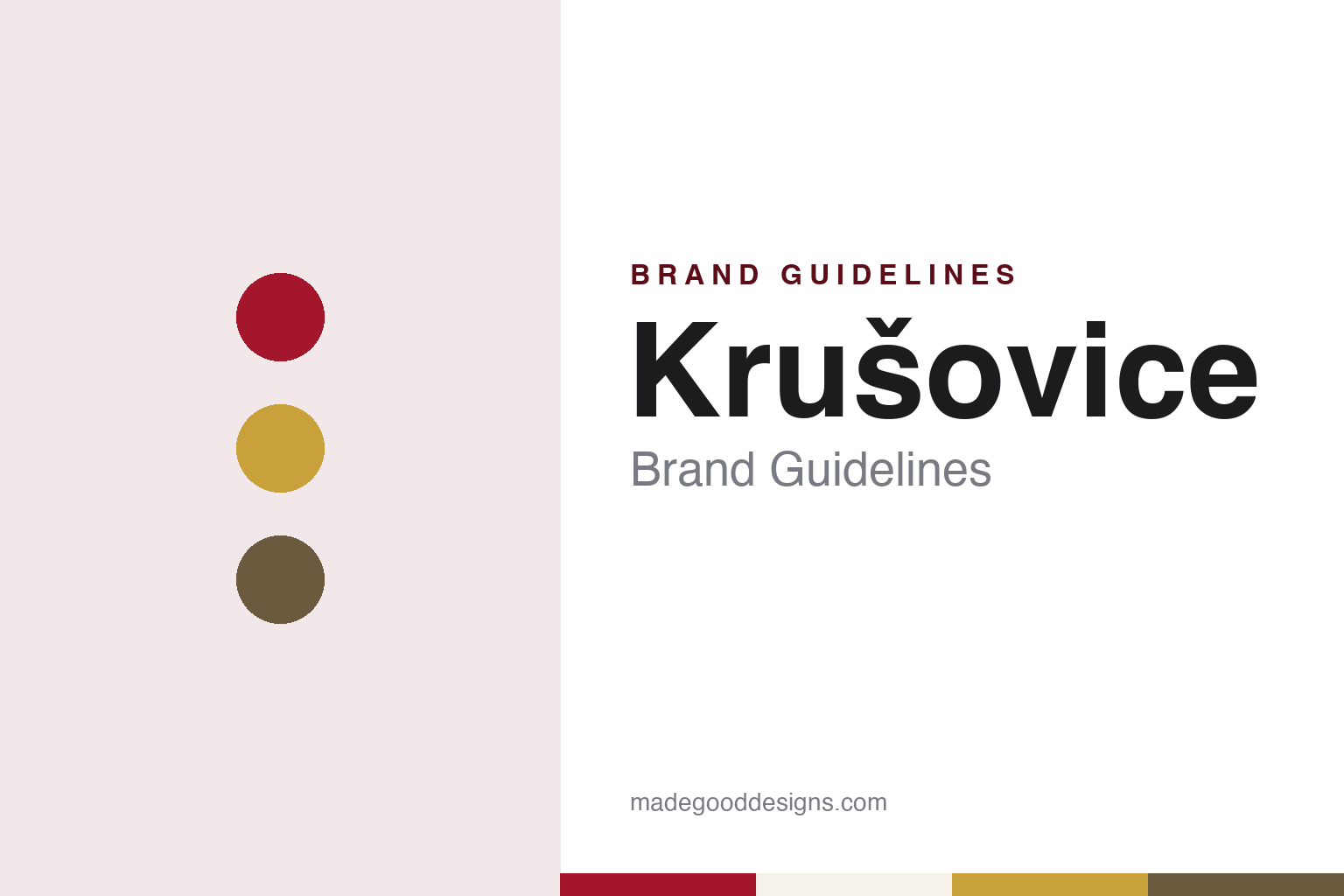
Krušovice Brand Guidelines
The royal brewery Rudolf II bought in 1583.
Aa
Two constants: a royal red, crown gold and hop earth palette and a Roman inscriptional capitals register. Abstract homage — not a Krušovice product or mark; no label, logo or bottle is reproduced.
An emperor’s brewery west of Prague
From a nobleman’s estate to the Bohemian crown.
The Royal Brewery of Krušovice — Královský pivovar Krušovice — stands in the village of Krušovice in the Rakovník district of Central Bohemia, about 70 kilometres west of Prague, as the German trade journal Brauwelt put it in 2007. The brewery says it was founded in 1581 and that beer has been brewed there continuously ever since; the year is embossed on its bottle. Czech Wikipedia is more cautious: it ties the brewery’s origins to the St Wenceslas Treaty of 1517, which allowed nobles to brew on their estates, says the exact founding date is unknown, and records the first concrete mention in 1581, when Jiří Birka of Násile, the first known owner of the estate, offered the brewery for sale to the emperor. Brauwelt gave 1517 as the founding year.
The sale went through. In 1583 the Habsburg emperor Rudolf II, who ruled from Prague, bought the brewery and attached it to the royal estate of Křivoklát, Czech Wikipedia says, and had Krušovice beer delivered to Prague Castle. That royal ownership is the source of the brewery’s name, Czech Wikipedia says; MediaGuru repeated the Prague Castle story in 2014.
Noble owners followed. Czech Wikipedia says that in 1685 Arnošt Josef of Valdštejn (Waldstein) acquired the brewery and built a new malt house and mill, and that after his death the estate passed, as part of his daughter Marie’s dowry, to the princely Fürstenberg family in the 1730s. The brewery’s own timeline says a first steam engine was installed in 1869, when the malt house, kiln, brewhouse and cellars were rebuilt. After the Second World War the brewery was nationalised under the Beneš decrees on 15 November 1945, and in 1961 it became part of the state enterprise Středočeské pivovary, Czech Wikipedia says. It regained its independence in 1991 and became a joint-stock company on 1 January 1992, the year, Czech Wikipedia says, it installed the first keg-filling line in the country and began exporting to the United States and the United Kingdom.
Colour
A crown, a glass named Rudolf and a bottle stamped 1581.
Czech Wikipedia says the company took the name Královský pivovar Krušovice in 1995, when a new logo was created, and English Wikipedia says a crown became part of the company’s logo.
In November 2014 the brewery introduced a half-litre handled glass called “Rudolf,” designed by the Czech designer Maxim Velčovský. MediaGuru reported on 28 November 2014 that Velčovský drew on historical portraits of Rudolf II and stylised the royal crown into a geometric ornament, with ten facets rising from its points; the old red logo on the glass gave way to a clear embossed one. The concept came from the agency VCCP, and the launch tied in with the brand’s 2014 campaign line “Be a king, or not.”
A new bottle followed. MediaGuru reported on 17 March 2016 that it carried embossed decoration with the year 1581 and the royal crown, which the brand called its symbol, smaller labels in earthy colours that refer to the Žatec hop-growing region, a simpler Krušovice logo, and a cap showing the crown and the beer’s number; brand manager Lenka Kroupová called it a “royal” bottle.
MediaGuru reported on 12 March 2026 that a new glass by the designer Rony Plesl would reach Czech pubs that month. Plesl said he wanted the crown itself to be the central motif, without lettering; the outline of the glass refers to a theatre curtain and royal ermine, vertical facets recall cut Czech crystal, and the founding year sits on the handle. Heineken’s marketing director Martina Ježdíková said the crown was to become a unifying symbol across the whole Krušovice portfolio. The launch campaign, “Klenot,” starred the actor Bolek Polívka, with creative work by FLO. In 2021, MediaGuru had reported that Saatchi & Saatchi replaced DDB as the brand’s creative agency.
Typography
Design and documentation.
The seven brands in this group are all Czech beers: Bernard, Krušovice, Gambrinus, Radegast, Primátor, Svijany and Lobkowicz. Between them they cover most of the ways a Czech brewery can be owned today. Finance.cz wrote in March 2024 that Gambrinus and Radegast belong to Plzeňský Prazdroj, whose sole shareholder is Japan’s Asahi; that the Royal Brewery of Krušovice belongs to Heineken; that Svijany and Primátor sit in the Czech holding LIF Group; that the Belgian brewer Duvel Moortgat has held half of the family brewery Bernard since 2001; and that Pivovary Lobkowicz Group belongs to Lapasan, a company under China’s CITIC.
A Czech beer brand’s identity is usually carried by a name, a town and a label rather than by a single bottle, and the brewery behind the name may have changed hands several times, or moved production to another town. That makes the plain questions worth asking: who founded the brewery, who owns it now, and where the beer is actually brewed.
Each guide separates what independent sources record from what the company says about itself — its founding story, its owners over time, where its beer is brewed and how its labels have changed — and marks plainly what rests only on the company’s own word.
Aa
Roman inscriptional capitals for a brewery that trades on a royal past. (Specimen set in Cinzel, a serif STAND-IN; NOT the Krušovice logo.)
Krušovice
From the Oetker group to Heineken.
The Czech news site Novinky.cz reported in June 2007 that the brewery had been part of the Dr. Oetker group since its privatisation in 1993; Brauwelt and Czech Wikipedia date the purchase by the Oetker-owned Binding brewery to 1994. Binding was later folded into the Radeberger Gruppe, which by 2005 held 99.83 per cent of the shares and squeezed out the remaining minority shareholders that August, Novinky.cz reported. Brauwelt wrote in 2007 that Binding had spent millions equipping Krušovice with modern plant.
In June 2007 the Dutch brewer Heineken announced that it was buying the brewery from Radeberger for an undisclosed cash price, with completion expected by 1 September 2007, Novinky.cz and Brauwelt reported; Heineken already owned the Starobrno brewery in Brno. The brewery’s own timeline dates Heineken’s arrival to 2008. Czech Wikipedia, citing Der Standard, says the Krušovice brand for the German market stayed with Radeberger.
The beer is still brewed at Krušovice. The brewery’s timeline lists a non-alcoholic bitter lager, Hořké nealko, in 2021 as its first non-alcoholic beer, and Bohém, a premium lager made with Žatec hops, in 2023; its range also includes the dark Černé and the Mušketýr lagers. Czech Wikipedia says Krušovice was an official sponsor of the IIHF Ice Hockey World Championship in 2015 and 2016. The brewery’s site is krusovice.cz, and the name Krušovice also simply means the village.
For a design guide, Krušovice shows how a single heraldic object — a crown borrowed from a sixteenth-century emperor — can be carried from a logo onto embossed glass, a bottle cap and a drinking glass until it can stand without a word of text. Compare Staropramen, the Prague brewery of Smíchov, and Zlatý Bažant, the Slovak lager brewed in Hurbanovo. For this guide we use royal red, crown gold and hop earth with a capital serif, an unofficial interpretation; no product or logo is reproduced.
Explore & save
Keep Krušovice’s identity on hand — save it to a board in the Made Good inspiration library.
Krušovice identity set
Pin the Krušovice royal red, crown gold and hop earth palette and the Roman inscriptional capitals register to your own board.