Le Coq Sportif Brand Guidelines
The Romilly knitwear maker that took the Gallic rooster.
Aa
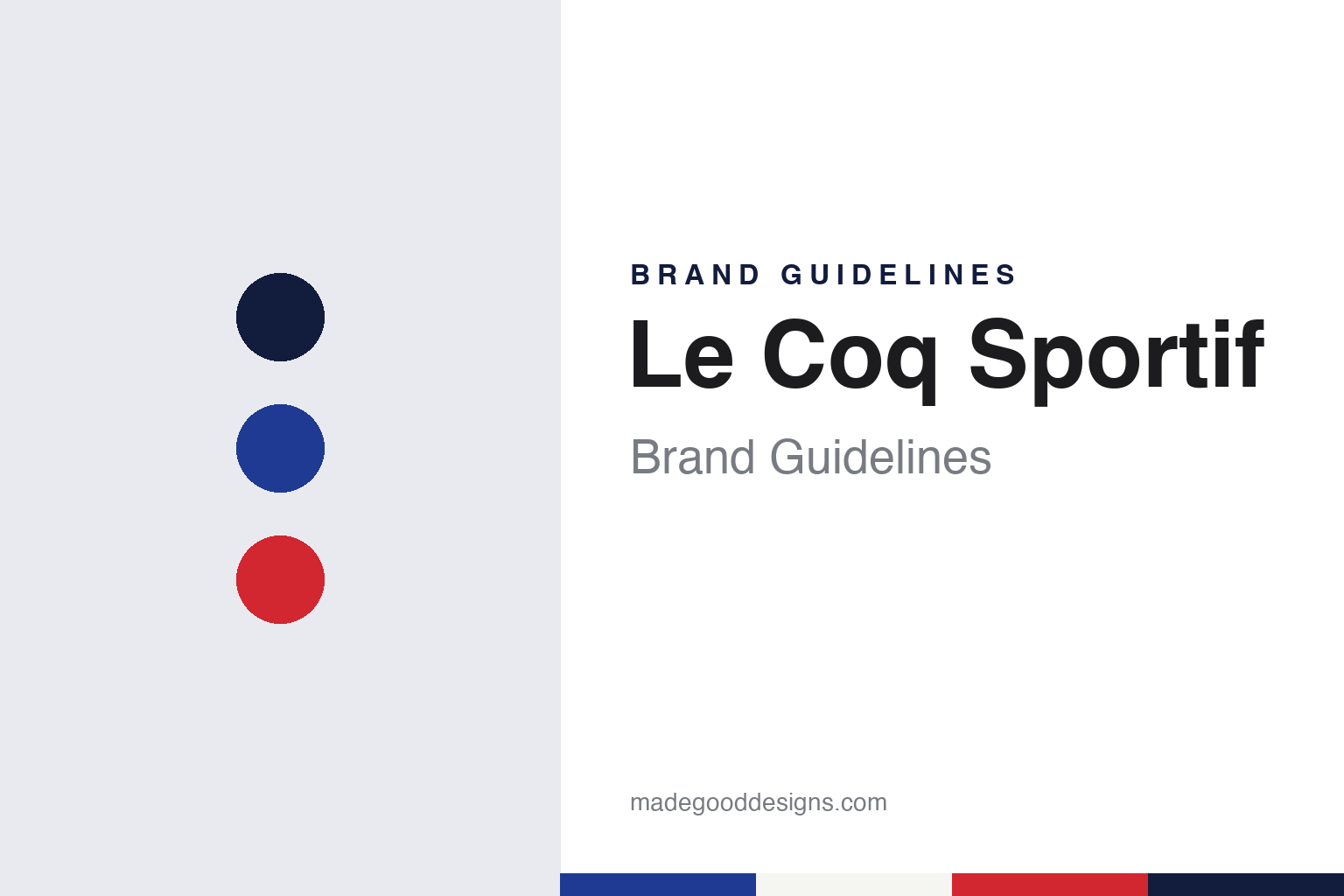
Two constants: a tricolour blue, rooster red and jersey white palette and a condensed jersey sans register. Abstract homage — not a Le Coq Sportif product or mark; no rooster, triangle or logo is reproduced.
Camuset
A knitwear workshop in the Aube and a national bird.
Le Coq Sportif began as a knitwear business. French Wikipedia says Émile Camuset set up a hosiery and knitwear workshop in Romilly-sur-Seine, in the Aube department, in 1882. From 1920, it says, encouraged by his daughter Mireille Camuset, the firm began making sports clothing alongside its traditional lines, taking its cue from British makers, and by the 1930s it was supplying French federations in football, basketball, rugby and athletics. English Wikipedia adds that the family released a catalogue in 1929, made up mostly of cycling jerseys, from its factory in Romilly.
The name and the symbol came together. Le Coq Sportif means “the athletic rooster”, and English Wikipedia says both the name and the trademark derive from the Gallic rooster, a national symbol of France. French Wikipedia dates the first garments carrying labels with the rooster’s image to 1948, and says that on 26 August 1950 “le Coq sportif, bonneterie sportive romillonne” became a registered trademark. The full name kept the brand tied to its town and its trade: sporting knitwear from Romilly.
Cycling gave the rooster its stage. French Wikipedia says the brand received its first major order in 1951, for the jerseys of the national teams riding the Tour de France, a year in which the race passed through Romilly-sur-Seine, where the jerseys were made. In 1955, it says, the France football team played the Soviet Union in a blue shirt made by the brand. At the Rome Olympics in 1960, French Wikipedia says, the company dressed the French athletes and created a new logo for the occasion, a rooster set in the middle of the five Olympic rings.
The triangle arrived in 1966. French Wikipedia says the Tour de France organisers agreed that year that the small rooster inside its triangle could appear on the race’s jerseys, and English Wikipedia says the company redesigned its logo as a triangle with a rooster inside and put it on the yellow jersey for the Tour that year. French Wikipedia says television and magazine coverage of that year’s race brought the brand new recognition.
Colour
Adidas, Airesis and a court-approved takeover.
The same year brought a partnership with Adidas. French Wikipedia says the two companies joined forces for the 1966 World Cup, with Le Coq Sportif supplying shirts and Adidas supplying footwear, and English Wikipedia says the agreement covered the production of three-stripes clothing in France. English Wikipedia describes a later dispute between the two companies over the three stripes in France in the early 1970s.
The family business then came under pressure. French Wikipedia says that in 1974, facing competition in textiles and rising raw-material costs, the company was restructured: on 13 June 1974 the Paris commercial court accepted a proposal from Adidas, and Le Coq Sportif became a subsidiary of its German partner. English Wikipedia describes the role of the businessman André Guelfi and of Horst Dassler, then running Adidas, in that arrangement. In the 1980s, French Wikipedia says, Adidas built an international network of distributors and agents for the brand and extended it into leather goods, balls and competition footwear.
Ownership changed several times after that. English Wikipedia says the brand later passed through the hands of the businessman Bernard Tapie and the American company Brown Shoe, with the Japanese firm Descente taking rights to develop a golf line. In 2005, French Wikipedia says, Marc-Henri Beausire and Robert Louis-Dreyfus relaunched the company through Airesis, a Swiss investment company, and the brand returned to its roots: a development centre reopened in Romilly-sur-Seine in 2010 and a textile production centre there in 2012, the year it began supplying the Tour de France’s yellow, green and polka-dot jerseys again. In March 2020, French Wikipedia says, the Paris 2024 organisers named Le Coq Sportif as outfitter for the French Olympic and Paralympic teams.
The Airesis era ended in court. Le Temps reported on 4 July 2025 that, after receivership proceedings that began in autumn 2024, the Paris economic-activities court chose a takeover bid from a consortium led by the French-Swiss businessman Dan Mamane, and Sportcal reported that Alexandre Fauvet, a former Lacoste executive, had been installed as chief executive. Le Temps added that the Japanese group Itochu, which owns the Le Coq Sportif brand in Asia, supported the plan.
Typography
Design and documentation.
A sportswear mark has to work at very small sizes and at a distance. On a shirt it usually sits on the chest, opposite a club crest or a national badge, and it has to read on a pitch, in a photograph and on a television screen as clearly as it does on a swing tag or a shoebox. That is why so many sportswear identities pair a compact symbol with a wordmark that can be dropped when space runs out.
Many brands also repeat the mark beyond the chest: as a tape running down the sleeve or the side seam, as a band of stripes or shapes on a cuff, or as a pattern woven into the fabric itself. On a team kit those placements share the shirt with the club’s own crest and with a sponsor’s name across the front, so the sportswear brand’s marks have to sit alongside other people’s identities without competing with them.
Each guide below looks at how one brand’s symbol, wordmark and repeated details have changed over time, who has owned the name, and what the documented record says about its history.
Aa
A condensed sport sans — the register of a jersey number and a race bib. (Specimen set in Barlow Condensed, a sans-serif STAND-IN; NOT the Le Coq Sportif logo.)
Le Coq Sportif
A national bird, a triangle and a town’s name.
Le Coq Sportif’s identity rests on the Gallic rooster, a national symbol of France, and on the settings the company has given it. French Wikipedia traces the rooster from a garment label in 1948, to a registered trademark in 1950 that still carried the words “bonneterie sportive romillonne”, to a rooster inside the Olympic rings for the Rome Games in 1960, and then to the small rooster inside a triangle that appeared on Tour de France jerseys from 1966.
The rooster has appeared on cycling jerseys, tennis clothing and football kits. English Wikipedia says the brand dressed Arthur Ashe when he won Wimbledon in 1975 and then launched an Arthur Ashe shoe, and that it made kits for clubs including Tottenham Hotspur, Everton and Ajax. French Wikipedia says the brand supplied the France rugby team from 2018 and AS Saint-Étienne from 2015 to 2022. The colours in this guide take their cue from the French tricolour, as our own interpretation.
The brand’s history also shows how an identity can outlast its owners. Between 1974 and 2025 the rooster passed from the Camuset family to Adidas, through several other owners, to Airesis and then, after a court process, to a consortium led by Dan Mamane. The rooster stayed on the clothing throughout, and the brand kept its link to Romilly-sur-Seine, where French Wikipedia says development and textile production returned in 2010 and 2012.
For a design guide, Le Coq Sportif shows how a national symbol can become a company’s own through a consistent frame, a town’s name and decades of use on race jerseys and team kits. Compare it with Adidas, its partner from 1966 and its owner from 1974, and Puma, another sportswear brand built on an animal symbol. For this guide we use tricolour blue, rooster red and jersey white with a condensed sans, an unofficial interpretation; no product or logo is reproduced.
Explore & save
Keep Le Coq Sportif’s identity on hand — save it to a board in the Made Good inspiration library.
Le Coq Sportif identity set
Pin the Le Coq Sportif tricolour blue, rooster red and jersey white palette and the condensed jersey sans register to your own board.