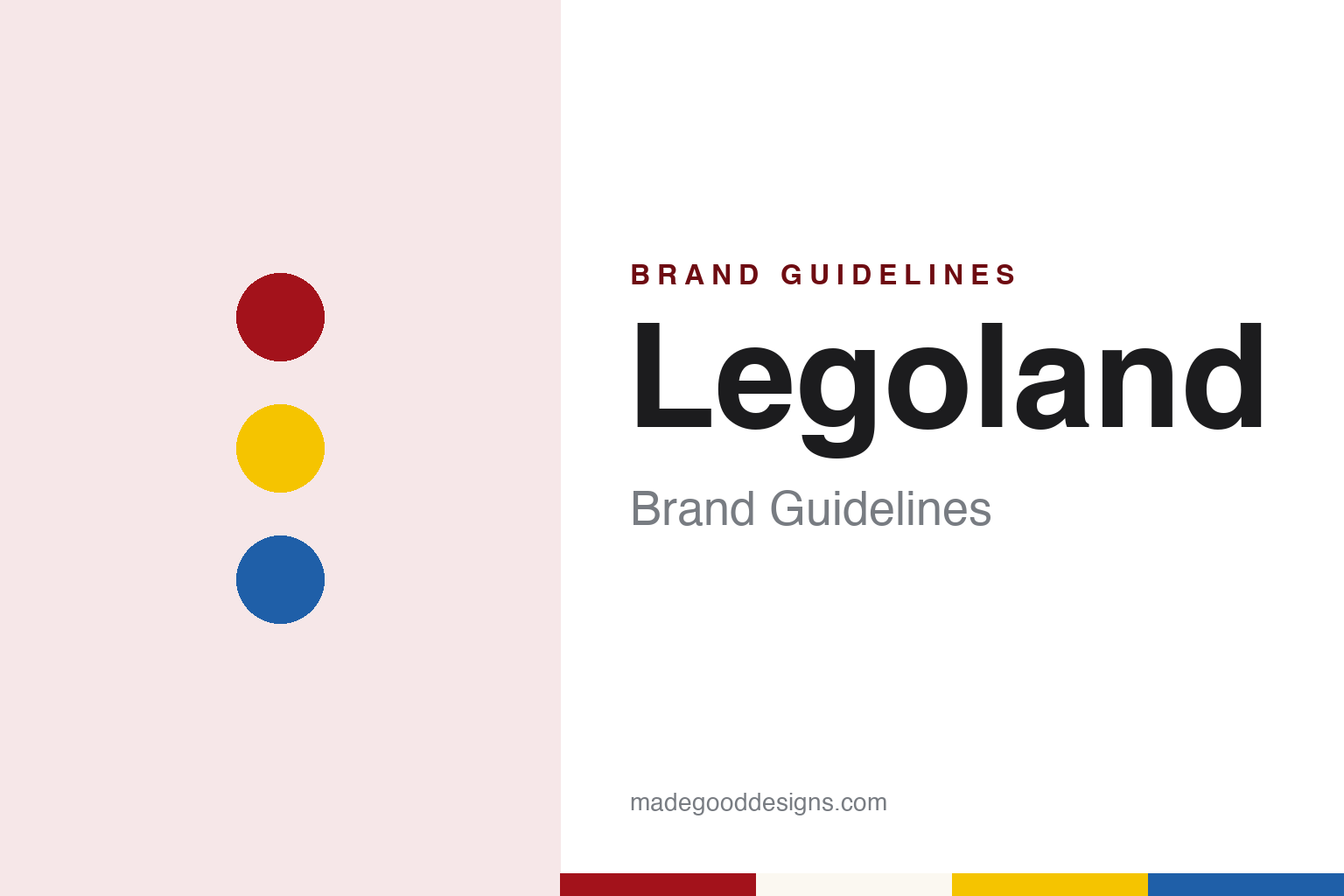
Legoland Brand Guidelines
The Billund park built from LEGO bricks.
Aa
Two constants: a brick red, brick yellow and brick blue palette and a chunky rounded sans register. Abstract homage — not a Legoland or LEGO mark; no logo, brick, model or minifigure is reproduced.
A park beside the factory
Visitors, a model builder and a window dresser from Copenhagen.
Legoland began as an answer to a crowd. The LEGO Group’s own history of the park says that once the interlocking brick system arrived in 1958, model building became a public attraction in its own right: schoolchildren, associations and retailers came to Billund, in western Denmark, to queue for the company’s exhibition of finished models at the factory. The company credits much of that to Dagny Holm, a cousin of the second-generation owner Godtfred Kirk Christiansen, who joined in 1961 as a model builder and, in its words, saw that bricks combined with other elements could become buildings, castles, figures and animals.
When the factory and its exhibition could no longer cope with the visitors, the company says, Godtfred Kirk Christiansen proposed showing LEGO models in the open air. He persuaded Arnold Boutrup — chief designer at a Copenhagen department store and, the company says, the man behind its shop-window displays — to create a real “LEGO land”. Lorry loads of earth and turf transformed flat moorland in Billund into rolling ground for a Miniland of landscapes and houses, all built from ordinary LEGO bricks by Holm and her team. The company lists the park’s other early attractions as a large LEGO train, a puppet theatre and a driving school with an educational purpose, along with bricks for children and adults to play with.
The park opened in 1968, near the LEGO company headquarters in western Denmark, as the Associated Press summarised it in 2019. The LEGO history says the opening season far exceeded the company’s own estimate, and it recalls an opening-day story told by Erik Tapdrup, later head of the development department LEGO Futura: so many visitors arrived that Godtfred Kirk Christiansen called him in to help wash dishes in the restaurant kitchen, where he found the marketing director Helge Torpe already at the sink. The two executives, the company says, worked there side by side for the rest of the day.
Colour
From a toy company’s park to a chain run by Merlin Entertainments.
Later parks followed from the mid-1990s. The LEGO history lists the later Legoland parks in order of opening: Windsor, in England, in 1996; California, in Carlsbad north of San Diego, in 1999; Deutschland, in the southern German town of Günzburg, in 2002; Florida in 2011; Malaysia in 2012; Dubai in 2016; Japan in 2017; and New York in 2021. The company says each park contributes creative LEGO models in support of the LEGO brand.
The parks left the LEGO Group in 2005. The company’s history says the parks it then owned were sold to Merlin Entertainments that year, after the LEGO Group’s economic crisis, to secure resources for its efforts to reverse the losses it had made in 2003 and 2004. Theme Park Insider, reporting on 13 July 2005, said Blackstone had made official its purchase of the Legoland parks, and that Blackstone and LEGO were forming a new company, Merlin Entertainments Group, in which Blackstone — already the owner of Merlin Entertainments in Europe — would hold the majority and LEGO a minority. The same report said Legoland officials had promised no changes to park branding, theme or operations as a result of the sale.
Ownership changed again in 2019. The Associated Press reported on 28 June 2019 that a group including Kirkbi Invest, the owner of LEGO, together with Blackstone and the Canada Pension Plan Investment Board, was buying Merlin, the British company that operates Legoland, and that Merlin had accepted the offer. The LEGO history says Kirkbi A/S, the LEGO owner family’s investment company, is a shareholder in the Merlin Entertainments Group and appoints representatives to its board, so that, in close co-operation with the LEGO Group, the parks are run with due respect to the values of the LEGO brand. It says Kirkbi and two investment companies joined forces behind Merlin in 2020.
The Legoland parks also briefly shared an owner with SeaWorld: Theme Park Insider noted in 2013 that Blackstone, which bought the SeaWorld parks in 2009, also owned the Legoland theme parks at the time.
Typography
Design and documentation.
A theme-park identity is read on the move. Visitors meet it first on a highway sign or a car-park pole, then at the entrance gate, and the same name has to work at the size of a building and the size of a ticket stub. That is why park marks tend to be built from bold, simple shapes that survive distance, glare and a quick glance from a moving car.
Inside the gates, the park map becomes the identity’s busiest document. It has to sort themed areas, paths, food stops and facilities into something a family can follow with one hand, so colour coding, numbered keys and a small set of pictograms usually carry more weight than the logo itself.
Characters and mascots add a second layer. A costumed figure, a cartoon on a cup or a face on a plush toy gives the brand a personality that a wordmark alone cannot, and it travels well onto merchandise.
Ride and area signage then borrows the theme of each zone, from rough timber lettering to bright fairground type, while souvenir packaging, bags and photo folders carry the main mark home. For designers, the lesson is a system that flexes by zone but still reads as one place.
Aa
A chunky rounded sans — the register of a park sign and a children’s map. (Specimen set in Baloo 2, a sans-serif STAND-IN; NOT the Legoland logo.)
Legoland
A park whose building material is also its brand.
The Legoland identity is built, literally, from the product it promotes. The name joins the toy brand to the word “land”, and the company writes it as LEGOLAND, in capitals like its parent. In the LEGO Group’s own telling, the park grew out of a factory exhibition of models, and its centrepiece, Miniland, was made from the same ordinary bricks sold in shops. That gives the brand a direct link between what visitors see and what they can buy: the buildings, figures and landscapes in the park are demonstrations of the toy.
The people the company credits with the original park came from model building and retail display rather than from the amusement business. Dagny Holm was a model builder inside the company, and Arnold Boutrup was known for department-store windows in Copenhagen. The LEGO history presents the park’s purpose as part of the toy brand: each Legoland, it says, contributes creative LEGO models and an enjoyable experience in support of the LEGO brand, and the involvement of Kirkbi at Merlin is described as a way of keeping the parks in line with that brand’s values.
The ownership structure keeps the two names close even though the parks are run by a different company. Theme Park Insider reported in 2005 that Legoland officials promised no change to park branding when the parks passed to Merlin, and the AP’s 2019 report described Merlin as the British operator of the parks, with the LEGO owners among its new owners. For a designer, the result is a park brand that borrows its name, its building material and much of its visual vocabulary from a toy, while being operated as one attraction brand among several in Merlin’s portfolio.
For a design guide, Legoland shows how a park can turn a product into its scenery, so that the material of the toy and the identity of the place become the same thing. Compare it with LEGO, the toy brand whose bricks build its models, and SeaWorld, which shared an owner with it after 2009. For this guide we use brick red, brick yellow and brick blue with a sans, an unofficial interpretation; no product or logo is reproduced.
Explore & save
Keep Legoland’s identity on hand — save it to a board in the Made Good inspiration library.
Legoland identity set
Pin the Legoland brick red, brick yellow and brick blue palette and the chunky rounded sans register to your own board.