Legrand Brand Guidelines
A porcelain works in Limoges that kept one buyer’s surname.
Aa
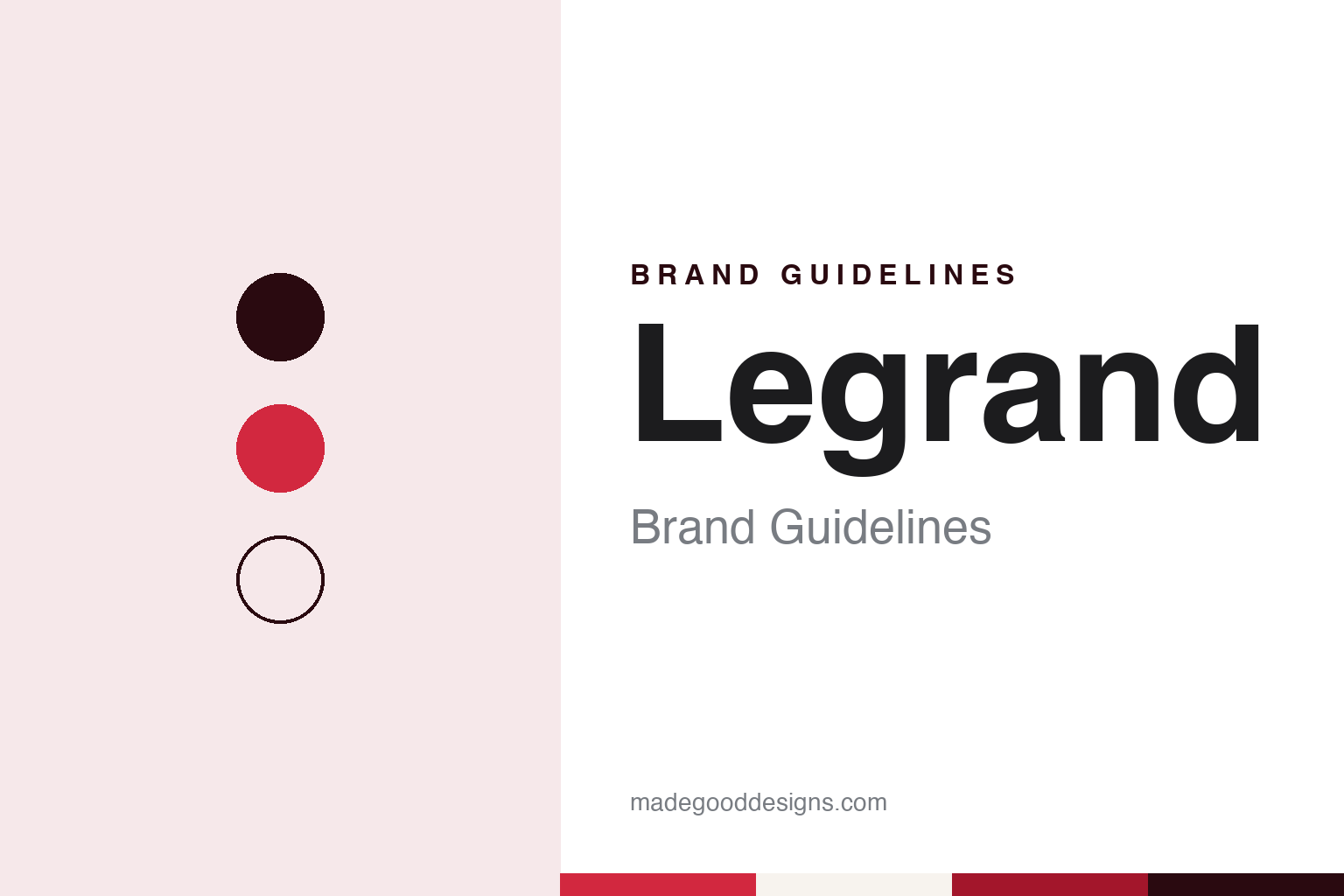
Two constants: a switch red, kiln brick and porcelain white palette and a plain grotesque register. Abstract homage — not a Legrand asset or mark; no logo or wordmark is reproduced.
Porcelain on the Vienne
Two timber merchants, a river and a kiln on the eastern edge of Limoges.
Legrand’s story starts with plates, not plugs. Writing in September 2025 for the company’s 160th anniversary, Le Journal des Entreprises traced the group back to 1865, when two timber merchants, Henri Barjaud de Lafond and Léonard Clidasson, opened a porcelain manufacture in Limoges, not far from the river Vienne. The location made practical sense: the wood that fed the kilns arrived by river, so being close to the supply was an advantage. English Wikipedia gives the same year and describes a porcelain workshop set up on the road to Lyon, originally making porcelain tableware.
Until 1904 it did not carry the Legrand name. Le Journal des Entreprises reports that from 1866 the business changed hands several times before it was bought in 1904 by Frédéric Legrand, together with Charles Alary and Jean Joquel. The company then took the name F. Legrand & Cie. English Wikipedia confirms the 1904 takeover and says simply that Frédéric Legrand gave his name to the company.
The name went through several forms over the next two decades as partners came and went. Seven years after the purchase, according to Le Journal des Entreprises, Legrand went into partnership with Émile Betoule, the son of a porcelain maker, and the firm became Betoule et Legrand. Through these years it was still a maker of porcelain.
One fact has not changed since the beginning. Le Journal des Entreprises notes that, a hundred and sixty years after its foundation, Legrand still occupies its original site at the eastern entrance to Limoges. The group that grew out of the workshop is a French industrial company that English Wikipedia describes as historically based in Limoges, in the Nouvelle-Aquitaine region, making electrical and digital building infrastructure products and connected devices.
That origin is visible in the company’s own products as well as in its address. Le Journal des Entreprises mentions that the decorative Céliane range of switches has been offered with a choice of finishes that includes Limoges porcelain, a material the company had stopped making in its own factory after 1949.
Colour
A switch-maker from Excideuil and a fire in 1949.
The turn from tableware to electrical fittings came through a partnership. In 1919, Le Journal des Entreprises reports, the firm joined forces with Jean Mondot, a man from Limoges who had opened a workshop at Excideuil in the Dordogne making switches and pear-shaped push switches in porcelain and boxwood. The company was renamed Betoule Legrand & Cie. English Wikipedia describes the same partnership and notes that before plastics, porcelain served as an insulating material for electrical parts.
The electrical side quickly took over. According to Le Journal des Entreprises, Émile Betoule sold his shares in 1924, and the firm became the Manufacture de porcelaines et d’appareillage électrique F. Legrand & Cie, owned in equal parts by Legrand and Mondot. The long name spelled out both trades, porcelain and electrical fittings, side by side. In 1938, the same article says, the factory installed a gas-fired tunnel kiln for firing electrical porcelain.
New owners arrived in 1944, when two brothers-in-law from northern France, Jean Verspieren and Édouard Decoster, took over the company, Le Journal des Entreprises says. The decisive break came five years later. In August 1949 a fire destroyed the central workshop where white porcelain was made. The owners rebuilt the factory to produce electrical equipment only. Delphine Camilleri, Legrand’s communications director, told the paper that the owners believed a country in reconstruction needed good electrical equipment more than porcelain plates. English Wikipedia also dates the decision to concentrate on wiring devices, switches and sockets, to the 1949 fire.
From that point the porcelain maker’s name became an electrical brand. In the 1950s, Le Journal des Entreprises says, new materials such as thermosets and thermoplastics replaced porcelain in electrical fittings, and the range widened to circuit protection, cable management and emergency lighting. The surname of the man who bought a tableware works in 1904 ended up on switches, sockets and trunking, and remains the name of the group today.
Typography
European industrial names and the surfaces they live on.
European industrial identities tend to be built from plain materials. Many company names began as a founder’s surname, the name of a town or river, or an acronym left behind when two firms merged and kept a trace of each. Those names were rarely chosen for sound or meaning; they were registered, painted on a works gate and stamped into metal, and they stayed because changing them would have meant changing every plate, invoice and drawing at once.
That history shapes how the marks look today. A wordmark that has to be cast into a pump housing, etched onto a switch plate or printed on a shipping crate needs simple letterforms, generous spacing and a single colour that survives grime, paint and sunlight. Symbols are often abstract shapes or stylised initials rather than pictures, because they must read at the size of a thumbnail on a control panel and at the size of a building on a factory roof.
The brand surfaces are mostly physical: product plates, machine liveries, signage at plant gates, vehicle fleets, trade-fair stands and the technical manuals that travel with the equipment. Reviewing one of these identities means looking at where the mark is actually fixed, not only at the version on a screen.
Aa
A plain grotesque — after a single surname printed on switches and sockets. (Specimen set in Work Sans, a sans STAND-IN; NOT the Legrand logo or any Legrand typeface.)
Legrand
Listings, acquisitions and a group that kept one name.
The single surname proved durable as the company expanded. English Wikipedia and Le Journal des Entreprises both date the start of expansion outside France to 1966, in Belgium, and the company’s listing on the Paris stock exchange to 1970. Expansion beyond Europe followed in 1977 with the takeover of Pial in Brazil, and Legrand entered the United States in 1984 by acquiring Pass & Seymour. In 1989 it bought the Italian company BTicino.
English Wikipedia lists later purchases such as Wiremold in the United States in 2000. In 2018, Wikipedia says, Legrand merged with Netatmo, the Paris-area connected-home company in which it had taken a stake in 2015, and Le Journal des Entreprises notes that the decorative switch range was later offered as “Céliane with Netatmo”.
Ownership changed early this century. In 2001, Le Journal des Entreprises reports, Schneider Electric launched a friendly share-exchange offer for the whole of Legrand’s capital, and the European Commission in Brussels blocked the deal. The newspaper dates the takeover by a consortium of the investment firms Wendel and KKR to 29 July 2002; English Wikipedia places their purchase of the entire share capital, and the withdrawal from the stock market, in 2003. The consortium sold out of the capital in 2011, the paper says.
Through these changes Legrand stayed in Limoges. The town where two timber merchants opened a porcelain works in 1865 is still the group’s home, and the name on the business is still that of the man who bought it in 1904.
For a design guide, Legrand shows how a buyer’s surname, taken on with a tableware works, can outlast the product it was once painted on and become the name on switches and sockets. Compare Schneider Electric, the French group whose 2001 offer for Legrand was blocked, and Sandvik, a Swedish name taken from a place. For this guide we use switch red, kiln brick and porcelain white with a sans, an unofficial interpretation; no product or logo is reproduced.
Explore & save
Keep Legrand’s identity on hand — save it to a board in the Made Good inspiration library.
Legrand identity set
Pin the Legrand switch red, kiln brick and porcelain white palette and the plain grotesque register to your own board.