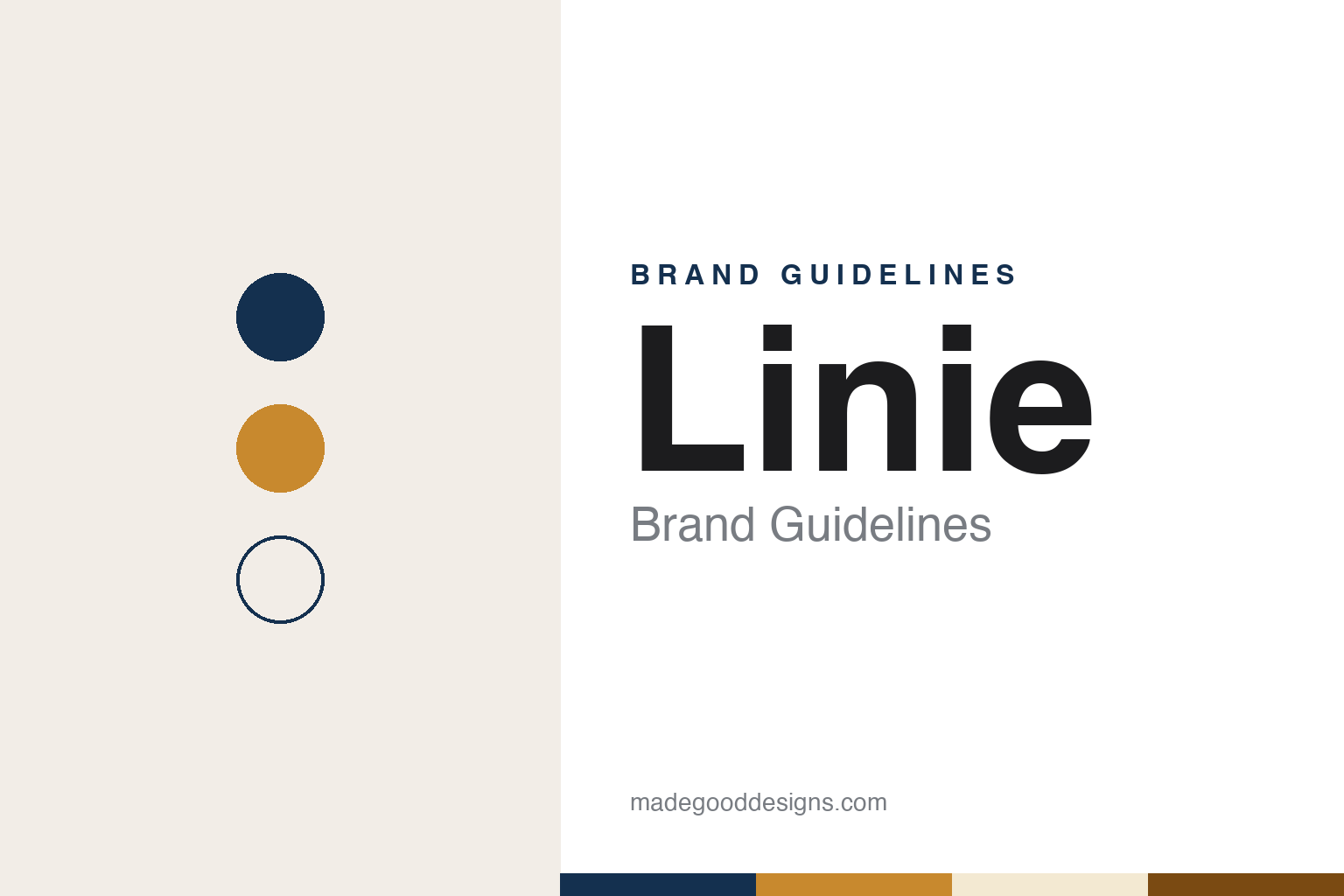
Linie Brand Guidelines
The Trondheim aquavit that goes to sea before it is bottled.
Aa
Two constants: a sea navy, sherry amber and parchment palette and a classical serif register. Abstract homage — not a Linie product or mark; no label, logo or bottle is reproduced.
A voyage that failed
Unsold aquavit, a two-year round trip and a better spirit.
Linie Aquavit traces its story to Trondheim and to a cargo nobody wanted. In 1805, The Spirits Business reported in a 2020 brand history, the Trondheim merchant Catharina Lysholm shipped aquavit to the East Indies aboard the brig Trondhjems Prøve. The spirit did not sell, and the casks came back to Norway after a voyage of about two years. VinePair, in a 2019 feature, gives the destination as Batavia, in what is now Indonesia, and says five casks made the round trip. Both accounts agree on the point the brand has repeated ever since: the aquavit that came home tasted better than the aquavit that had left.
The man who turned that accident into a product was Jørgen B. Lysholm, Catharina’s nephew according to The Spirits Business. The Spirits Business dates the launch of Linie to 1821. VinePair describes how, by the late 1830s, Lysholm’s Trondheim distillery was sending aquavit in oak barrels on ships carrying dried cod to Rio de Janeiro and other South American ports. The name followed the route. Linie means “line”, and the line in question is the equator, which the casks cross twice before the spirit is bottled.
The Spirits Business notes that the state took control of the country’s distilleries in the 1920s and that Linie survived the change. The brand then spent decades as a product of Vinmonopolet, the Norwegian state wine and spirits monopoly. Retail and production sat inside the same monopoly until 1 January 1996, when, English Wikipedia says, production, import, export and storage were split off into a new company, Arcus, while Vinmonopolet kept the shops.
Colour
A ship, a sherry cask and a label that reads like a logbook.
Linie’s identity rests on a process rather than a picture. Before it goes to sea, The Spirits Business reported, the spirit spends about a year in casks in warehouses near Oslo; VinePair says the casks are former oloroso sherry barrels between ten and fifteen years old. The casks are then loaded on a cargo ship. Since 1927, according to The Spirits Business, the Norwegian shipping line Wilhelmsen has handled that sea passage. VinePair wrote in 2019 that the casks travel in containers on a Wilhelmsen ship that calls at more than two dozen ports in the United States, Latin America and Asia, crossing the equator twice on a journey of about four months.
The voyage is also the label’s main text. Each bottle, VinePair reports, is marked with the dates of its sea journey, and retail descriptions of the bottle say the back of the label names the ship together with the dates of departure and return. In that way each bottle is tied by name and date to one particular crossing.
The brand has carried the same idea into its marketing. The Spirits Business reported that in 2018 a webcam broadcast a cargo ship’s voyage on Linie’s website, so that drinkers could follow the casks at sea in real time. The wordmark itself, as the Made Good Designs guide to the Linie Aquavit font explains, is best read as custom lettering in a classical, heritage register rather than as a typeface anyone can download.
Typography
Design and documentation.
The seven brands in this group are all Nordic aquavit and spirits and Polish vodka names: Linie, Aalborg, O.P. Anderson, Brennivín, Koskenkorva, Sobieski and Soplica. Spirits brands in general sit at many different points in the trade, from names that still carry a founder’s story to labels that now belong to much larger drinks groups, and a single brand can be sold everywhere from a corner shop to a bar list.
A spirits brand’s identity is usually carried less by a single bottle than by a label, a name and the place it promises, because the company behind the name may have changed hands, moved its production or grown far beyond the place where it started. That makes the questions behind each name worth asking plainly: who started it, who owns it now, and where its spirit is actually distilled and bottled.
Each guide separates what independent sources record from what the company says about itself — its founding story, its owners over time, where its spirit is made and how its labels have changed — and marks plainly what rests only on the company’s own word.
Aa
A classical serif for a heritage wordmark with a maritime story. (Specimen set in Cormorant Garamond, a serif STAND-IN; NOT the Linie logo.)
Linie
From a state monopoly to a Nordic listed group.
Arcus did not stay in state hands for long. English Wikipedia says the Norwegian Ministry of Trade and Industry sold two thirds of the company to the investment firm Sucra in July 2001, that Sucra bought the remaining shares in 2003, and that the Swedish investment company Ratos bought Arcus in 2005. Arcus then listed on the Oslo Stock Exchange, with a first day of trading on 1 December 2016, according to a Ratos release of 30 November 2016.
Production moved with the company. The Norwegian engineering weekly Teknisk Ukeblad reported in 2011 that Arcus would leave its old site at Hasle in Oslo for a new plant at Gjelleråsen, just outside the city, in the summer of 2012. Anora Industrial, the group’s production arm, says the Gjelleråsen plant runs five copper pot stills that make aquavits including Lysholm LINIE, Aalborg, Gammel Opland and Løiten, and that more than 8,000 oak casks are stored on the site. Danish aquavit came to the same address: after Arcus bought the Aalborg brands from Pernod Ricard in a deal completed in January 2013, Danish production moved to Gjelleråsen in 2015.
The latest change of ownership came in 2021. Arcus merged into the Finnish wine and spirits company Altia, and the combined business, Anora Group, was registered on 1 September 2021, the company announced. Anora is headquartered in Helsinki and listed on Nasdaq Helsinki, and Linie now shares an owner with the Finnish vodka Koskenkorva. The bottle is sold both as “Linie Aquavit” and as “Lysholm Linie”; Linie is also simply the German word for “line”, which makes searches for the brand a little noisy.
For a design guide, Linie shows how a single repeated journey — a cask, a ship and two crossings of the equator — can serve as a brand’s whole story, its process and its label copy for two centuries. Compare Aalborg, the Danish akvavit now made at the same Norwegian plant, and O.P. Anderson, the Swedish aquavit. For this guide we use sea navy, sherry amber and parchment with a serif, an unofficial interpretation; no product or logo is reproduced.
Explore & save
Keep Linie’s identity on hand — save it to a board in the Made Good inspiration library.
Linie identity set
Pin the Linie sea navy, sherry amber and parchment palette and the classical serif register to your own board.