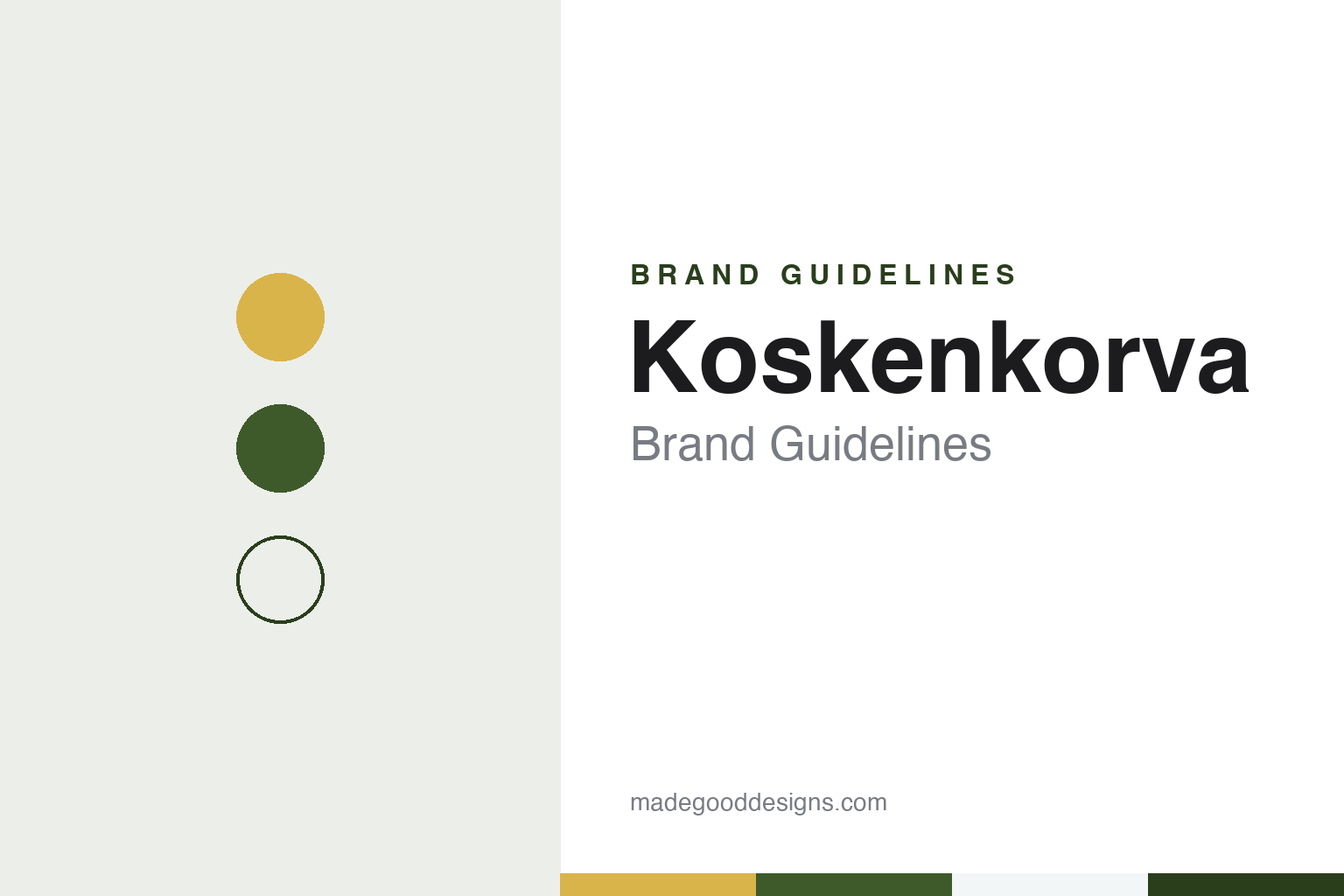
Koskenkorva Brand Guidelines
Finland’s 1953 barley viina from an Ilmajoki distillery.
Aa
Two constants: a barley gold, field green and frost white palette and a plain grotesque sans register. Abstract homage — not a Koskenkorva product or mark; no label, logo or bottle is reproduced.
A distillery in Ilmajoki
A village, a wartime plant and a spirit launched in 1953.
Koskenkorva is named after a place. The village of Koskenkorva lies in Ilmajoki, in Southern Ostrobothnia in western Finland, and the brand says its distillery stands on land that the state alcohol company Oy Alkoholiliike Ab bought from the family who farmed there. Anora Industrial, the industrial arm of today’s owner, says Alkoholiliike’s supervisory board approved a distillery in the village on 1 September 1938, choosing a region that grew more potatoes than it needed. The Winter War delayed the work. The first batch, two tonnes of potato spirit, was made in spring 1941, and for a long time it remained the only one, the company says. A visitor brochure published by the Finnish village association Suomen Kylät credits the building’s design to the architect Erkki Huttunen.
The plant was then adapted to distil sulphite spirit, a by-product of the forest industry, and that work continued until 1963, Anora Industrial says. In 1953 came the first consumer product: Koskenkorva Viina, a clear spirit that the brand says was meant for mixed drinks or to be drunk chilled, as a schnapps. Finnish Wikipedia says that for several decades it was sold in only one size, a half-litre glass bottle, and was not exported; other sizes and variants arrived in the 1990s. The brand says it had become Finland’s most popular spirit by 1960.
The raw material changed in 1963, when barley replaced potatoes, Anora Industrial says. Twenty years later, on 24 November 1983, Alko’s supervisory board decided to build a new multi-product plant at Koskenkorva, designed to turn grain into spirit, starch and animal feed. That structure still defines the site. English Wikipedia describes Koskenkorva today as a starch plant and distillery that makes barley-based grain spirit for the group’s own use, along with ethanol, feed materials and barley starch, and the Suomen Kylät brochure says the plant uses only Finnish barley.
Colour
From Alko to Altia to Anora.
Koskenkorva has always belonged to the Finnish drinks company that grew out of the state monopoly, though that company has changed its name and its shape several times. Oy Alkoholiliike Ab was set up in 1932, after Finland’s prohibition ended, as the state monopoly for both the production and the sale of alcohol, and was later renamed Alko. In 1999 production was separated from retail: Anora Industrial says Altia split from Alko that year as an independent state-owned manufacturer and importer, while Alko stayed on as Finland’s retail monopoly. English Wikipedia adds that Altia was partly privatised.
The most recent change came in 2021. Altia and the Norwegian drinks group Arcus announced their intention to merge on 29 September 2020. After competition reviews in Finland, Sweden and Norway, the merger was registered on 1 September 2021, forming Anora Group, with its headquarters in Helsinki, English Wikipedia says, citing the companies’ releases and The Spirits Business. Anora lists Koskenkorva among its key brands alongside the Norwegian aquavit Linie and the Swedish akvavit O.P. Anderson.
The making is split between two Finnish sites. The spirit is distilled at Koskenkorva in a continuous process; English Wikipedia describes a 200-step distillation designed to produce high-purity ethanol. Finnish Wikipedia says the spirit is taken to 96 per cent before it is diluted with groundwater to 38 per cent and given a small addition of sugar. Bottling takes place at Anora’s plant at Rajamäki, in Nurmijärvi, a site whose history Anora Industrial traces to a yeast factory and spirit distillery founded in 1888 and acquired by the state alcohol company in 1920.
In Finland the drink is called viina rather than vodka. English Wikipedia says the word “vodka” appears on the label because of European Union rules, and Finnish Wikipedia, citing the newspaper Kaleva in December 2008, dates that classification to an EU directive in force from May 2009. Stronger versions without added sugar are sold as Koskenkorva Vodka, mainly for markets outside Finland.
Typography
Design and documentation.
The seven brands in this group are all Nordic aquavit and spirits and Polish vodka names: Linie, Aalborg, O.P. Anderson, Brennivín, Koskenkorva, Sobieski and Soplica. Spirits brands in general sit at many different points in the trade, from names that still carry a founder’s story to labels that now belong to much larger drinks groups, and a single brand can be sold everywhere from a corner shop to a bar list.
A spirits brand’s identity is usually carried less by a single bottle than by a label, a name and the place it promises, because the company behind the name may have changed hands, moved its production or grown far beyond the place where it started. That makes the questions behind each name worth asking plainly: who started it, who owns it now, and where its spirit is actually distilled and bottled.
Each guide separates what independent sources record from what the company says about itself — its founding story, its owners over time, where its spirit is made and how its labels have changed — and marks plainly what rests only on the company’s own word.
Aa
A plain grotesque sans for a village name on a field-scene label. (Specimen set in Archivo, a sans-serif STAND-IN; NOT the Koskenkorva logo.)
Kossu
A field-scene label and a long run as Finland’s best-seller.
Finns call it Kossu. The brand describes its traditional label as showing local barns and fields, and Finnish Wikipedia says the label’s Ostrobothnian field landscape was designed by Lasse Linnanmäki. The same article says a bottle by Tapio Wirkkala, the Finnish designer also known for the bottle of Finlandia, was used for a time, together with an abstract image by him. The wording on the label has shifted as well: it first read “Koskenkorvan viinaa,” then “Koskenkorvan viina,” and now reads “Koskenkorva Viina.” A small number printed on the label, 013, is Alko’s old product number for the spirit, Finnish Wikipedia says; the original number was 23.
The brand’s place in Finland is documented in sales rankings. Finnish Wikipedia, citing Yle and Keskisuomalainen in January 2016, says Koskenkorva was the best-selling spirit at Alko, the national retail monopoly, for 35 years, from 1980 until 2015, when Leijona Viina overtook it. Alko’s best-selling product overall had already been a long drink since 2005, the same article notes. The range has grown around the original: a 30 per cent version, reported by Turun Sanomat in 2013, a version made with rye instead of barley, vanilla and other flavours, and a salty-liquorice Koskenkorva Salmiakki, which the brand says it introduced in the 1990s.
The distillery itself has drawn attention for how it uses grain. In November 2018 The Drinks Business named Altia its Green Company of the Year at the magazine’s Green Awards in London, citing the circular economy at Koskenkorva, where, the magazine reported, the barley taken in is divided between grain spirit, animal feed and starch for the packaging industry. Anora Industrial says a bio-power plant was completed at the site in 2014.
For a design guide, Koskenkorva shows how a spirit named after a village can pair that place name with a field scene on its label. Compare Finlandia, the other barley spirit launched by the Finnish state alcohol company, and Linie, its Norwegian stablemate at Anora. For this guide we use barley gold, field green and frost white with a sans-serif, an unofficial interpretation; no product or logo is reproduced.
Explore & save
Keep Koskenkorva’s identity on hand — save it to a board in the Made Good inspiration library.
Koskenkorva identity set
Pin the Koskenkorva barley gold, field green and frost white palette and the plain grotesque sans register to your own board.