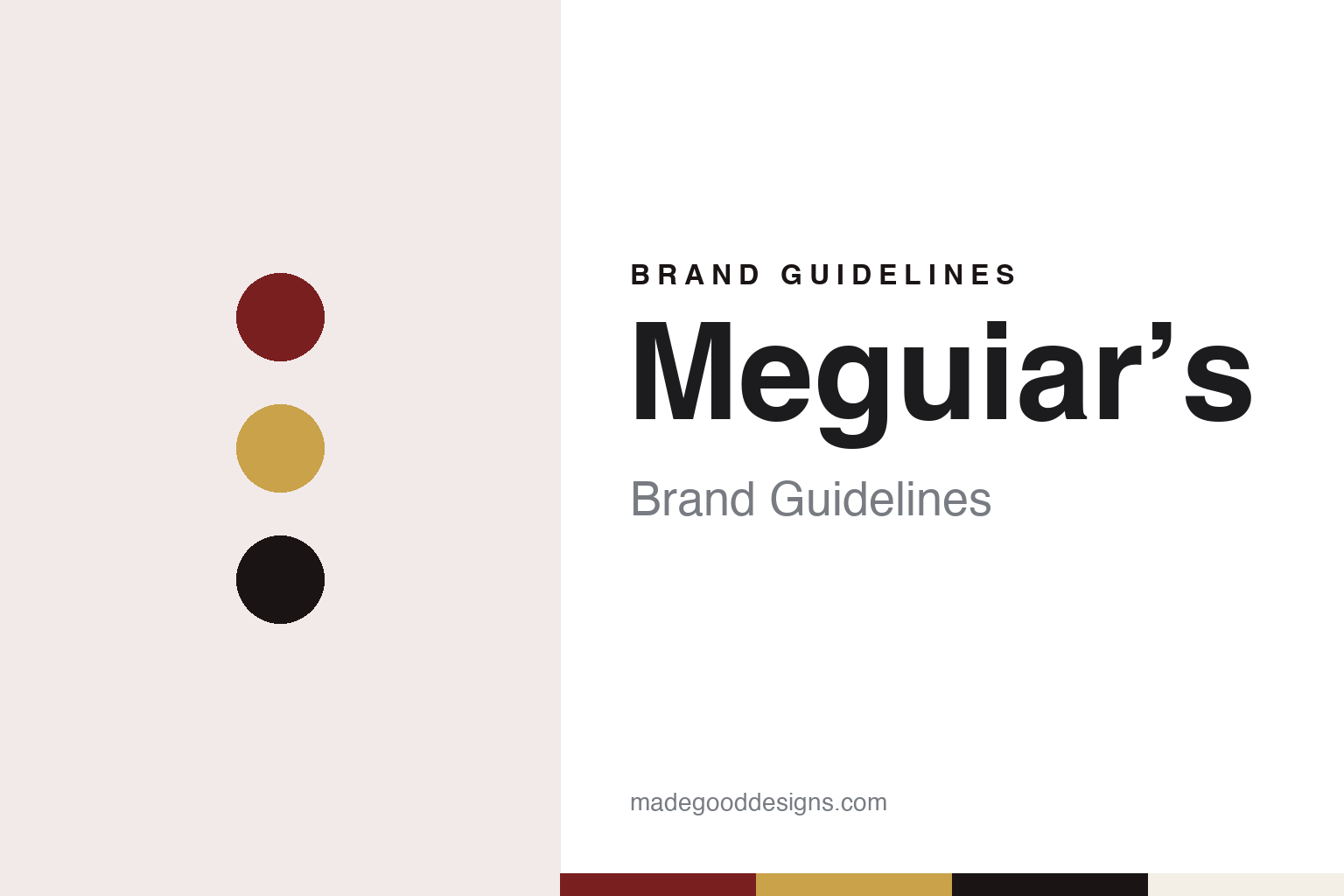
Meguiar’s Brand Guidelines
A family furniture polish that moved from four legs to four wheels.
Aa
Two constants: a deep red, gold and black palette and a heritage serif register. Abstract homage — not a Meguiar’s product or mark; no bottle, label or logo is reproduced.
Four legs to four wheels
A furniture polish, an eggbeater and a family garage.
Meguiar’s dates its story to 1901. On the heritage timeline of its British website, the company says Frank Meguiar Jr. made his first bottle of furniture polish in his garage, with the help of his family, an eggbeater and a tin bath. Each night, the company says, enough polish was made to fill the next morning’s orders and pay for that day’s groceries.
The move into cars came in the 1910s, according to the same timeline. As horseless carriages became popular, the company says, Frank Meguiar Jr. noticed that the mostly wooden automobiles of the day were coated with the same finishes that were applied to furniture, and the business followed its polish from the parlour to the road. The timeline sums up the change in a heading that has become part of the brand’s own story: from four legs to four wheels.
Through the 1930s, the company says, Frank Meguiar Jr. kept developing cleaning products and held to the principle that he would not sell a product unless he was convinced it was the right one. The timeline presents that belief as something handed down the generations of the family that followed him.
The family handover came in 1950. The company says the business then passed to Frank’s three sons. Maurice, the eldest, managed sales; Kenneth, the youngest, ran production; and Malcolm, the middle son, shared his father’s interest in formulating. Meguiar’s credits Malcolm with creating many of the products it still sells, including Meguiar’s Cleaner Wax.
The early name that mattered most was Mirror Glaze. When 3M announced its agreement to buy the company in September 2008, the release, reprinted in the trade association SEMA’s SEMA eNews on 11 September 2008, described Meguiar’s as beginning by supplying Mirror Glaze polishes and waxes for professional use. The heritage timeline says those products were at first sold only to professionals.
Colour
From the body shop to the car show.
The 1960s changed the audience. The company says that as car shows grew in popularity, enthusiasts began to notice that Meguiar’s polishes were behind many of the high-gloss finishes on display, and retailers started to receive requests to stock Mirror Glaze products that were then available only for professional use.
The answer was a consumer range. In 1973, according to the heritage timeline, the Meguiar’s brand of consumer automotive products was officially introduced as the Classic line. From that point the company had two audiences under one family name: the professional shops that had used Mirror Glaze, and the hobbyists who washed and waxed their own cars at home.
The 1980s, the company says, brought offices around the world, introducing the range to new markets. In the 1990s it added the Gold Class range. In 2004, the timeline says, Meguiar’s launched the synthetic NXT Generation line, and in 2008 it introduced the Ultimate line, which included Ultimate Quik Detailer.
The third generation shaped the brand’s voice. The company’s timeline describes Barry Meguiar as someone whose whole life has been spent caring for cars, and credits him with spending decades travelling to support car clubs, automotive events and museums. From the mid-1990s, it says, he built Car Crazy, a television programme and later a wider media project aimed at car enthusiasts. The 2008 release quoted in SEMA eNews named Barry Meguiar as the company’s president and chief executive, and described Meguiar’s Car Crazy Television and Radio as part of its support for the car hobby.
That support became a large part of how the brand presents itself. The same release said car enthusiasts knew Meguiar’s for its presence at car shows across the United States as well as for its products.
Ownership changed in 2008. According to SEMA eNews, 3M announced on Monday, 8 September 2008, that it had entered into an agreement to acquire Meguiar’s Inc. which the release described as family-owned. Terms were not disclosed, and the deal was expected to close in the fourth quarter of that year. The release said Meguiar’s would join 3M’s Automotive Aftermarket Division, which supplies products for auto body repair professionals and enthusiasts, and quoted Barry Meguiar as saying that combining with 3M would help the company serve “Car Crazy” people around the world.
Typography
Design and documentation.
The brands in this group all make things people put on, or in, their cars: waxes and polishes, cleaners and detailing products, treatments for glass, and accessories such as floor liners. Car-care and auto-accessory brands in general sit at many different points in the trade, from businesses that still carry a founder’s name to labels that now belong to much larger industrial or consumer-goods groups, and a single name can be sold everywhere from a petrol-station shelf to a specialist detailing shop.
A car-care brand’s identity is usually carried by a bottle, a label, a colour or a name rather than by the product itself, because what is inside the bottle is rarely seen. The company behind the name may also have changed hands, moved its production or licensed the name to others along the way. That makes the plain questions worth asking: who started it, who owns it now, and where its products are actually made.
Each guide separates what independent sources record from what the company says about itself — its founding story, its owners over time, where it makes its products and how its packaging has changed — and marks plainly what rests only on the company’s own word.
Aa
A heritage serif — a family-name, show-car register. (Specimen set in Libre Baskerville, a serif STAND-IN; NOT the Meguiar’s logo.)
Meguiar’s
A family name inside 3M.
At the time of the 3M agreement, SEMA eNews reported, Meguiar’s was headquartered in Irvine, California, and made waxes, polishes, cleaners, conditioners and protectants for the automotive and marine markets. The release said the products covered paint, wheels, tires and interiors. 3M placed the brand alongside its own body-shop range of abrasives, masking tapes, adhesives, compounds and paint-finishing polishes.
The brand still trades under the family name. On its British website, the newsletter terms state that Meguiar’s UK is a trading name of 3M UK Trading Ltd, and the same site carries the heritage timeline that runs from Frank Meguiar Jr.’s garage to the Ultimate line. The timeline describes the company’s centenary in 2001, a century after that first bottle of polish.
The product names do much of the identity work. Mirror Glaze recalls the professional origins, Gold Class carries a colour in its name, and the Classic, NXT Generation and Ultimate lines each mark a stage in the timeline. The possessive in the brand name, carried over from the family, is part of how the company is written: Meguiar’s, with the apostrophe.
For a design guide, Meguiar’s shows how a family name, a founding story and a car-show culture can stay at the front of a brand after it becomes part of a materials manufacturer. Compare Turtle Wax and Griot’s Garage, two other American car-care names built around waxes and polishes. For this guide we use a deep red, a gold and a near-black with a serif, an unofficial interpretation; no product or logo is reproduced.
Explore & save
Keep Meguiar’s’s identity on hand — save it to a board in the Made Good inspiration library.
Meguiar’s identity set
Pin the Meguiar’s deep red, gold and black palette and the heritage serif register to your own board.


