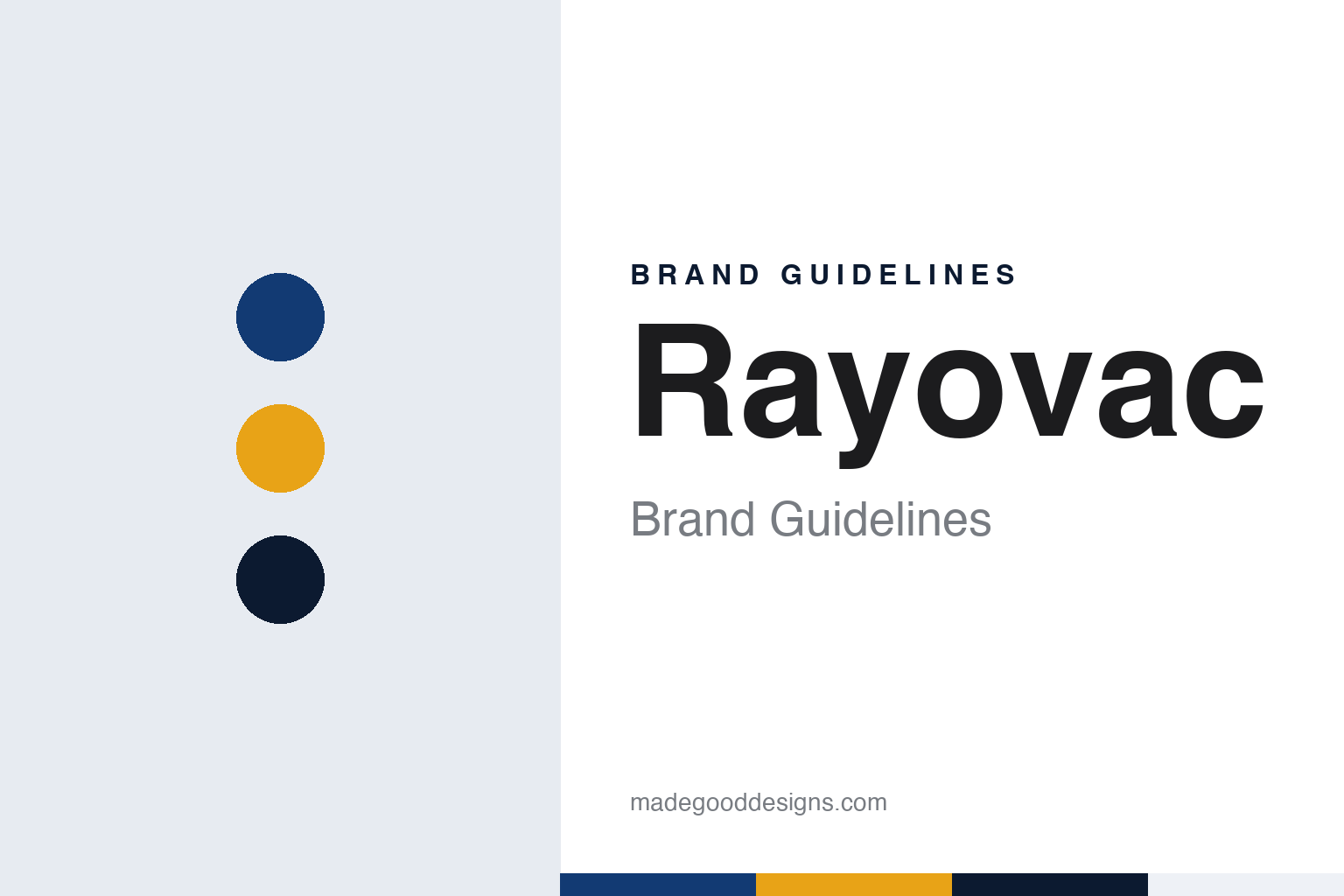
Rayovac Brand Guidelines
A Madison battery maker whose radio-era trade name became the company.
Aa
Two constants: a navy, amber and night-blue palette and a condensed grotesque register. Abstract homage — not a Rayovac product or mark; no pack, cell or logo is reproduced.
From an attic to Madison
Three partners, a dry cell and a name borrowed from France.
Rayovac did not start under that name. According to the International Directory of Company Histories, the business began in 1906 as the French Battery Company, formed by three men: James B. Ramsay, a Wisconsin businessman who led the venture, his friend P.W. Strong, and Alfred Landau, who had been making dry-cell batteries in the attic of his home in Chicago and selling them locally.
The attic did not hold the business for long. The same history says the partners moved the operation to a small building in Madison, Wisconsin, in March 1906, and later that year into a two-storey brick building with money from a group of new investors. The early years were difficult. Some materials proved unreliable after batteries had been shipped, buyers asked for refunds, and Landau left the company in 1907.
To replace his technical knowledge, the history says, Ramsay turned to Dr. Charles F. Burgess, the founder of the chemical engineering department at the University of Wisconsin. Burgess invested in the company and helped it upgrade its products. The firm was profitable by 1910, survived factory fires in 1910 and 1915, and lost Burgess in 1916, when he left to start his own enterprise.
The modern name came out of the radio years. In the 1920s, the International Directory says, the French Battery Company sold a family of trade names: Ray-O-Vac for radio batteries, Ray-O-Lite for flashlight cells and Ray-O-Spark for ignition batteries. The radio name became so well known that the company officially adopted Ray-O-Vac as its own name in the early 1930s.
Rayovac tells some of this story itself. On its heritage page, the brand uses the line “Powering Happy Moments Since 1906” and says it has spent its history making batteries in Wisconsin. It says that in 1917 the French Battery Company received military orders for its No. 6 size cells and flashlight cells, and that in 1927 Charles Lindbergh carried two Ray-O-Lite flashlights as part of his emergency equipment on his solo flight across the Atlantic.
Colour
ESB, INCO, the Pyles, Spectrum and Energizer.
The Second World War shaped the brand’s public image. Rayovac’s heritage page says its leak-proof batteries powered field telephones, mine detectors, radio communications and flashlights, and that its Clinton plant also produced parts for rifles and other military gear. The company says that in 1944 it worked with Dr. Samuel Ruben, a co-inventor of the plug-in radio, to produce his air-tight button cells in a new Madison plant.
Ownership then passed through several hands. According to the International Directory of Company Histories, Ray-O-Vac merged in 1957 with the Electric Storage Battery Co. (ESB), a maker of industrial and automotive batteries, and effectively became a division of ESB. ESB itself was bought by the Canadian mining company INCO in 1974.
In 1982, the same history says, Thomas and Judith Pyle, a husband-and-wife team with a background in consumer products, bought the business from INCO with two other investors and changed its name to Rayovac Corporation. Their approach, which Judith Pyle called “nichemanship”, aimed every new product at a specific group of customers. The International Directory lists the WORKHORSE flashlight of 1984 among the results, along with redesigned packaging and new checkout displays.
In September 1996, the Boston buyout firm Thomas H. Lee Group bought control of Rayovac with the plan of taking it public, and the company’s shares began trading in 1997. A year earlier, in April 1995, Rayovac had signed the basketball player Michael Jordan to endorse its rechargeable batteries.
The most recent change came with a larger deal. On 2 January 2019, Energizer Holdings of St. Louis announced that it had closed its acquisition of Spectrum Brands’ Battery and Portable Lighting Business. Today Energizer’s brands page lists Rayovac among its battery brands, and the footer of rayovac.com states that Rayovac is a trademark of Energizer Brands. The Rayovac site groups its range into batteries, hearing aid batteries, lights, specialty batteries and rechargeables.
Typography
Design and documentation.
The brands in this group all make or sell batteries, from the small cells that go into torches, remote controls and toys to the heavy batteries that start cars, boats and trucks. Battery brands in general sit at many different points in the trade: some names belong to the company that makes the cells, some are owned by retailers or parts chains, and some are licensed to different companies in different parts of the world.
A battery brand’s identity is usually carried less by the product itself than by its packaging, its colours, its slogans and sometimes a mascot, because one sealed case looks much like another. Behind the label, the company that owns the name and the factory that builds the battery may have changed several times. That makes the plain questions worth asking: who started the brand, who owns it now, and who actually makes the batteries.
Each guide separates what independent sources record from what the company says about itself — its founding story, its owners over time, where its batteries are made and how its packaging has changed — and marks plainly what rests only on the company’s own word.
Aa
A condensed grotesque — a compact, packaging-style register. (Specimen set in Oswald, a sans-serif STAND-IN; NOT the Rayovac logo.)
Rayovac
A trade name that outlived its company name.
The Rayovac story is, at heart, a naming story. The founders traded as the French Battery Company, but their product names, according to the International Directory of Company Histories, were a family built on a single coined prefix: Ray-O-Vac, Ray-O-Lite and Ray-O-Spark, each pointing to a different use for the same kind of cell.
That family is what customers came to know. When the radio boom of the 1920s made the Ray-O-Vac battery a household purchase, the trade name carried more weight than the corporate one, and the company followed its own product, taking Ray-O-Vac as its name in the early 1930s. Half a century later, in 1982, the Pyles renamed the business Rayovac Corporation, writing the old trade name as one word.
Flashlights have run alongside batteries for most of that history. The International Directory names the Sportsman flashlight of 1949 and the WORKHORSE range of the 1980s, and the Rayovac site still gives lights their own section beside its batteries. Hearing aid batteries have a section of their own on the site too, and the heritage page dates the company’s button-cell production in Madison to its 1944 work with Samuel Ruben.
The brand’s owners changed many times, from the original partners to ESB, INCO, the Pyles, Thomas H. Lee and then Energizer, yet the name stayed on the product throughout. Under Energizer it now sits in the same portfolio as Energizer itself and VARTA, which Energizer’s brands page lists together with Rayovac.
For a design guide, Rayovac shows how a coined trade name can outgrow the company that invented it and then survive a long run of owners by staying on the pack. Compare Energizer, its present owner, and Duracell, a long-time competitor on the same shelf. For this guide we use a deep navy, a lantern amber and a night blue with a condensed sans-serif, an unofficial interpretation; no product or logo is reproduced.
Explore & save
Keep Rayovac’s identity on hand — save it to a board in the Made Good inspiration library.
Rayovac identity set
Pin the Rayovac navy, amber and night-blue palette and the condensed grotesque register to your own board.