Exide Brand Guidelines
A battery name coined from two words of chemistry, kept through more than a century of owners.
Aa
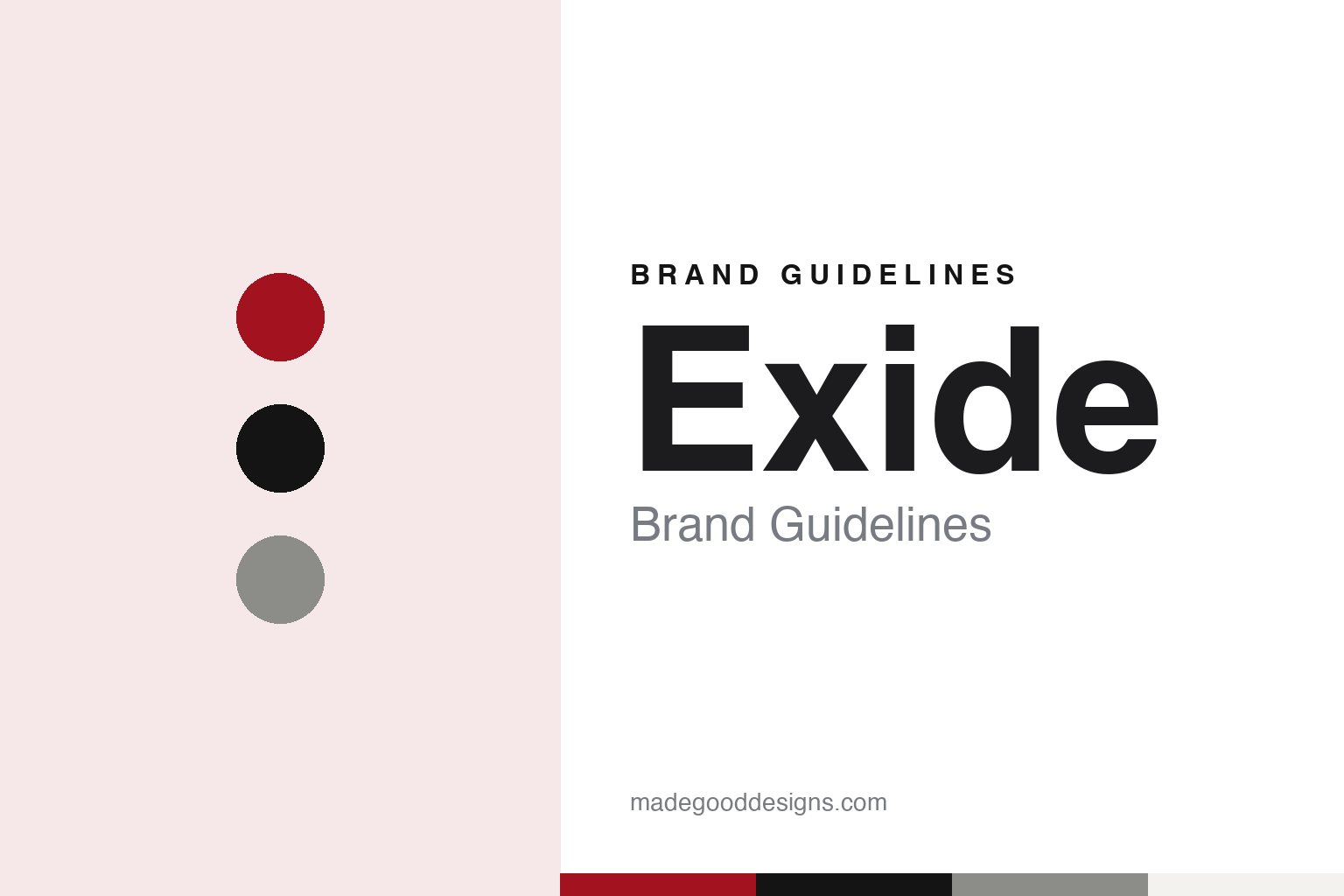
Two constants: a red, black and lead-grey palette and a condensed sans register. Abstract homage — not an Exide product or mark; no battery, label or logo is reproduced.
A company before a name
Patents, power stations and a word from chemistry.
The Exide story begins with a company that did not yet use the name. According to English Wikipedia, the Electric Storage Battery Company was founded in 1888 by William Warren Gibbs, who bought the ideas and patents of the inventor Clement Payen in order to turn the storage battery into a commercial product. Gibbs aimed it first at electric lighting companies, which could use stored power to serve their customers. French Wikipedia gives the same founding year and the same founder.
Patents were the company’s early strategy. English Wikipedia says that in December 1894 Gibbs announced the purchase of storage-battery patents and patent rights held by a list of rivals, including the General Electric Company, the Edison company, Thomson-Houston and Brush. By 1893, it says, the company was already producing accumulators used to steady electric grids, and its batteries later went into electric street railways.
The sea came next. In 1898, English Wikipedia says, an Exide-brand battery provided the submerged power for the USS Holland (SS-1), and the company remained a supplier of batteries for US Navy submarines at least through the Second World War. Its president in 1899, Isaac Rice, was instrumental in founding the Electric Boat Company, according to the same article.
The name itself arrived with a taxicab. English Wikipedia says that in 1900 the company developed a battery of greater capacity and lower weight for electric taxicabs, and that this was the first battery to bear the name Exide, short for “Excellent Oxide”. French Wikipedia also dates the name to 1900 and gives the same contraction. It is a technical word made into a brand: two words of battery chemistry, cut down to five letters that read easily on a label.
The early twentieth century widened the business. In 1902, English Wikipedia says, the Electric Storage Battery Company formed the Willard Storage Battery Co. in Cleveland, Ohio, and in 1911 Charles F. Kettering turned to the company for an automotive battery to go with his new electric starter. During the First World War, it says, Exide batteries operated aircraft radio sets and powered radio stations. In 1920 the company bought land in Crescentville, Philadelphia, to build a new plant. It filed for the trademark Exide Ironclad in 1934, registered in 1935, and in 1938 it acquired the Giant Storage Battery Company. In the Second World War, according to English Wikipedia, it supplied batteries for US Navy submarines and was the primary contractor for the batteries in the Mark 18 electric torpedo.
Colour
ESB, Inco, a listing and a split.
The post-war decades brought a run of corporate changes. In 1957, English Wikipedia says, the Electric Storage Battery Company entered the dry-cell business when it acquired the Ray-O-Vac Company. In 1967 the Electric Storage Battery Company was merged into ESB Incorporated, and in 1972 ESB acquired the Edison Storage Battery Company. From 1974 through 1978, the article says, ESB became Inco Electroenergy Corporation after a takeover by Inco, and in 1983 Inco sold its Exide Corporation unit to the First Chicago Investment Corporation and principals of the Spectrum Group.
Growth by acquisition followed. English Wikipedia says that in 1987 Exide Corp., doing business as Exide Technologies, acquired the General Battery Corporation and moved its headquarters to Reading, Pennsylvania. Exide became a publicly traded company in October 1993, and in 2000 it acquired GNB Technologies, a North American supplier of automotive batteries. French Wikipedia adds the European purchases that shaped the business there: CEAC, the Compagnie européenne d’accumulateurs, which held the Fulmen and Tudor brands, and Sonnenschein.
Exide filed for Chapter 11 bankruptcy protection in 2002, 2013 and 2020, according to English and French Wikipedia. English Wikipedia says that in July 2020 Exide sold certain North American assets to Atlas Holdings, and that on 25 August 2020 Atlas launched two standalone companies, Stryten Manufacturing and Element Resources, after acquiring substantially all the operating assets of the Americas business. French Wikipedia describes Stryten as taking over battery production and Element Resources as taking over recycling.
The Exide name in the United States now travels through distribution. English Wikipedia says that on 2 April 2019 Battery Systems, Inc. acquired Exide’s branch network business and became the exclusive distributor of Exide-branded aftermarket transportation batteries. In October 2026, the exide.com home page sends visitors in the United States to a Battery Systems catalogue and visitors in Canada to a separate distributor, while a third link points to the Exide Group site for Europe, the Middle East, Africa and Asia-Pacific.
Typography
Design and documentation.
The brands in this group all make or sell batteries, from the small cells that go into torches, remote controls and toys to the heavy batteries that start cars, boats and trucks. Battery brands in general sit at many different points in the trade: some names belong to the company that makes the cells, some are owned by retailers or parts chains, and some are licensed to different companies in different parts of the world.
A battery brand’s identity is usually carried less by the product itself than by its packaging, its colours, its slogans and sometimes a mascot, because one sealed case looks much like another. Behind the label, the company that owns the name and the factory that builds the battery may have changed several times. That makes the plain questions worth asking: who started the brand, who owns it now, and who actually makes the batteries.
Each guide separates what independent sources record from what the company says about itself — its founding story, its owners over time, where its batteries are made and how its packaging has changed — and marks plainly what rests only on the company’s own word.
Aa
A condensed sans — a tall, industrial label register. (Specimen set in Oswald, a sans-serif STAND-IN; NOT the Exide logo.)
Exide
From Philadelphia to Gennevilliers.
Outside North America, the company that carries the name is Exide Technologies, run from Gennevilliers, near Paris. French Wikipedia says the activities outside North America continued under the Exide Technologies name after the 2020 sale, with a seat at Gennevilliers, while the historic headquarters had been in Milton, Georgia. English Wikipedia also names Gennevilliers as the headquarters and lists research and development facilities in Büdingen, Germany, and Azuqueca de Henares, Spain, alongside one in the United States.
The product range is wide. According to English Wikipedia, Exide makes batteries for cars, trucks, heavy-duty vehicles, lawn and garden machines, marine and leisure use, golf carts and power sports, using absorbed glass mat, flooded, enhanced flooded and gel technologies, and it sells lithium-ion batteries for motorbikes in Europe. For industry, it lists batteries for forklifts, railways, mining and submarines, chargers for material handling, and energy storage for telecommunications, uninterruptible power supplies, utilities and solar power.
Newer products carry their own names. English Wikipedia says that in July 2024 Exide Technologies unveiled Solition Mega Three, part of its containerised energy-storage series, and that in 2025 the company announced it would show its Fulmen commercial-vehicle battery line at the Equip Auto trade fair in Paris. Fulmen is one of the European brands that French Wikipedia ties to the CEAC acquisition.
The name has outlived most of the companies that owned it. The Electric Storage Battery Company became ESB, ESB passed to Inco, Inco sold Exide to investors, Exide listed on the stock market, and in 2020 the North American operations were sold and renamed. Through each change, the five letters coined for a taxicab battery in 1900 stayed on the product.
For a design guide, Exide shows how a short, invented word drawn from a technical phrase can carry a brand across owners, continents and a split between two separate businesses. Compare Rayovac, the dry-cell maker the Electric Storage Battery Company bought in 1957, and Interstate Batteries, an American battery brand that English Wikipedia says has marketed batteries made by Exide Technologies among others. For this guide we use a deep red, a near-black and a lead grey with a condensed sans-serif, an unofficial interpretation; no product or logo is reproduced.
Explore & save
Keep Exide’s identity on hand — save it to a board in the Made Good inspiration library.
Exide identity set
Pin the Exide red, black and lead-grey palette and the condensed sans register to your own board.