Meri Meri Brand Guidelines
A kitchen-table card business that grew into a party house.
Aa
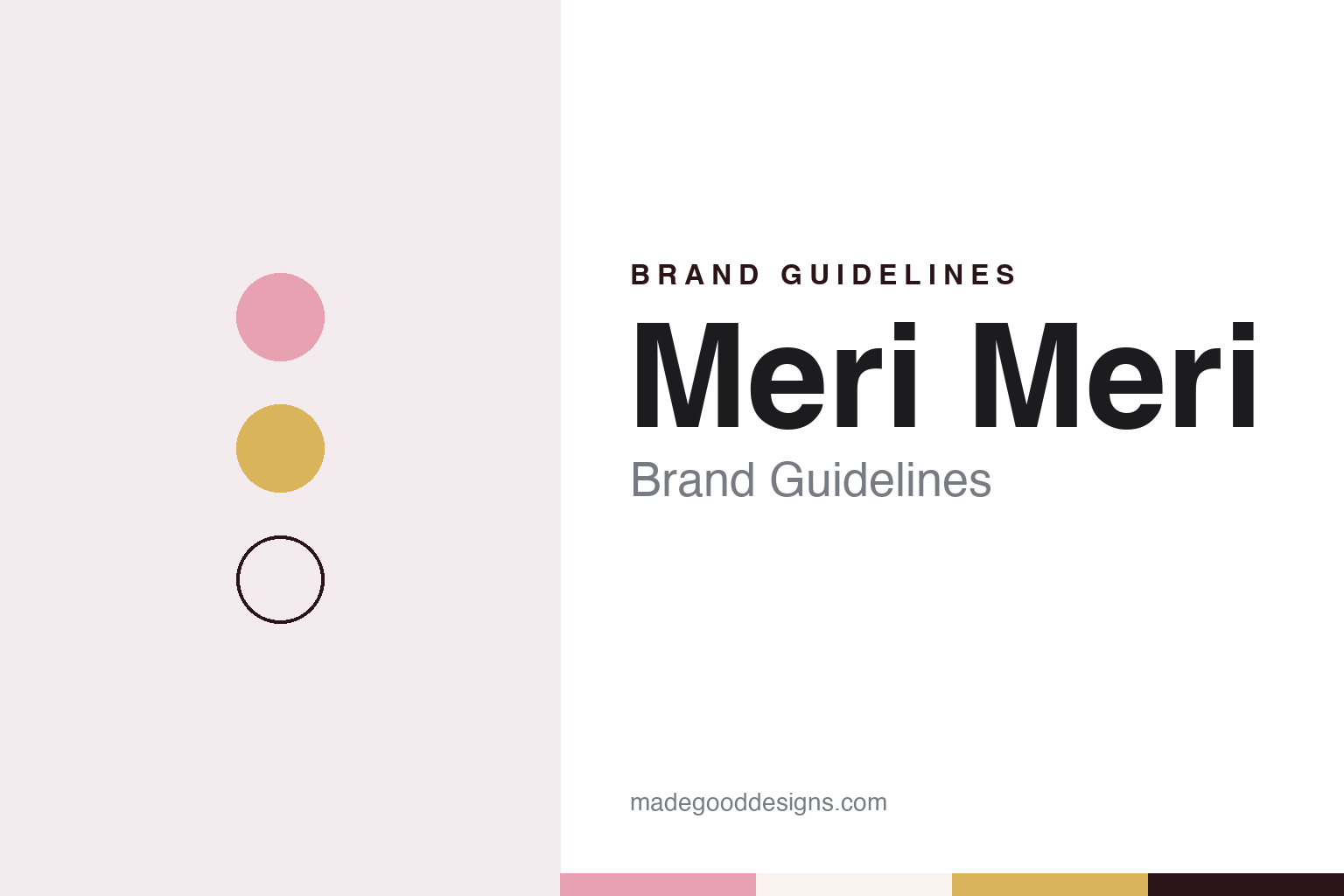
Two constants: a garland pink, gold and card-cream palette and a storybook serif register. Abstract homage — not a Meri Meri product or mark; no partyware, logo or packaging is reproduced.
Cards, 1985
A greeting-card business run around the school run.
Meri Meri began with greeting cards. English Wikipedia says the company originated in 1985 in Los Angeles, when Meredithe Stuart-Smith started making cards at home and selling them to shops under the Meri Meri name, and it places the business in the alternative card movement of the 1980s, when small design-led companies began to compete with the large American card publishers. Meri Meri’s own account puts the early work in Northern California: on its “About Us” page the company says that Stuart-Smith worked with San Francisco-based mothers who crafted the cards from home, collecting supplies from her basement and fitting the work around their families.
The founder gives a simple reason for the arrangement. “I started this because I wanted to pick my kids up from school,” she says on the company’s website, which describes the business as a kitchen-table start-up. Meri Meri says that within two years she had sold her first range of cards to Bergdorf Goodman in New York, and Wikipedia dates the company’s first New York exhibition to 1987, when, it says, the cards caught the store’s attention and the business began to build customers across the country.
Wikipedia says the company moved its base to Belmont, California, in 1990, and the company says it had a small office in California at that time.
Stuart-Smith has told the story in her own words. In a May 2020 interview with The Grace Tales, she recalled living in Los Angeles and selling her cards door to door, and said many shops told her that “no one would ever buy these.” The order that changed that, she said, came from Bergdorf Goodman at her stand at a 1987 trade show. In the same interview she said she grew up in Kansas, down the street from Hallmark’s head offices, and spent her childhood drawing, cutting and pasting; the original Meri Meri cards, she said, “were not so very different” from the ones she had made as a child.
Colour
From California to the Cotswolds.
The next move crossed the Atlantic. Wikipedia says that in 1996 Stuart-Smith moved to England and set up a United Kingdom arm of the company, while the headquarters stayed in Belmont for a time. The UK register agrees on the date: Companies House lists Meri Meri, Inc., an overseas company registered in Reno, Nevada, with a UK establishment in Cheltenham that opened on 1 September 1996.
Cheltenham has since become the creative centre. Meri Meri now describes its head office as being in the heart of the Cotswolds in Cheltenham, with an office in Reno in the United States, and says that in 2018 it moved into a three-storey creative space in the town, with a design studio filled, in its words, with sketches, drawers of party plates, hats and decorations, and “plenty of bows and shimmer”. Wikipedia adds that the company has bases in the United States, the United Kingdom and the Netherlands.
The product range changed as the card trade did. According to Wikipedia, the growth of internet communication in the early 2000s pushed the company towards new product areas, first party and event invitations and then paper products for children’s parties; in 2008, it says, Meri Meri showed six children’s party accessory collections at the New York Stationery Show. The company dates its Cupcake Kit to the same year. Wikipedia says that around 2017 the business moved into children’s bedlinen, soft furnishings and homewares.
The Grace Tales described the Cheltenham studio in 2020 as a converted Victorian warehouse, and Stuart-Smith said its rooms were “filled with fabric, ribbon, glitter, sewing machines and all sorts of papers”, used for party decorations, dress-up, stickers, baking supplies and stationery.
Typography
Design and documentation.
Party-supply brands sit in an unusual corner of the shop. Their products — plates, cups, napkins, balloons, banners and favours — are bought for a single occasion, and the name of the company that made them is often printed far smaller than the theme on the front of the pack. Some of these businesses design their own patterns, some print characters licensed from film, television and toy companies, and many do both, so the maker and the image a shopper recognises are frequently two different things.
That makes the questions behind each name worth asking plainly: who started the business, who owns it now, whether it designs its ranges itself, and where its paper goods, balloons and decorations are actually printed or made. A single brand may make some products in its own plants and source others from outside suppliers.
Each guide separates what independent sources record from what the company says about itself — its founding story, its owners over time, where its products are made and how its ranges have changed — and marks plainly what rests only on the company’s own word.
Aa
A soft, high-contrast serif — the register of a brand that pairs children’s parties with grown-up styling. (Specimen set in Playfair Display, a serif STAND-IN; NOT the Meri Meri logo.)
Meri Meri
Childhood imagination, styled for the table.
Meri Meri now describes itself as a designer of “everything fun for life’s celebrations”: partyware, seasonal decorations, children’s gifts and dress-up costumes. Its products, the company says, are “inspired by the imagination of childhood and rooted in sophisticated design”, and it names statement garlands, themed partyware, home decorations, dress-up costumes and candles among the lines that followed the cards.
The calendar drives the design work. Meri Meri says new products launch every spring/summer and autumn/winter, with further ranges for Valentine’s Day, Easter, Halloween, Thanksgiving, Christmas and New Year, and that each product moves from “that spark of a new idea” to the choice of a finish, made by a team of designers, illustrators and crafters. It says it is adding reusable partyware made from wood, recycled plastic and a bamboo-fibre mix, and its online shops for the UK, the US and Europe went live in 2017, according to the company.
Collaborations have widened the look. Meri Meri’s website names a partnership with the French pâtisserie house Ladurée, and Wikipedia records a 2020 range of plates and other products with the French artist Nathalie Lété, as well as a 2017 homewares range with the store The Hambledon and a 2018 Meri Meri dressing-up pop-up at Harrods in London. On its website Stuart-Smith carries the title of founder and president, and is quoted saying: “Imagination is freedom.”
For a design guide, Meri Meri shows how a party brand can borrow the finish of stationery, with gilding, layered paper and storybook illustration doing the work a loud logo might do elsewhere; compare Talking Tables and Ginger Ray. For this guide we use garland pink, gold and card cream with a serif, an unofficial interpretation; no product or logo is reproduced.
Explore & save
Keep Meri Meri’s identity on hand — save it to a board in the Made Good inspiration library.
Meri Meri identity set
Pin the Meri Meri garland pink, gold and card-cream palette and the storybook serif register to your own board.