Talking Tables Brand Guidelines
A tablescaper’s idea, named for the conversation it starts.
Aa
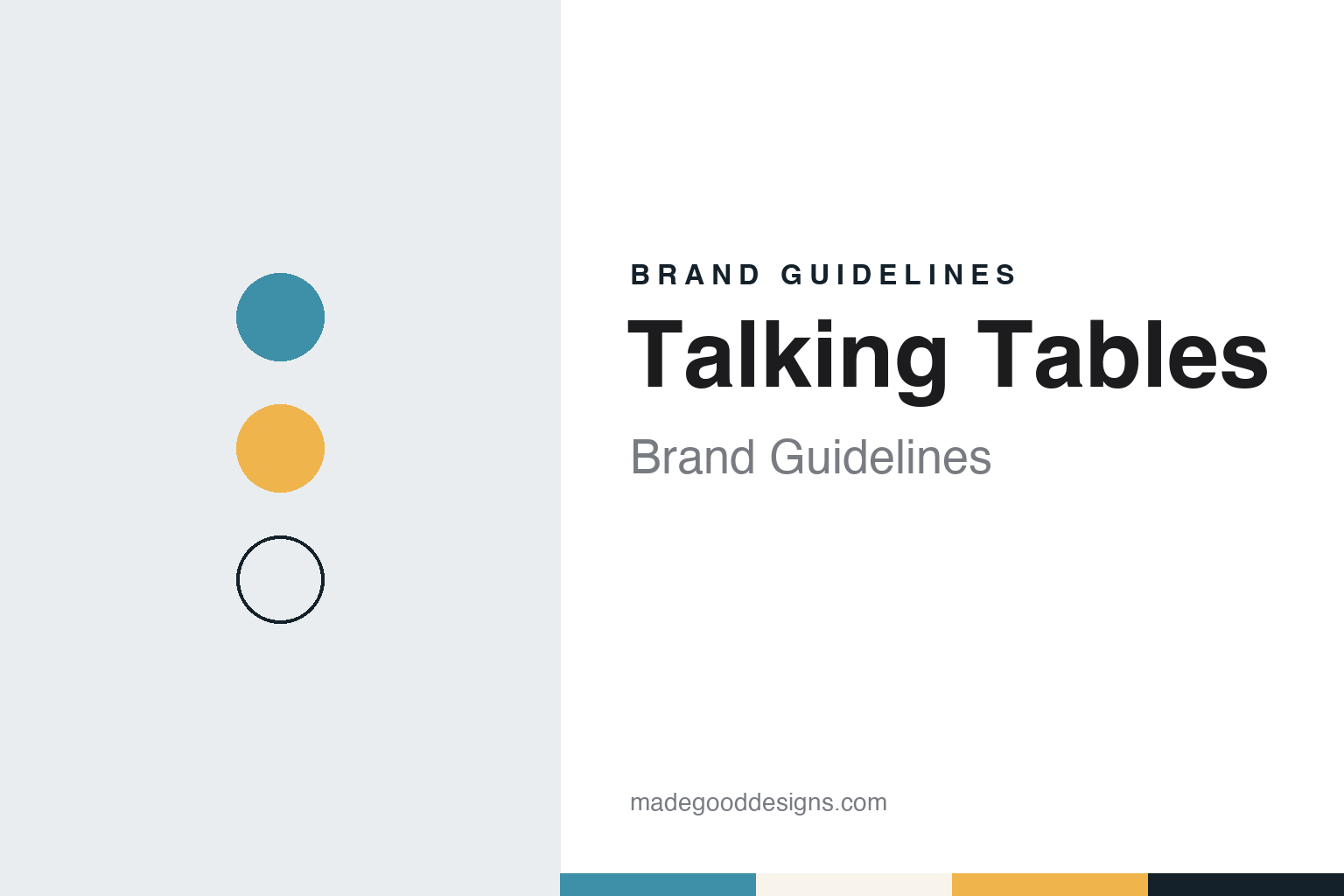
Two constants: a teal, candle gold and paper-cream palette and a friendly table sans register. Abstract homage — not a Talking Tables product or mark; no tableware, logo or packaging is reproduced.
The kitchen table
A gap on the shelves for matching tableware.
Talking Tables grew out of a love of laying a table. On its website the company says that it was at her mother’s kitchen table that its founder, Clare Harris, discovered her love of “tablescaping”, and that she went on to launch Talking Tables from her own kitchen table. In a member profile published by ACID, the Anti Copying in Design organisation, in October 2020, the company said that in 1997 Harris saw a gap in the market for fun, design-led party accessories, gifts and games: she could not find co-ordinating paper tableware for Christmas, birthdays or weddings.
The paperwork came first. Companies House records that Talking Tables Limited was incorporated on 19 February 1998, with its registered office in London, and that Clare Harris has been a director since that day. The company itself gives 1999 as the year Talking Tables launched, telling ACID that it sold through a wholesale model to retailers. The register lists the company’s business as non-specialised wholesale trade.
Wholesale shaped the early customer list. Talking Tables told ACID that its first stockists were design-led shops such as Paperchase, Heal’s and Conran, and that by 2020 its products were sold by retailers including John Lewis, Selfridges and Waitrose.
The name explains the idea. According to the same profile, “the company name came about because Clare wanted our products to get the table talking”.
Colour
A family business, grown without outside investors.
Talking Tables has stayed close to its founders. Companies House shows Mark McCormack as a director and company secretary since 1 March 2002, alongside Harris. On its “About Us” page the company says that, rather than turning to external investors for funding, Clare grew the business organically, and that “to this day it’s very much still a family owned and led business.” The company runs separate websites for the UK, Europe and the United States.
The design work is shared between staff and outside illustrators. The company told ACID in 2020 that it has product developers and designers in-house and also works with freelance designers, for whom it adapted an ACID template agreement. It was candid about its early years: it said it had no prior knowledge of intellectual property when it launched in 1999, and registered its logo as a trade mark only after several years of trading. Its advice to new designers was that it is “easier than you think” to copy another design without meaning to.
That experience turned the company into an advocate. In the same profile it said it had used ACID’s legal affiliates for advice on infringement cases, had joined ACID events at the House of Commons to lobby MPs on design law, and wanted government to listen to UK designers. Its advice to newcomers was to research the market, make sure work is original and agree terms before starting a project, because, it said, you should “never assume your conditions will be your client’s conditions.”
The range has grown well beyond paper plates. The company’s website now sorts its products into Christmas, birthday and other occasions, home and kitchen pieces such as candles, plates, bowls, table linens and glassware, and games, including board games, trivia, jigsaw puzzles and escape-room games.
Typography
Design and documentation.
Party-supply brands sit in an unusual corner of the shop. Their products — plates, cups, napkins, balloons, banners and favours — are bought for a single occasion, and the name of the company that made them is often printed far smaller than the theme on the front of the pack. Some of these businesses design their own patterns, some print characters licensed from film, television and toy companies, and many do both, so the maker and the image a shopper recognises are frequently two different things.
That makes the questions behind each name worth asking plainly: who started the business, who owns it now, whether it designs its ranges itself, and where its paper goods, balloons and decorations are actually printed or made. A single brand may make some products in its own plants and source others from outside suppliers.
Each guide separates what independent sources record from what the company says about itself — its founding story, its owners over time, where its products are made and how its ranges have changed — and marks plainly what rests only on the company’s own word.
Aa
A warm, open sans — the register of a brand that wants the table to start talking. (Specimen set in DM Sans, a sans STAND-IN; NOT the Talking Tables logo.)
Talking Tables
Parties with a purpose.
The brand now speaks about why people gather as much as what goes on the table. Its UK website footer says that “your gathering keeps giving”, and that shopping with the company helps “to end social isolation”.
The materials have changed with that message. Talking Tables says that most of its products are recyclable at home, that it offsets its paper products by planting trees, that it has removed glitter from its new lines, and that it is working to remove single-use plastic from its collections. In its 2020 ACID profile the company described a home-recyclable paper cup, developed with a European supplier, that uses a waterproof varnish in place of a plastic lining, and a range of paper party products made without plastic, packaging included. The company said it develops its own products and works with like-minded suppliers on materials, production and the removal of plastic from packaging, and it described the work as ongoing: “We’re not perfect but we are on this journey.”
Those changes sit inside a familiar party vocabulary. Birthday ranges include cake decorations, tableware, party decorations, headbands, badges and party games, while the seasonal ranges follow Christmas and the rest of the calendar. The emphasis throughout is on co-ordinated sets, the matching plates, napkins, cups and decorations that the founder says she could not find when she started.
The website’s tone stays light. Its footer invites shoppers to “join the party” and offers a “happiness guarantee”.
For a design guide, Talking Tables shows how a party brand can build its identity around a table setting and a social purpose rather than a single product; compare Meri Meri and Ginger Ray. For this guide we use tablecloth teal, candle gold and paper cream with a sans, an unofficial interpretation; no product or logo is reproduced.
Explore & save
Keep Talking Tables’s identity on hand — save it to a board in the Made Good inspiration library.
Talking Tables identity set
Pin the Talking Tables teal, candle gold and paper-cream palette and the friendly table sans register to your own board.