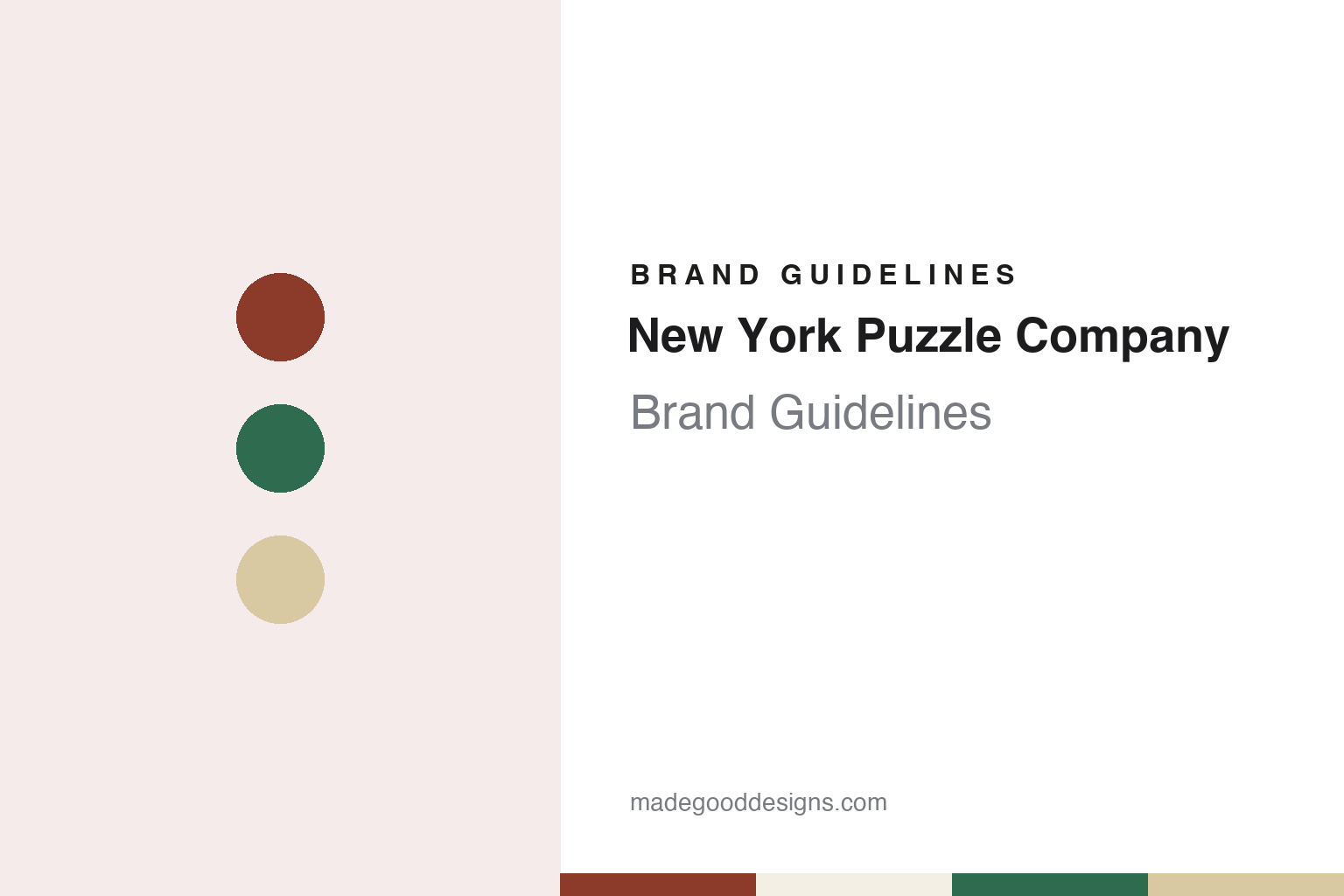
New York Puzzle Company Brand Guidelines
The Brooklyn puzzle maker that began with a subway map.
Aa
Two constants: a Brooklyn brick, transit green and linen palette and a magazine serif register. Abstract homage — not a New York Puzzle Company product or mark; no box, logo or puzzle image is reproduced.
From a subway map to a Brooklyn studio
Two college friends and one very familiar map.
New York Puzzle Company tells its origin story in a single line. On its “About Us” page the company says it was founded in 2007 by two college pals, and that it started with a simple idea: to make a jigsaw puzzle of the New York City subway map. Its “Our Story” page names the two founders, who are also listed as the company’s co-owners — Adam Silver and Sarah Dickinson. Both, the company says, studied at Cornell University.
The same page sets out how the two divide the work. Silver, the company says, was a child obsessed with puzzles whose first job was restocking the puzzle shelf in a toy store; he went on to study economics and history at Cornell and law at the University of Michigan, and he now heads sales, strategy, product development and licensing. Dickinson is described as a designer who had worked across architecture, interior design and accessories, and who had already collaborated with the MTA on earlier projects, among them a MetroCard bag. She studied history with a minor in architecture at Cornell, later took a master’s degree in environmental conservation education at NYU, and runs design, operations and finance.
The early catalogue was small. The company says it began with six puzzle designs and decided to exhibit them at the New York Toy Fair to see how buyers would respond. From that start the range has grown into what the company calls an expansive line built around licensed imagery, with titles from the classic book and magazine world sitting next to work by living illustrators.
Brooklyn is the company’s base. New York Puzzle Company says most of its work happens at its main office in Brooklyn, and that as it grew it opened a European satellite office in Saint-Jean-de-Luz, France, which serves as its home base for European distribution. Its website runs a wholesale section for shops, a store finder, a puzzle subscription club and a list of pop-up and holiday markets where the company sells in person.
Colour
A catalogue built on licences and illustrators.
Licensing sits at the centre of the range. The company says its line features a range of licences, and on its About page it names three of them: The New Yorker, vintage Babar and classic Peter Rabbit. The collections menu on its website adds more, among them the Cornell Lab of Ornithology, Vogue magazine and Harry Potter, alongside in-house groupings called Transit, Travel Maps and Vintage Images.
The New Yorker collection is a central strand. Each puzzle in it reproduces a cover of the magazine, and the company’s collection page introduces the range by describing how, since the first issue, New Yorker covers have captured their moment with wit and style — city scenes, political satire and cultural events among the recurring subjects. The website offers New Yorker collector’s sets and a separate New Yorker puzzle subscription, and lists a gift section aimed at the magazine’s readers.
Illustrators form the second strand. The company’s artist menu names Victo Ngai, Loré Pemberton, Peter de Sève and Mary GrandPré among others, and the “Our Story” page describes the products as having a distinctly literary and nostalgic feel, drawing on the wit of The New Yorker, classic book art and collaborations with independent artists. The company says it chooses each image so that the finished puzzle is evocative and pitched at the right level of challenge, and that many customers frame their completed puzzles.
Formats have widened around the standard box. The website sorts puzzles by theme and difficulty and lists mini puzzles, advent calendar sets, square, landscape and portrait formats, and two cutting styles it names random cut and ribbon cut. Beyond jigsaws, the company sells mugs, playing cards and puzzle sorting trays.
Typography
Design and documentation.
Jigsaw puzzle makers range widely in how they are built. Some are long-established family firms with their own presses and cutting lines; others are small studios that commission artwork, design the box and work with a specialist manufacturer to print and cut the pieces. Some names belong to larger groups that run several puzzle brands side by side, each aimed at a different shelf or a different kind of puzzler.
Because so much of a puzzle’s look comes from the picture on the lid, a maker’s identity often lives in its choices rather than in a single mark: which illustrators it works with, how it names its ranges, how its boxes are laid out and how the pieces are cut. The same picture can feel quite different depending on the board, the finish and the shape of the cut.
Each guide separates what independent sources record from what the company says about itself — who started it, who owns it now, where its puzzles are designed and made, and how its ranges and packaging have changed — and marks plainly what rests only on the company’s own word.
Aa
A magazine serif for a puzzle maker built on covers and book art. (Specimen set in Libre Caslon Text, a serif STAND-IN; NOT the New York Puzzle Company logo.)
New York Puzzle Company
Made in the USA, by the company’s account.
Production is a central part of how the company presents itself. New York Puzzle Company says its puzzles are made in the USA and, on its “Our Story” page, that each puzzle is printed, cut and boxed in the United States. It says it uses recycled chipboard for its puzzles and boxes, prints with soy inks, and gives its pieces a linen finish to reduce glare; the shrink-wrap on its boxes, the company adds, is recyclable.
Visually, the brand leans on the pictures it licenses. Because the catalogue is built from magazine covers, picture-book art, bird illustrations and commissioned work, the box image changes with every title, and the company name works as a publisher’s imprint across all of it. The subway map that started the business still points to the house style: city subjects, print-culture references and a nostalgic, literary tone.
For a design guide, New York Puzzle Company shows how a small Brooklyn maker can build an identity out of licensed covers and illustrators rather than one house look — compare Galison, the New York art-paper publisher, and Liberty Puzzles, another American puzzle maker. For this guide we use Brooklyn brick, transit green and linen with a serif, an unofficial interpretation; no product or logo is reproduced.
Explore & save
Keep New York Puzzle Company’s identity on hand — save it to a board in the Made Good inspiration library.
New York Puzzle Company identity set
Pin the New York Puzzle Company Brooklyn brick, transit green and linen palette and the magazine serif register to your own board.