Balfour Brand Guidelines
The Attleboro fraternity jeweller that became a class-ring and yearbook group.
Aa
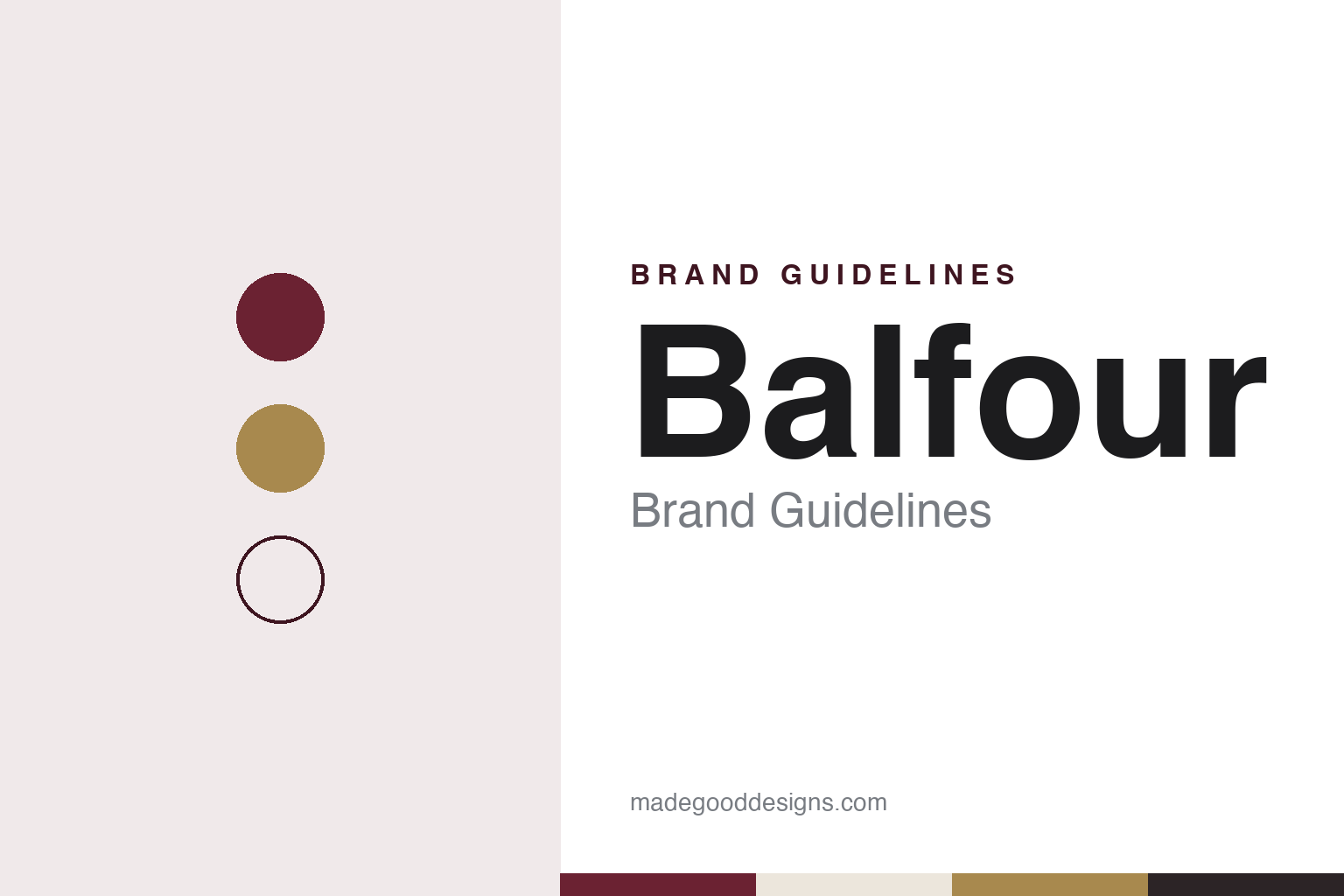
Two constants: a burgundy, antique gold and stone palette and an engraved serif register. Abstract homage — not a Balfour product or mark; no ring, crest, logo or school emblem is reproduced.
Attleboro
A fraternity jeweller in a jewellery town.
Balfour was founded in Attleboro, Massachusetts, on 13 June 1913 as the L. G. Balfour Company, according to English Wikipedia. Its founder, Lloyd Garfield Balfour, was a Kentucky-born graduate of the University of Louisville and Indiana University who had spent five years as a travelling representative for a maker of fraternity jewellery before starting his own firm. Attleboro was then a centre of the American jewellery trade, and the business grew from a small group of craftsmen there.
The company began with insignia for college fraternities and sororities. English Wikipedia says Pi Beta Phi voted at its 1913 convention to make Balfour its official jeweller, the company’s first sorority account, and that badges, pins and rings for Greek-letter societies were the core of the business in its early years.
School work followed within a decade. In 1922 Balfour set up a department to make and sell high school class rings and insignia, and in 1923 it introduced multi-year contract plans for schools, English Wikipedia says. In the 1970s it began producing a much wider range of products for sports champions, and in the late 1970s it bought engraving operations in Dallas, after which its graphics business grew considerably.
Colour
From Attleboro to Austin.
Balfour changed hands several times in the late twentieth century. Town & Country Corporation, a fine-jewellery company based in Chelsea, Massachusetts, bought it in November 1988 and said it would keep the existing facilities and management, English Wikipedia says. In 1994 Balfour sold its fraternal division — the business on which it had been founded — to a longtime employee, whose new firm became Legacy Fine Jewelry. Many fraternal clients and staff followed; Legacy at first had its rings made by Balfour, then ended that arrangement and later merged into the ring maker Masters of Design, English Wikipedia says.
In December 1996 Town & Country sold Balfour to CJC Holdings, which combined it with its own ring maker, ArtCarved. Balfour’s Attleboro operations were closed and moved to ArtCarved’s headquarters in Austin, Texas, ending the company’s eight decades in the Massachusetts jewellery town. The combined business was first called Scholastic Brands, became Commemorative Brands in 1997 and took the name American Achievement Corporation in June 2000, according to English Wikipedia, which names the New York private-equity firm Fenway Partners as its owner in that period.
The group kept adding school businesses, and by 2002 Balfour, ArtCarved, Taylor Publishing and Milestone Traditions were all combined under American Achievement. Milestone Traditions, a Philadelphia-area firm that developed official ring programmes, was bought that year. In 2004 the group added CB Announcements, a college graduation-announcement maker in Manhattan, Kansas, and folded it into the Balfour division. In 2009 it moved its Taylor Publishing yearbooks under the Balfour brand. Balfour’s own product names include Celestrium, a trademark it holds for a stainless-steel ring metal that resembles white gold, English Wikipedia says.
Typography
School rings, yearbooks and fan merchandise.
The companies in this group sell school pride, team loyalty and nostalgia, and they reach their customers by very different routes. Class-ring and yearbook makers work mainly through schools and colleges: a school signs up with a supplier, and students order rings, yearbooks, caps and gowns and announcements through it. Jostens has worked this way since the early twentieth century, and Meredith College’s 2024 switch of its ring and regalia supplier from Jostens to Balfour & Co. shows how those school contracts can change hands.
Much of what these brands make carries someone else’s name. Class rings, yearbooks and campus apparel are built around a school’s own colours, crest and mascot, and caps, jerseys and fan shirts carry college and team marks under licence.
The apparel side runs from vintage-style campus sweatshirts and tees to plain garment-dyed blanks sold to screen printers, who add the designs themselves, and to the caps and replica jerseys bought by fans in shops and online. The ring makers sell clothing too: Jostens runs a school spirit-wear shop, and Balfour & Co. lists apparel among its graduation products.
Ownership in the sector is often in the hands of investors rather than founders. Jostens has been owned by the private-equity firm Platinum Equity since 2018, and Balfour’s parent group passed to an investor group led by an affiliate of Cerberus Capital Management in 2021 and now trades as Balfour & Co. Each guide sets out who founded the brand, who owns it now and what it says about where its products are made, and marks plainly what rests only on the company’s own word.
Aa
An engraved serif for a brand of signets and class rings. (Specimen set in Cormorant Garamond, a serif STAND-IN; NOT the Balfour logo.)
Balfour & Co.
A 2021 restructuring and a new parent name.
The parent group went through a restructuring in 2021. On 15 January 2021 American Achievement Corporation announced that four of its junior lenders had filed an involuntary Chapter 11 petition against the company and certain subsidiaries; the company said it would keep operating and fulfilling orders. In March 2021 an investor group led by an affiliate of Cerberus Capital Management became the majority equity holder, the company said in October 2021.
That October, American Achievement Corporation and Iconic Group were renamed Balfour & Co., a name it said drew on Balfour, its largest brand. The Dallas-based company said it brought seven brands together, among them Balfour, ArtCarved, GradImages and Taylor Publishing Company, and had about 5,000 team members across North America, selling class jewellery, yearbooks, caps and gowns, commencement photography, announcements and apparel. It described reaching customers through digital marketing, personal deliveries in schools and assortments customised for each school.
English Wikipedia notes that, after the 1994 sale, Balfour under American Achievement no longer made fraternity and sorority jewellery. National Jeweler reported in January 2022 that Balfour & Co. had launched a Kendra Scott Greek jewellery collection for 108 fraternities and sororities, following an earlier Kendra Scott class-ring line. The collection had eight styles of rings, necklaces and pendants, sold only through Balfour’s website, in sterling silver, a metal called argentum, and 10-, 14- and 18-karat gold in white, yellow or rose, and could be engraved with an organisation’s Greek letters and crest, the magazine said. Meredith College in Raleigh, North Carolina, said in April 2024 that it had moved its class ring, graduation products and regalia from Jostens to Balfour & Co. in March 2024, with Balfour also providing photography at college events and traditions.
For a design guide, Balfour shows how a founder’s surname can outlast several owners and end up naming the whole group. Compare Jostens, the Minnesota class-ring and yearbook maker, and Herff Jones of Indianapolis. For this guide we use a deep burgundy, an antique gold and a stone grey with a serif, an unofficial interpretation; no product or logo is reproduced.
Explore & save
Keep Balfour’s identity on hand — save it to a board in the Made Good inspiration library.
Balfour identity set
Pin the Balfour burgundy, antique gold and stone palette and the engraved serif register to your own board.
Source & notes
Frequently Asked Questions
What font can I use to match the Balfour look?
This guide describes Balfour’s type as “An engraved serif for a brand of signets and class rings”. Its type specimen is set in Cormorant Garamond from Google Fonts as a stand-in; Cormorant Garamond is not Balfour’s own lettering.
What colours are in the Balfour palette?
This guide’s Balfour palette is Crest burgundy #6B2232, Charcoal #2C2426, Antique gold #A8894E, Stone #ECE6DC and Paper #F8F5F0. The tones are the guide’s own unofficial interpretation, not official Balfour hex codes.
When was Balfour founded?
Balfour was founded in 1913 (as the L. G. Balfour Company), in Attleboro, Massachusetts.
Who founded Balfour?
Balfour was founded by Lloyd Garfield Balfour in 1913 (as the L. G. Balfour Company).