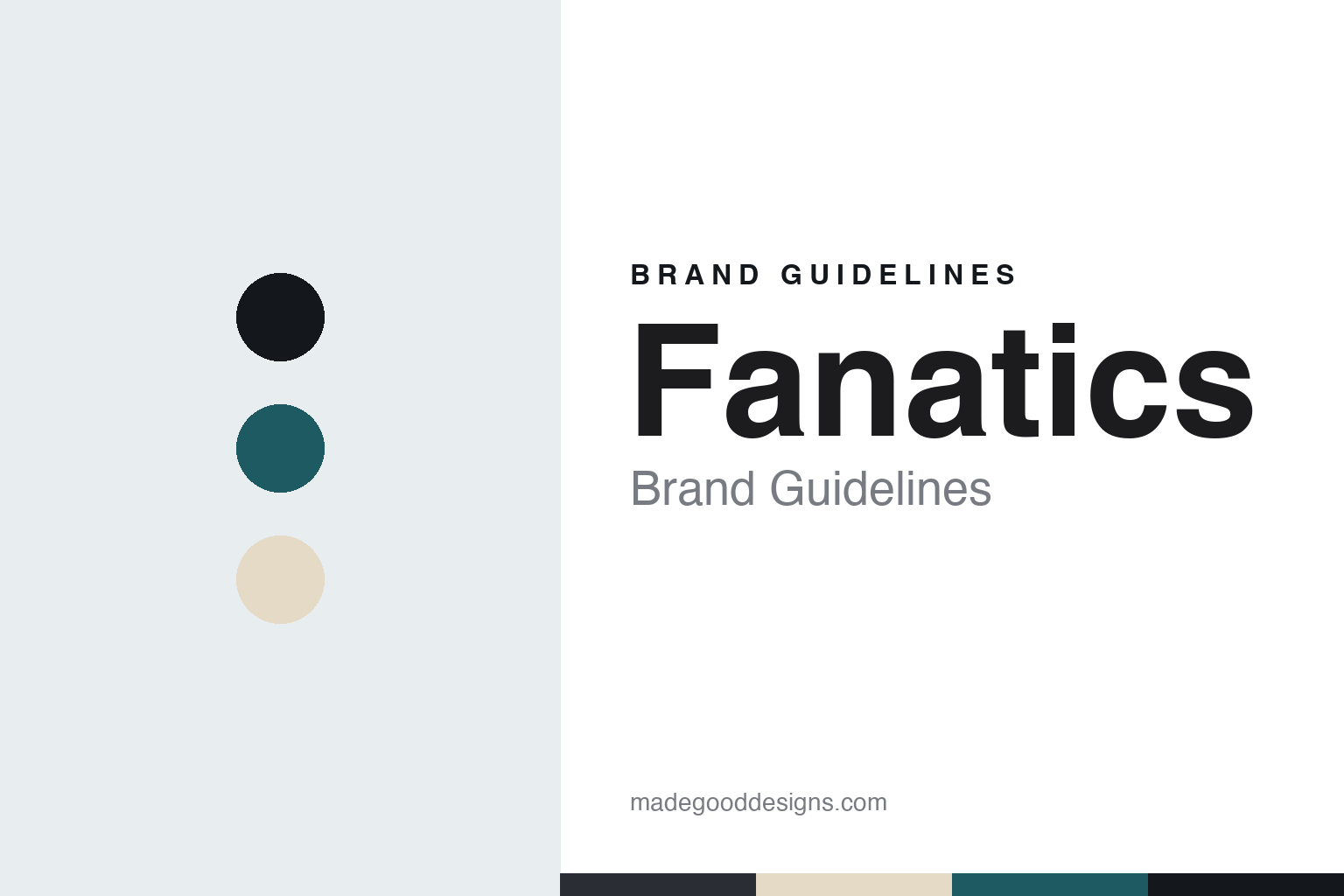
Fanatics Brand Guidelines
A Jacksonville mall store that became a sports platform.
Aa
Two constants: a graphite, teal and sand palette and a heavy grotesque sans register. Abstract homage — not a Fanatics product or mark; no jersey, logo or team mark is reproduced.
Football Fanatics
A mall store, a website and a takeover.
Fanatics traces back to a single shop in northeast Florida. English Wikipedia says Football Fanatics was founded by the brothers Alan and Mitchell Trager in Jacksonville, starting with a store in the Orange Park Mall in 1995 that concentrated on local team merchandise, particularly apparel for the Jacksonville Jaguars. The business later moved into e-commerce, running online stores for teams.
That online business brought it into a larger group. In February 2011 GSI Commerce, the e-commerce company built by Michael Rubin, acquired Fanatics, which the company’s own timeline describes as a Florida-based company running e-commerce for many professional and college teams. The company says GSI had become the e-commerce provider for the NFL, NBA, MLB, NHL and NASCAR between 2002 and 2011.
Weeks later the group was broken up. In March 2011 Rubin sold GSI Commerce to eBay and bought back the sports e-commerce business, keeping the Fanatics name for the new company, according to the company. Forbes explained the logic in November 2012: eBay wanted GSI’s fulfilment services for large retailers and had no use for its three consumer businesses — Fanatics, Rue La La and ShopRunner — and Rubin bought Fanatics outright. Forbes then described Fanatics as a Jacksonville company operating the e-commerce sites of the NFL, NBA, MLB, NHL and Nascar, along with about 60 professional teams and college programmes.
That is why English Wikipedia dates the present company to 2011, with Rubin as its founder, while its roots go back to the 1995 store. Rubin remains chief executive, and the company still lists Jacksonville among its main offices, alongside New York, San Mateo, Tampa, Manchester, Tokyo and Hyderabad.
Colour
From online store to manufacturer.
Through the 2010s Fanatics turned from an online retailer into a company that designs and makes its own goods. The company says it bought Dreams, Inc. and the FansEdge business in 2012, opened a Silicon Valley base in 2014 to build what it calls an on-demand merchandise model, and bought the UK online retailer Kitbag in February 2016 as its first move into global football.
A move into manufacturing came in April 2017, when Fanatics agreed to buy Majestic and the rest of VF Corporation’s Licensed Sports Group, Retail Dive reported. Majestic had been making MLB’s licensed on-field uniforms at a factory in Pennsylvania, and the announcement said uniforms would continue to be made there. Later that year Fanatics bought the licensing agency Fermata Partners, which became the base of its college division, Sportico reported in 2020.
Licensing deals with Nike followed. The company says a three-way partnership announced in May 2018 made Fanatics the maker and distributor of Nike-branded NFL adult jerseys and apparel, and that a January 2019 deal had it make Nike-designed MLB on-field uniforms and fan gear; a third agreement, in July 2022, covered Nike-branded fan gear for its top college partners from 2024.
Headwear came next. In September 2020 Fanatics bought assets from Vetta Brands, including the headwear licensee Top of the World and its rights to more than 600 universities, Sportico reported; a 220,000-square-foot warehouse in Norman, Oklahoma, was to become the base of its headwear business, and Fanatics planned to rehire more than 200 people laid off when Top of the World closed. In December 2020 it added WinCraft, a maker of licensed non-apparel goods, the company says.
In February 2022 Fanatics, with a group of investors, acquired Mitchell & Ness, the Philadelphia maker of throwback jerseys, and in April 2023 it bought Epi, a Milan sports-merchandise company. In March 2023 the NHL named Fanatics the outfitter of its on-ice player uniforms in a ten-year deal beginning in 2024, according to the company.
Typography
Rings, yearbooks, campus wear and fan gear.
The companies in this group sell school pride, team loyalty and nostalgia, and they reach their customers by very different routes. Class-ring and yearbook makers work mainly through schools and colleges: a school signs up with a supplier, and students order rings, yearbooks, caps and gowns and announcements through it. Jostens has worked this way since the early twentieth century, and Meredith College’s 2024 switch of its ring and regalia supplier from Jostens to Balfour & Co. shows how those school contracts can change hands.
Much of what these brands make carries someone else’s name. Class rings, yearbooks and campus apparel are built around a school’s own colours, crest and mascot, and caps, jerseys and fan shirts carry college and team marks under licence.
The apparel side runs from vintage-style campus sweatshirts and tees to plain garment-dyed blanks sold to screen printers, who add the designs themselves, and to the caps and replica jerseys bought by fans in shops and online. The ring makers sell clothing too: Jostens runs a school spirit-wear shop, and Balfour & Co. lists apparel among its graduation products.
Ownership in the sector is often in the hands of investors rather than founders. Jostens has been owned by the private-equity firm Platinum Equity since 2018, and Balfour’s parent group passed to an investor group led by an affiliate of Cerberus Capital Management in 2021 and now trades as Balfour & Co. Each guide sets out who founded the brand, who owns it now and what it says about where its products are made, and marks plainly what rests only on the company’s own word.
Aa
A heavy grotesque sans in a sports-headline register. (Specimen set in Archivo, a sans STAND-IN; NOT the Fanatics logo.)
A sports platform
Fan gear, cards, betting, events and more.
In August 2021 Fanatics reorganised itself as what it calls a digital sports platform, made up of three businesses — merchandise, collectibles and sports betting — with Rubin as chief executive of the wider company. In December 2021 it acquired Topps, the trading-card brand, which it says became the cornerstone of Fanatics Collectibles.
Today the company lists seven businesses: Fanatics Commerce, Fanatics Collectibles, Fanatics Betting & Gaming, Fanatics Events, Fanatics Advertising, Fanatics Markets and Fanatics Studios, the last launched in January 2026 with OBB Media. It describes Fanatics Commerce as a designer, manufacturer and retailer of licensed consumer products, including fan gear, jerseys, lifestyle and streetwear, headwear and hard goods, run as a vertically integrated platform for leagues, teams, colleges and associations. A loyalty programme, Fanatics ONE, launched in August 2025, links the businesses.
The company gives its own scale figures: partnerships with more than 900 sports properties, more than 22,000 employees, more than 80 offices and facilities worldwide, and over 2,000 retail locations including all Lids stores, of which it says it is the majority owner. On sourcing, it says it publishes a list of the finished-goods suppliers for its own brands — cut, sew and embellishment — alongside Fanatics-owned facilities and contractors, and asks its main suppliers to trace their own suppliers further up the chain.
For a design guide, Fanatics shows how a fan-merchandise group can work behind many other names, making and selling league, college and heritage labels under licence alongside its own. Compare Mitchell & Ness, the throwback-jersey label it owns, and Lids, the cap chain it describes as majority-owned. For this guide we use graphite, a deep teal and a warm sand with a heavy sans, an unofficial interpretation; no product or logo is reproduced.
Explore & save
Keep Fanatics’s identity on hand — save it to a board in the Made Good inspiration library.
Fanatics identity set
Pin the Fanatics-inspired graphite, teal and sand palette and the heavy grotesque sans register to your own board.
Source & notes
Frequently Asked Questions
What font can I use to match the Fanatics look?
This guide describes Fanatics’ type as “A heavy grotesque sans in a sports-headline register”. Its type specimen is set in Archivo from Google Fonts as a stand-in; Archivo is not Fanatics’ own lettering.
What colours are in the Fanatics palette?
This guide’s Fanatics palette is Graphite #2A2D33, Ink #14171B, Pennant teal #1E5A61, Bench sand #E4DAC6 and Paper #F7F6F3. The tones are the guide’s own unofficial interpretation, not official Fanatics hex codes.
When was Fanatics founded?
Fanatics was founded in 1995 (Football Fanatics), in Jacksonville, Florida.
Who founded Fanatics?
Fanatics was founded by Alan and Mitchell Trager in 1995 (Football Fanatics).