Mitchell & Ness Brand Guidelines
The 1904 Philadelphia shop that remade old jerseys.
Aa
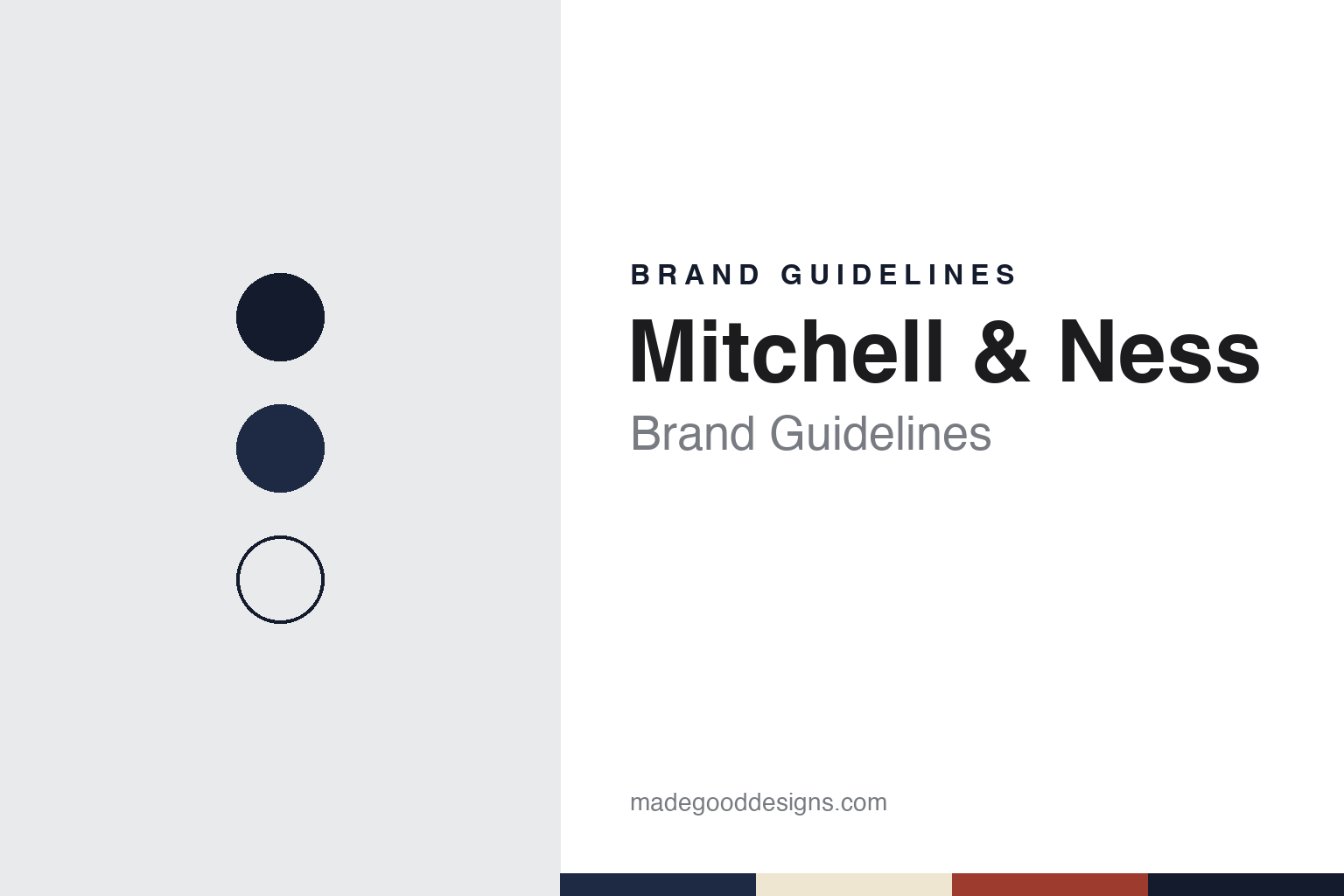
Two constants: a deep navy, flannel cream and brick red palette and a slab serif register. Abstract homage — not a Mitchell & Ness product or mark; no jersey, logo or team mark is reproduced.
The Sporting Goods Shop
A tennis and golf shop in Philadelphia.
Mitchell & Ness began in Philadelphia in 1904. English Wikipedia says it was founded as Mitchell & Ness Sporting Goods by Frank P. Mitchell, an Amateur Athletic Union tennis and wrestling champion, and Charles M. Ness, a Scottish-born golfer. Their shop strung tennis rackets and made golf clubs to order. The company’s own press release of July 2016 describes the business at its start as “a golf and tennis company.”
Team uniforms came next. Wikipedia records that the firm sold uniforms to local baseball and football clubs, supplied the Philadelphia Eagles from the team’s first NFL season in 1933 through 1963, and put its label on a Philadelphia Athletics uniform in 1938, with the Phillies following in the early 1940s. By the end of that decade, it says, the Mitchell & Ness label was appearing on high school and college uniforms around Philadelphia. The 2016 release puts the same three professional clubs, the Eagles, the Athletics and the Phillies, on its list of early customers.
That trade did not last. Wikipedia says the company dropped its team business in the late 1970s to concentrate on retail, selling field hockey equipment and ski gear, and by 1983 had shrunk to a single small store in central Philadelphia under its owner, Peter Capolino. ESPN.com still described Capolino as the company’s owner in May 2002, by which time the shop had become something quite different: a maker of reproductions of the uniforms that teams had worn decades earlier.
Colour
From a repair job to a throwback business.
The turn came in 1983. According to Wikipedia, a customer brought in a 1960 Pittsburgh Pirates vest and a 1949 St. Louis Browns shirt, both made of wool flannel, and asked whether they could be repaired. The shop managed it, and from that job came the idea of reproducing historically accurate flannel baseball uniforms, at a time when Major League clubs had long since moved to double-knit polyester. Wikipedia says the company researched old newspapers, programmes, books and film, consulted collectors and visited the archives of the Baseball Hall of Fame in Cooperstown, and found long-stored rolls of baseball flannel in a North Philadelphia warehouse. Sports Illustrated wrote about the business in 1987, and The New York Times two years later.
Baseball reproductions became a range in the late 1980s: Wikipedia dates the Cooperstown Collection to 1988, while ESPN.com reported in 2002 that Capolino started making baseball jerseys in 1989. Basketball followed in 1999 with the Hardwood Classics collection of NBA jerseys, then a football Throwback Collection in 2000 and, in 2002, rights to remake vintage NHL sweaters, according to Wikipedia. ESPN.com reported in May 2002 that hip-hop artists wearing the reproductions in concerts and music videos from about 1999 had brought the brand a younger audience than the collectors it first served.
The company’s 2016 release says the Mitchell & Ness Nostalgia Company was created in the 1980s to bring back authentic jerseys significant to sports history, and its tagline at the time was “Defining Authentic.” Wikipedia describes its range today as team jerseys and shorts, jackets, hoodies and caps, sold under league licences, and notes a house label, “M&N.” It also says the company keeps a file of every MLB uniform worn since the Cincinnati Red Stockings of 1869.
Typography
Licensed apparel and its makers.
The companies in this group sell school pride, team loyalty and nostalgia, and they reach their customers by very different routes. Class-ring and yearbook makers work mainly through schools and colleges: a school signs up with a supplier, and students order rings, yearbooks, caps and gowns and announcements through it. Jostens has worked this way since the early twentieth century, and Meredith College’s 2024 switch of its ring and regalia supplier from Jostens to Balfour & Co. shows how those school contracts can change hands.
Much of what these brands make carries someone else’s name. Class rings, yearbooks and campus apparel are built around a school’s own colours, crest and mascot, and caps, jerseys and fan shirts carry college and team marks under licence.
The apparel side runs from vintage-style campus sweatshirts and tees to plain garment-dyed blanks sold to screen printers, who add the designs themselves, and to the caps and replica jerseys bought by fans in shops and online. The ring makers sell clothing too: Jostens runs a school spirit-wear shop, and Balfour & Co. lists apparel among its graduation products.
Ownership in the sector is often in the hands of investors rather than founders. Jostens has been owned by the private-equity firm Platinum Equity since 2018, and Balfour’s parent group passed to an investor group led by an affiliate of Cerberus Capital Management in 2021 and now trades as Balfour & Co. Each guide sets out who founded the brand, who owns it now and what it says about where its products are made, and marks plainly what rests only on the company’s own word.
Aa
A slab serif — the register of old team lettering. (Specimen set in Zilla Slab, a slab-serif STAND-IN; NOT the Mitchell & Ness logo.)
Mitchell & Ness
Three owners since 2007.
Ownership has changed three times since 2007. In November 2007 FashionUnited reported that the adidas Group’s Sports Licensed Division had acquired Mitchell & Ness Nostalgia Company, which it described as a wholesaler, marketer and distributor of vintage athletic product, holding licences from the NBA, MLB, the NHL and the NFL; the terms were kept confidential. In July 2016 a company press release announced that Juggernaut Capital Partners, a private equity firm based in Washington, D.C., and the executive Kevin Wulff had acquired the Mitchell & Ness assets from adidas, with Wulff as chief executive and the staff in the United States and the United Kingdom carrying on as before. That release gave Philadelphia as the company’s headquarters and listed licences from MLB, the NBA, NFL, NHL, NCAA and MLS.
In February 2022 Fanatics, the licensed sports merchandise company, bought the brand alongside what the NHL later called a celebrity and influencer ownership group. Complex reported on 18 February 2022 that Fanatics held three-quarters of the business and the group the rest, and that Mitchell & Ness would run as a separate entity within Fanatics Commerce. On 29 June 2022 the NHL announced on NHL.com that Mitchell & Ness would design and manufacture officially licensed lifestyle apparel, headwear and accessories for the league and all 32 of its teams, alongside separate agreements with the players’ association and the NHL Alumni Association. Wikipedia adds that the brand expanded to the United Kingdom and Australia in 2012 and that it has supplied headwear to teams in Australia and New Zealand’s National Basketball League.
For a design guide, Mitchell & Ness shows how a brand can be rebuilt around an archive: a 1904 Philadelphia sporting goods shop that found its second life in reproducing what teams once wore. Compare Fanatics, its owner since 2022, and adidas, which owned it from 2007 to 2016. For this guide we use a deep navy, a flannel cream and a brick red with a slab serif, an unofficial interpretation; no product or logo is reproduced.
Explore & save
Keep Mitchell & Ness’s identity on hand — save it to a board in the Made Good inspiration library.
Mitchell & Ness identity set
Pin the Mitchell & Ness deep navy, flannel cream and brick red palette and the slab serif register to your own board.
Source & notes
Frequently Asked Questions
What font can I use to match the Mitchell & Ness look?
This guide describes Mitchell & Ness’s type as “A slab serif — the register of old team lettering”. Its type specimen is set in Zilla Slab from Google Fonts as a stand-in; Zilla Slab is not Mitchell & Ness’s own lettering.
What colours are in the Mitchell & Ness palette?
This guide’s Mitchell & Ness palette is Deep navy #1E2A44, Ink #141B2C, Flannel cream #EFE6D2, Brick red #9C3B2E and Paper #FAF7F0. The tones are the guide’s own unofficial interpretation, not official Mitchell & Ness hex codes.
When was Mitchell & Ness founded?
Mitchell & Ness was founded in 1904, in Philadelphia, Pennsylvania.
Who founded Mitchell & Ness?
Mitchell & Ness was founded by Frank P. Mitchell and Charles M. Ness in 1904.
Who owns Mitchell & Ness?
Mitchell & Ness is owned by Fanatics and an investor group (since February 2022).