Comfort Colors Brand Guidelines
The Vermont garment-dye label behind the faded campus tee.
Aa
Two constants: a washed slate, clay and sea-glass palette and a soft serif register. Abstract homage — not a Comfort Colors product or mark; no garment, label or logo is reproduced.
A garage in Vermont
Dye, a washing machine and a worn-in look.
Comfort Colors began in 1975 in rural Vermont. Its owner today, the Montreal apparel maker Gildan, tells the story in a company blog post of November 2025: Barry T. Chouinard started experimenting with dye in his garage, with little more than a washing machine, aiming for shirts that felt worn in from the first wear. For many years the business was known by its founder’s name. When Vermont Business Magazine reported on the company in September 2015, it noted that Comfort Colors had previously traded as Barry T Chouinard.
Gildan’s account says the garage operation had grown into a full business by the 1980s, and credits it with introducing what it calls the apparel industry’s first garment-dyed, ring-spun cotton T-shirts. That is the owner’s claim. What the record shows more plainly is the shape of the business in its later independent years. When Gildan agreed to buy it in February 2015, it described Comfort Colors as headquartered in Northfield, Vermont, with dyeing, packaging and distribution in Northfield and in New Bedford, Massachusetts; Vermont Business Magazine also listed a site in Berlin, Vermont.
According to Gildan’s 2015 announcement, Comfort Colors bought prepared-for-dye garments from outside suppliers, Gildan among them, and then put them through its own customised dyeing process in-house. The result, in Gildan’s words at the time, was a distressed or worn look. In 2015, then, Comfort Colors was a dyeing business rather than a knitting or sewing one.
Before it owned Comfort Colors, Gildan was already one of the vendors whose undyed shirts went into the Vermont dye works, according to the same 2015 announcement.
Colour
Pigment, reactive dye and nature-named colours.
The brand’s signature is the colour itself. In its 50th-anniversary account of 2025, Gildan describes three techniques behind Comfort Colors: pigment dyeing, in which pigments sit on the surface of the fabric to give a washed, vintage look; reactive colours, in which the dye bonds chemically with the cotton; and pigment sprays, sprayed directly onto the garment so that each piece takes on its own pattern. The company groups its palette under the line “Colors Inspired by Nature” and calls its pigment process Pigment Pure.
On Gildan’s corporate brand page, viewed in November 2026, Comfort Colors is introduced as “the home of pigment-dyed shirts,” and the company calls itself the original pioneer of the technique. The same page lists three collections, 31 styles and 79 colours, and says the shirts are made from 100% ring-spun cotton grown and harvested in the United States. Those are the company’s own figures and claims. The page also states that the Comfort Colors trademark is owned by Gildan Activewear SRL.
Where the shirts were sold helped make the name. In 2015 Gildan described Comfort Colors as one of the most recognised brands among shoppers at college bookstores, specialty shops, and destination and resort stores. That is Gildan’s own description. The garments are sold undecorated, as blanks for printers to finish with their own designs, as the same announcement put it.
Recent marketing has leaned on music. In September 2026 Gildan announced that Comfort Colors had been the official printwear supplier at Lollapalooza, its first year with the festival, with a branded studio where visitors picked a signature shade at a “Shade Wall.” In November 2026 the company said Comfort Colors was the primary apparel provider for merchandise on Bruno Mars’ The Romantic Tour, through a partnership between Gildan and the tour’s merchandise rights holder, Merch Traffic, with the 1717 Heavyweight Adult Tee as a featured product.
Typography
Blanks, licences and campus shops.
The companies in this group sell school pride, team loyalty and nostalgia, and they reach their customers by very different routes. Class-ring and yearbook makers work mainly through schools and colleges: a school signs up with a supplier, and students order rings, yearbooks, caps and gowns and announcements through it. Jostens has worked this way since the early twentieth century, and Meredith College’s 2024 switch of its ring and regalia supplier from Jostens to Balfour & Co. shows how those school contracts can change hands.
Much of what these brands make carries someone else’s name. Class rings, yearbooks and campus apparel are built around a school’s own colours, crest and mascot, and caps, jerseys and fan shirts carry college and team marks under licence.
The apparel side runs from vintage-style campus sweatshirts and tees to plain garment-dyed blanks sold to screen printers, who add the designs themselves, and to the caps and replica jerseys bought by fans in shops and online. The ring makers sell clothing too: Jostens runs a school spirit-wear shop, and Balfour & Co. lists apparel among its graduation products.
Ownership in the sector is often in the hands of investors rather than founders. Jostens has been owned by the private-equity firm Platinum Equity since 2018, and Balfour’s parent group passed to an investor group led by an affiliate of Cerberus Capital Management in 2021 and now trades as Balfour & Co. Each guide sets out who founded the brand, who owns it now and what it says about where its products are made, and marks plainly what rests only on the company’s own word.
Aa
A soft serif for a washed, lived-in register. (Specimen set in Fraunces, a serif STAND-IN; NOT the Comfort Colors logo.)
Comfort Colors
From a Vermont dye works to a Gildan brand.
Comfort Colors stayed independent for four decades. On 4 February 2015 Gildan Activewear announced a definitive agreement to buy substantially all of the assets of Comfort Colors, describing it as a supplier of garment-dyed undecorated T-shirts and sweatshirts for the North American printwear market. Gildan said the purchase would increase its reach in what it called the fashion basics segment of that market. The deal was completed on 2 March 2015, Gildan announced that day.
Change in Vermont followed within months. In September 2015 Vermont Business Magazine, citing the television station WCAX, reported that the Comfort Colors plant in Northfield would close by the end of October, as Gildan consolidated the brand’s operations at other plants. Gildan’s own timeline now records the 2015 purchase as adding a vintage garment-dye collection to its imprintables business, the trade term for blank apparel sold to decorators.
Since then Comfort Colors has been one of a family of brands. Gildan’s corporate site, in November 2026, lists it alongside the Gildan brand itself and American Apparel, and, since Gildan completed its purchase of HanesBrands on 1 December 2025, alongside Hanes, Bali, Maidenform and Playtex. In 2025 the brand marked 50 years, and Gildan Brands Australia, the group’s Australian wholesale arm, published a history of the founder’s garage, the dye processes and the 2015 sale.
Gildan’s marketing for the brand leans on nature-named shades and phrases such as “lived-in” and “good vibes,” and, at Lollapalooza in 2026, on an event studio built around choosing a colour.
For a design guide, Comfort Colors shows how a blank-shirt brand can build an identity from a process rather than a print: faded, nature-named colours on a garment that other designers finish. Compare Gildan, its parent since 2015, and Hanes, a sister brand since 2025. For this guide we use washed slate, sun-faded clay, sea glass and butter with a serif, an unofficial interpretation; no product or logo is reproduced.
Explore & save
Keep Comfort Colors’s identity on hand — save it to a board in the Made Good inspiration library.
Comfort Colors identity set
Pin the Comfort Colors washed slate, clay and sea-glass palette and the soft serif register to your own board.
Source & notes
Frequently Asked Questions
What font can I use to match the Comfort Colors look?
This guide describes Comfort Colors’ type as “A soft serif for a washed, lived-in register”. Its type specimen is set in Fraunces from Google Fonts as a stand-in; Fraunces is not Comfort Colors’ own lettering.
What colours are in the Comfort Colors palette?
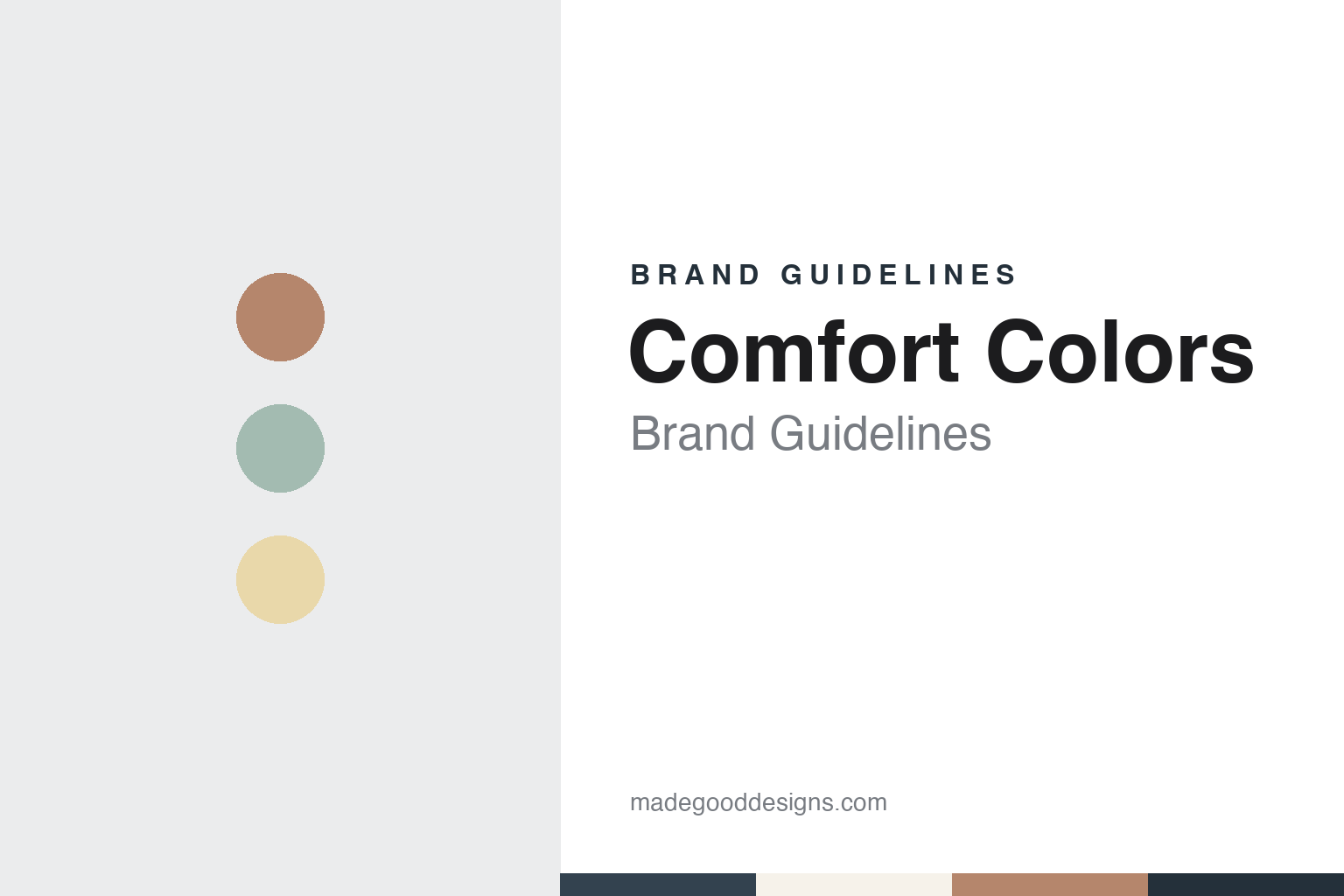
This guide’s Comfort Colors palette is Washed slate #33424F, Sun-faded clay #B5866C, Sea glass #A3BBB1, Butter #E9D8AA and Paper #F6F2EA. The tones are the guide’s own unofficial interpretation, not official Comfort Colors hex codes.
When was Comfort Colors founded?
Comfort Colors was founded in 1975, in Rural Vermont, United States.
Who founded Comfort Colors?
Comfort Colors was founded by Barry T. Chouinard in 1975.
Who owns Comfort Colors?
Comfort Colors today: A brand of Gildan Activewear, Montreal (since 2015).