Gildan Brand Guidelines
The Montreal mill that makes the shirt before the print.
Aa
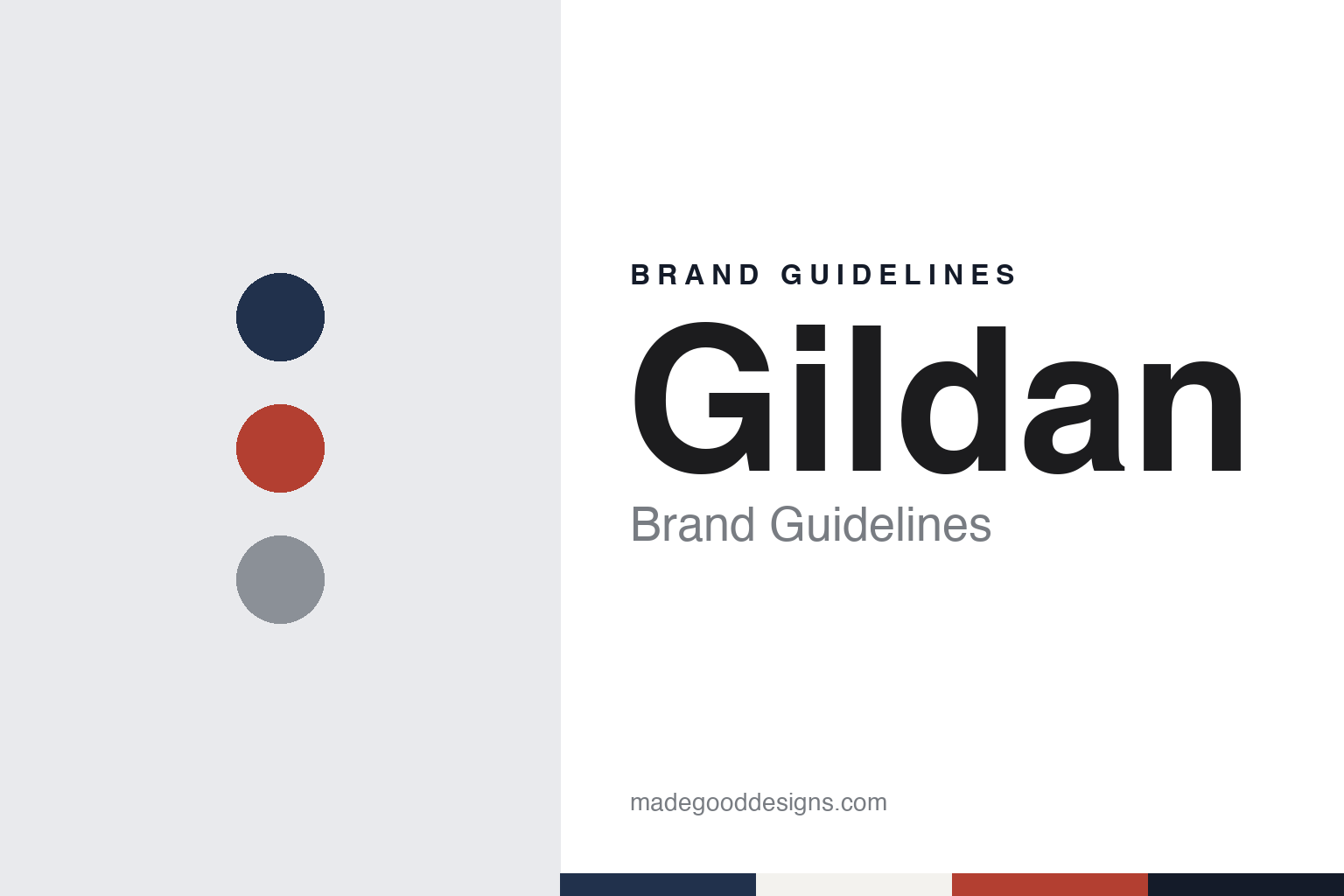
Two constants: a mill navy, red and heather grey palette and an industrial sans register. Abstract homage — not a Gildan product or mark; no garment, label or logo is reproduced.
Harley and the mill
A children’s wear firm buys a knitting mill.
Gildan grew out of a family clothing business in Montreal. The company’s own timeline says Joseph Chamandy started Harley Inc. in 1946 to make basic children’s apparel, including activewear and sleepwear, and that his grandsons Greg and Glenn Chamandy took over its leadership in 1982. English Wikipedia names the two brothers as Gildan’s founders.
The date the company counts as its founding is 1984, when the family firm bought a knitting mill with circular machines. The knitting business was called Gildan Textiles Inc., and the company says the name combines the names of two salesmen who worked for it at the time. English Wikipedia adds that the mill was bought to make fabric for Harley. In French the company is Les Vêtements de Sport Gildan Inc.
The business moved step by step towards owning every stage of production. In 1987, the company says, it bought a dyeing facility in Valleyfield, Quebec, which gave it control of everything after yarn-spinning. In 1992 it began making T-shirts under the Gildan brand, and closed Harley to concentrate on what had become Gildan Activewear; English Wikipedia dates the closure of Harley to 1994. In 1993, according to Gildan, it entered the Canadian and United States printwear markets through its first large wholesalers.
That choice of market defined the company. Gildan sold plain cotton shirts to wholesalers, who resold them to screen printers in the United States and Canada to be decorated with designs and logos, as English Wikipedia describes it. The shirt was the product; the print was somebody else’s.
Colour
Blanks for printers, made in its own plants.
Gildan’s corporate site calls the company one of the largest vertically integrated apparel manufacturers in the world. Its corporate site explains the model: the company sells products in bulk to printers, brands and companies that decorate them as they choose, and it prefers to own each step, from spinning yarn to assembling and distributing garments. That ambition is visible in the dates on its timeline.
Production moved south in the late 1990s. Gildan opened its first vertically integrated offshore sewing plant in San Pedro Sula, Honduras, in 1997, and its first vertically integrated textile facility in Honduras began operating in 2002. A sewing facility in Nicaragua followed in 2004, a fully integrated textile facility in the Dominican Republic in 2005, and an integrated textile facility in Bangladesh in 2010, the company says; in 2024 it reported substantially completing a large textile and sewing complex in Bangladesh. Today Gildan says its manufacturing operations are in Central America, the Caribbean Basin, North America and Bangladesh.
Yarn became part of the chain too. Gildan formed a yarn-spinning joint venture in Georgia in 2003, acquired the remaining half of its CanAm Yarns joint venture in 2012, added two US spinning facilities through the Swift Spinning purchase in 2017, and in 2021 acquired Phoenix Sanford, the parent company of Frontier Yarns, according to its timeline.
The company went public in June 1998 on the Toronto Stock Exchange and the American Stock Exchange, and moved its US listing to the New York Stock Exchange in 1999. It entered the European market for printed activewear in 2000, Australia in 2004 and, the company says, India and Vietnam in 2023.
The Gildan brand page, viewed in November 2026, presents it as “the smart choice” for decorators building printwear businesses, with fabrics ranging from 100% US cotton to 100% polyester and seven collections, 69 styles and 151 colours. Those are the company’s figures. English Wikipedia describes the core product as undecorated blank activewear, such as T-shirts, hoodies and fleece, that screen-printing companies later decorate with designs and logos.
Typography
Blanks, licences and campus shops.
The companies in this group sell school pride, team loyalty and nostalgia, and they reach their customers by very different routes. Class-ring and yearbook makers work mainly through schools and colleges: a school signs up with a supplier, and students order rings, yearbooks, caps and gowns and announcements through it. Jostens has worked this way since the early twentieth century, and Meredith College’s 2024 switch of its ring and regalia supplier from Jostens to Balfour & Co. shows how those school contracts can change hands.
Much of what these brands make carries someone else’s name. Class rings, yearbooks and campus apparel are built around a school’s own colours, crest and mascot, and caps, jerseys and fan shirts carry college and team marks under licence.
The apparel side runs from vintage-style campus sweatshirts and tees to plain garment-dyed blanks sold to screen printers, who add the designs themselves, and to the caps and replica jerseys bought by fans in shops and online. The ring makers sell clothing too: Jostens runs a school spirit-wear shop, and Balfour & Co. lists apparel among its graduation products.
Ownership in the sector is often in the hands of investors rather than founders. Jostens has been owned by the private-equity firm Platinum Equity since 2018, and Balfour’s parent group passed to an investor group led by an affiliate of Cerberus Capital Management in 2021 and now trades as Balfour & Co. Each guide sets out who founded the brand, who owns it now and what it says about where its products are made, and marks plainly what rests only on the company’s own word.
Aa
An industrial sans for a mill-floor register. (Specimen set in Archivo, a sans STAND-IN; NOT the Gildan logo.)
Gildan
From one brand to a family of names.
From the 2010s Gildan grew by buying brands. Its timeline lists Gold Toe Moretz, a sock supplier, in 2011; Anvil Knitwear in 2012; the Montreal hosiery maker Doris Hosiery in 2014; Comfort Colors, the Vermont garment-dye label, in 2015; Alstyle and the sock brand Peds in 2016; and the American Apparel brand in 2017.
The company also went through a public contest over its leadership. Gildan’s board removed co-founder Glenn Chamandy as president and chief executive in December 2023; after a months-long proxy contest led by an activist investor, the previous chief executive and the whole board resigned, shareholders elected the investor’s slate of directors, and Chamandy was reinstated as president and chief executive in May 2024, Retail Dive reported on 30 May 2024.
A bigger change came next. Gildan announced an agreement to buy HanesBrands in August 2025, and on 1 December 2025 it completed the purchase, The Canadian Press reported that day, after shareholders of both companies had approved the terms. The deal brought the Hanes brand and its innerwear names into the Montreal company. In October 2026 Gildan completed the sale of the HanesBrands Australia business to BBFIT Investments, an entity associated with the investment firm BB Retail Capital, the company announced on 26 October 2026.
In November 2026 Gildan’s corporate site lists ten brands: Gildan, Hanes, Comfort Colors and American Apparel; the innerwear names Bali, Maidenform and Playtex; and the sock and legwear names GOLDTOE, ALLPRO and Peds. Its slogan is “Making Apparel Better,” and its 40th-anniversary material of 2024 described products worn “from college hoodies to concert t-shirts and corporate events.”
For a design guide, Gildan shows how a brand built for other people’s graphics can become a family of consumer names without changing its own plain register. Compare Comfort Colors, the garment-dyed label it bought in 2015, and Hanes, part of the company since 2025. For this guide we use mill navy, a printwear red and heather grey with a sans, an unofficial interpretation; no product or logo is reproduced.
Explore & save
Keep Gildan’s identity on hand — save it to a board in the Made Good inspiration library.
Gildan identity set
Pin the Gildan mill navy, red and heather grey palette and the industrial sans register to your own board.
Source & notes
Frequently Asked Questions
What font can I use to match the Gildan look?
This guide describes Gildan’s type as “An industrial sans for a mill-floor register”. Its type specimen is set in Archivo from Google Fonts as a stand-in; Archivo is not Gildan’s own lettering.
What colours are in the Gildan palette?
This guide’s Gildan palette is Mill navy #21314C, Ink #141B29, Printwear red #B33F31, Heather grey #8B9097 and Cotton white #F3F2EE. The tones are the guide’s own unofficial interpretation, not official Gildan hex codes.
When was Gildan founded?
Gildan was founded in 1984, in Montreal, Quebec, Canada. Gildan is known for Blank T-shirts and fleece for decorators.
Who founded Gildan?
Gildan was founded by Glenn and Greg Chamandy in 1984.