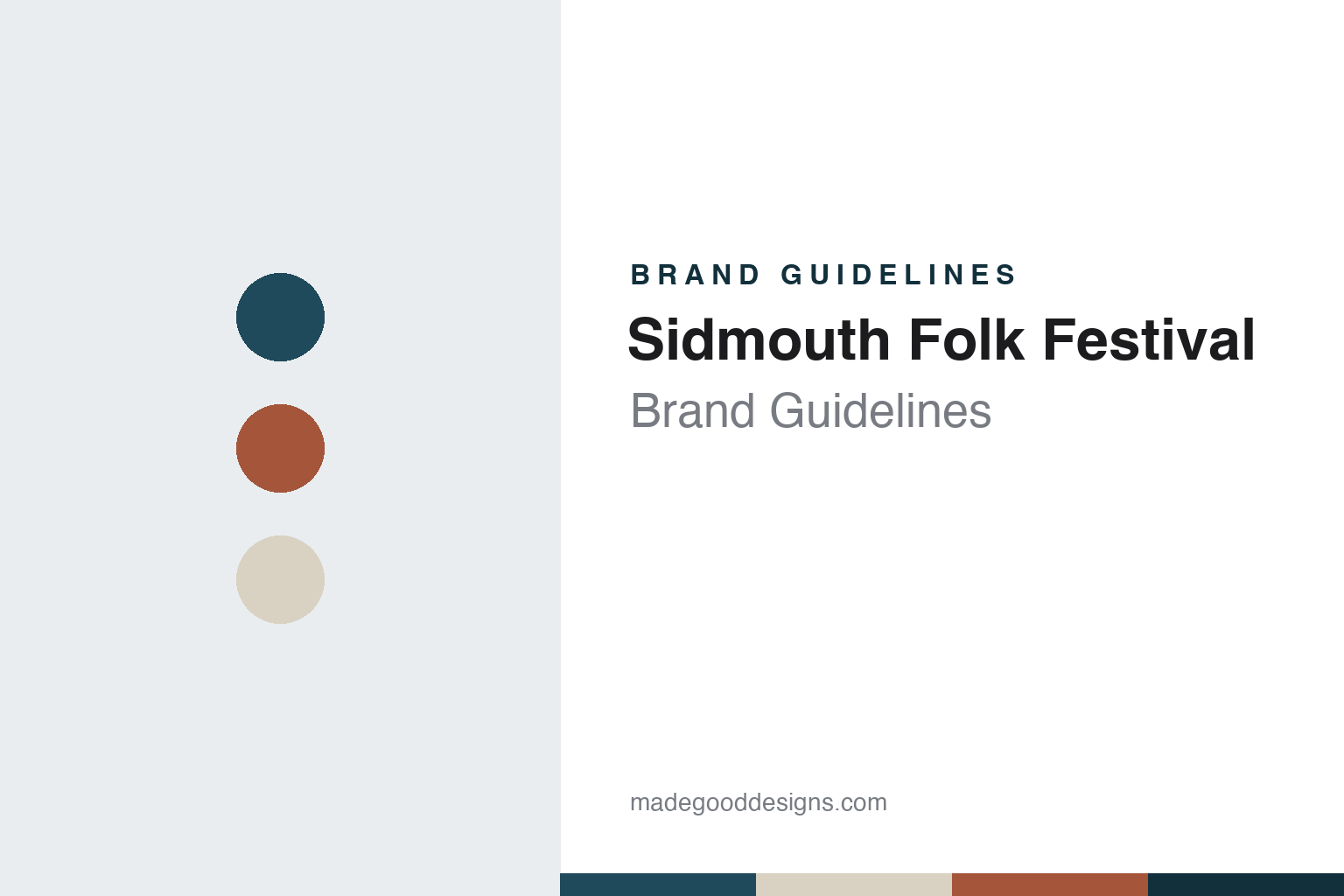
Sidmouth Folk Festival Brand Guidelines
A week of folk music, dance and song by the sea in East Devon since 1955.
Aa
Two constants: an esplanade blue, red cliff and shingle palette and a seaside display serif register. Abstract homage — not a Sidmouth Folk Festival poster or mark; no logo, artwork or programme is reproduced.
A dance week by the sea
From an EFDSS dance festival in 1955 to a week that fills a seaside town.
The Sidmouth Folk Festival began in 1955. The festival’s own short history says that in July of that year the English Folk Dance and Song Society (EFDSS) decided to add Sidmouth to the folk dance festival it already ran in Stratford, for the extra draw of the seaside and the Devon countryside. The first publicity leaflet, it says, announced performances in Connaught Gardens and dances on the Ham and in Blackmore Gardens, names that still sit on the festival map today. The first event was directed by Nibs Matthews and Margaret Grant and ran from Saturday 30 July to 6 August 1955.
Those 1955 dates set the pattern for the calendar. The festival says the week has always included the first Monday in August, and Sidmouth Town Council’s events page, updated in November 2026, repeats the rule and lists the coming editions: the 73rd festival from 30 July to 6 August 2027, and the 74th from 4 to 11 August 2028. The festival describes the 2024 edition as the 70th Sidmouth Folk Festival.
The name has changed more than once. English Wikipedia says the festival was founded as a folk dance festival and gradually widened to take in ceilidh dancing, music, song and folk crafts, and later performers from abroad, when it became the Sidmouth International Folklore Festival. From 1986 it was managed by the agency Mrs Casey Music, which retitled it the Sidmouth International Festival; the same article says the festival marked its 50th year in 2004, the year a history of the event, The First Week in August – Fifty Years of the Sidmouth Festival, was published by its archivist, Derek Schofield.
A new structure followed. English Wikipedia says that by November 2004 a steering group had formed to co-ordinate the 2005 events under the name Sidmouth Folk Week, and that the charity Sidmouth FolkWeek Ltd was registered in 2005. The festival website says the charity was formed in 2005 after a change in the management of the festival, and that it supports the festival through fundraising and the street and venue collections; its chair is Derek Schofield. In December 2018 the event took back the name Sidmouth Folk Festival, English Wikipedia says. The 2020 edition was not held, and the festival returned in 2021.
Colour
A concert marquee, a big top on the hill and dance across the town.
The festival is spread across the town rather than fenced into one field. Its website describes a week-long programme held at venues throughout the East Devon seaside town, with concerts, ceilidhs and folk dances, dance displays, storytelling, a Children’s Festival, youth sessions and participatory workshops, and gives the count for the coming edition as more than 800 events over eight days. English Wikipedia, describing the festival as it has run for years, gives a figure of more than 700 events and speaks of tens of thousands of visitors.
Three venues carry the main programme. The Ham, which the festival places where the River Sid meets the sea near Port Royal at the eastern end of the Esplanade, is the concert marquee, with seated concerts at lunchtime, in the afternoon and in the evening on every day of the week. The Bulverton, a standing big top on the hill next to the festival campsite, holds evening roots shows, late-night ceilidhs and daytime workshops; English Wikipedia names its “Late Night Extra” as a long-running feature there. The Manor Pavilion theatre in the town centre adds evening shows, and its adjoining Arts Centre holds talks and smaller concerts. A festival bus links the campsite with the town.
A dated snapshot of the week comes from Sidmouth Town Council, which in July 2022 published a guide to the opening weekend of the 68th festival, held from 29 July to 5 August that year. It listed Eddi Reader in the evening concert at The Ham on the Saturday, an evening show at the Manor Pavilion, dancing at The Bulverton, a Children’s Festival at Peacock Lawns and, on the Sunday evening, the festival patrons Show of Hands at The Ham. English Wikipedia names Martin Carthy as a festival patron.
Dance remains at the core of the programme. The festival says teams perform through the week in free Dance Spectaculars in Connaught Gardens and the Blackmore Gardens Marquee, around the town and on the Esplanade, and that every morning brings dance workshops ranging across Appalachian, Molly, Cotswold, Cornish, Border, rapper and clog styles. English Wikipedia describes the teams as morris, sword and other traditional dance sides. The festival also lists a solo jig competition, a Morris Wednesday fancy-dress ceilidh in Blackmore Gardens, and three dance processions, the last of them a Torchlight Procession on the final Friday that closes the week. The council’s 2022 guide described the Sidmouth Horse Trials on the Sunday at Port Royal as an all-comers event for hobby horses, morris animals and other “beasts of disguise.”
Typography
Folk festivals and their settings.
A folk festival rarely has a single building to stand for it. Its identity is carried instead by a place and a date: a seaside town that turns its gardens and promenade into stages for a week, an island whose villages and halls share the programme, a showground or estate field where marquees go up for a long weekend, a cultural village set in a rainforest, or a run of community halls in the cold months. The setting gives the festival its name, and the calendar fixes it in the memory, whether that is the week that takes in the first Monday in August or a bank holiday weekend at the end of summer.
The programme is the second layer. Concert marquees, standing big tops, dance houses, storytelling tents and children’s areas are usually given names of their own, and those names recur in programmes, on site maps and on stage boards year after year. Dance displays and processions take the festival out into the streets, so that teams of morris, sword, rapper or clog dancers become part of the look of the event as much as any printed material.
Print and lettering then travel from one edition to the next. A festival may commission a new poster each year while keeping the same wordmark, or keep a house style while changing its artwork; edition numbers, founding years and the name of the host town often sit beside the title on programmes, wristbands and listings. When a festival changes its name, moves to a new site or passes to a new organiser, these repeated elements are what carry its identity across the change.
The guides in this group look at folk festivals through those elements: where they are held, when they fall in the year, how their sites and stages are named, and how their names and printed matter have been handled over time. The colours and typefaces shown are our own interpretation, not official assets.
Aa
A seaside display serif — read as a concert board, a programme cover and a promenade poster. (Specimen set in DM Serif Display, a serif STAND-IN; NOT the Sidmouth Folk Festival logo.)
Sidmouth Folk Festival
A town, a week and a run of names.
The identity of the Sidmouth Folk Festival rests first on its town and its calendar. The festival’s own strapline calls it “a week-long seaside celebration of music, dance and song. Since 1955,” and its pages return again and again to the founding year and to the fixed August week. Its venues are named places in Sidmouth itself, from the Ham and the Esplanade to Connaught Gardens and Blackmore Gardens, so the town plan works as the festival plan.
The run of names is part of that story too. Sidmouth International Folklore Festival, Sidmouth International Festival, Sidmouth Folk Week and Sidmouth Folk Festival each mark a period in the event’s history, and the return to “Folk Festival” in 2018 brought the title back to the plain form that joins the town to the genre. Town Council listings now give each year’s edition a number, the 73rd in 2027, which keeps the long count in view.
For a design guide, the Sidmouth Folk Festival shows how a festival can let a seaside town carry its identity: named gardens, a marquee where the river meets the sea, a big top on the hill and dancers on the promenade. Compare Whitby Folk Week, another English seaside folk week that fills a whole town each August, and Towersey Festival, the English folk festival whose 50th-anniversary history was published by Mrs Casey Music, the agency that ran Sidmouth from 1986. For this guide we use esplanade blue, red cliff and shingle with a serif, an unofficial interpretation; no product or logo is reproduced.
Explore & save
Keep Sidmouth Folk Festival’s identity on hand — save it to a board in the Made Good inspiration library.
Sidmouth Folk Festival identity set
Pin the Sidmouth Folk Festival esplanade blue, red cliff and shingle palette and the seaside display serif register to your own board.
Source & notes
Frequently Asked Questions
What font can I use to match the Sidmouth Folk Festival look?
This guide describes Sidmouth Folk Festival’s type as “A seaside display serif — read as a concert board, a programme cover and a promenade poster”. Its type specimen is set in DM Serif Display from Google Fonts as a stand-in; DM Serif Display is not Sidmouth Folk Festival’s own lettering.
What colours are in the Sidmouth Folk Festival palette?
This guide’s Sidmouth Folk Festival palette is Esplanade blue #1F4A5C, Harbour ink #12303C, Red cliff #A4553A, Shingle #D9D2C3 and Sea-air paper #F7F4EE. The tones are the guide’s own unofficial interpretation, not official Sidmouth Folk Festival hex codes.
When was Sidmouth Folk Festival founded?
Sidmouth Folk Festival was founded in 1955, in Sidmouth, Devon, England.
Who founded Sidmouth Folk Festival?
Sidmouth Folk Festival was founded by English Folk Dance and Song Society in 1955.