Towersey Festival Brand Guidelines
The village folk festival that ran over the August bank holiday from 1965 to 2024.
Aa
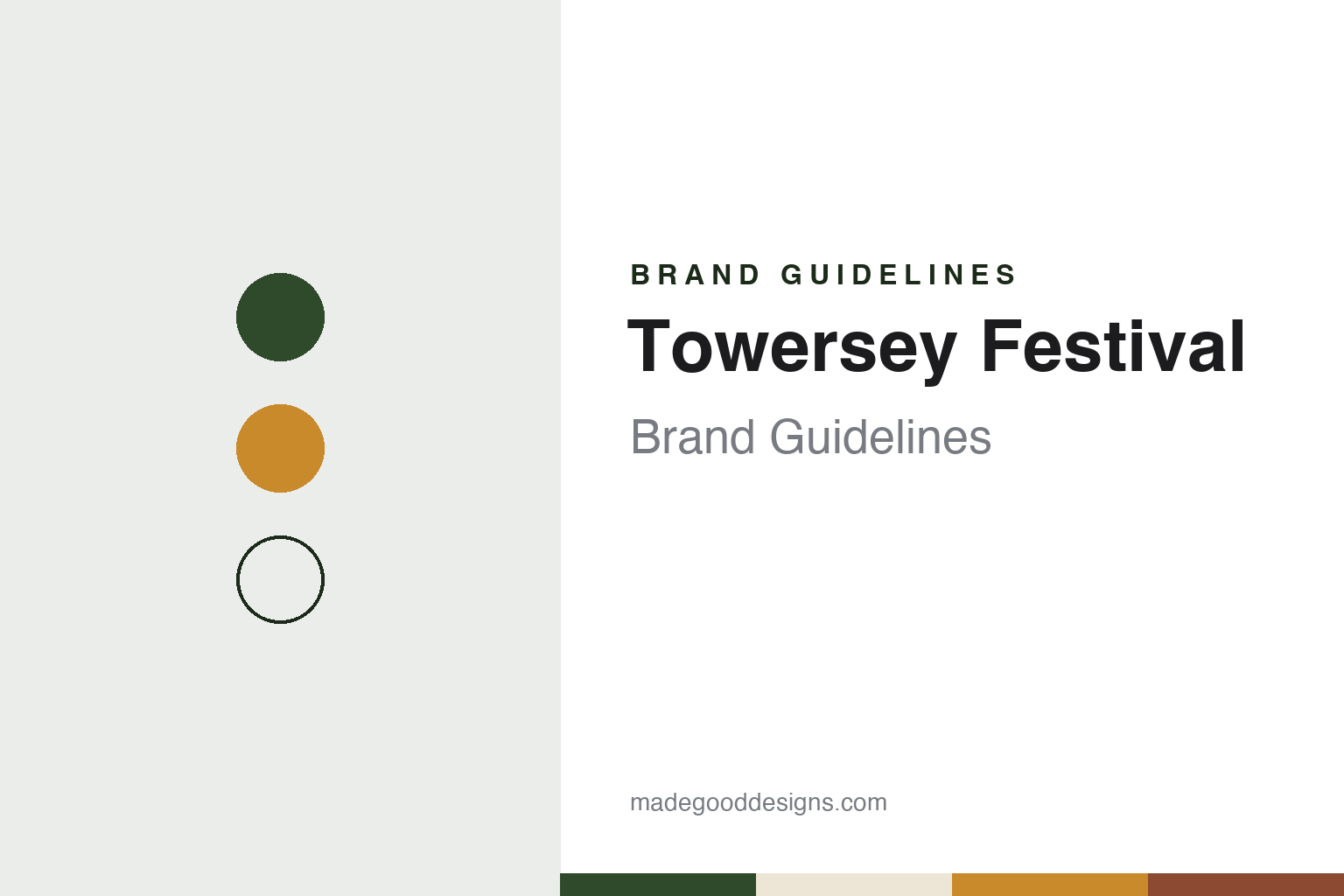
Two constants: a meadow green, lantern amber and village brick palette and a village slab serif register. Abstract homage — not a Towersey Festival poster or mark; no logo, artwork or wristband is reproduced.
A village fete
From a one-day fete in 1965 to a sixtieth and final weekend in 2024.
Towersey Festival began in 1965 in the village of Towersey, on the border of Oxfordshire and Buckinghamshire. BBC News, reporting in May 2024, called it an independent event founded by Denis Manners MBE in 1965 that championed roots and folk music. English Wikipedia says the first year was a one-day village fete with morris dancing and a folk singing session, held to raise money for the village hall, and that its success led to a three-day event the following year.
The festival’s 50th-anniversary book gave the same outline. Announcing it in July 2014, Folking.com reported that the second, three-day festival drew a few hundred people, that the event later spread over five days, and that it had come to draw more than 10,000 visitors; it quoted the Thame Gazette of 1966, which called Towersey the “little village with the big ideas.” The book, Towersey Festival: 50 Years In The Making, was published on 23 July 2014 by Mrs Casey Music with some 300 photographs.
The festival stayed in family hands. In a 2021 question-and-answer piece published by the Claydon Estate, the festival director Joe Heap said his grandfather and some friends had started the event in 1965 as a community event. BBC News named Mary Hodson and Joe Heap, two of Denis Manners’ grandchildren, as the festival’s co-directors in 2024.
The site moved twice. BBC News said the festival was first held in the village, moved to nearby Thame in 2015, and settled at the Claydon Estate in Buckinghamshire in 2020; English Wikipedia names the Thame site as Thame Showground. The 2020 edition was not held, and the Claydon Estate listed the festival there from 27 to 30 August 2021.
Towersey Festival has now ended. On 29 May 2024 BBC News reported that the organisers had announced that year’s festival would be their last; the four-day 60th-anniversary edition went ahead from 23 August 2024, with a 1965 dance party and an “in conversation” gathering with people who had been there at the start. In January 2025 BBC News confirmed that the final Towersey Festival had taken place in August 2024, and reported that the same team had launched a separate, smaller event at the Claydon Estate called Found Festival.
Colour
Bank holiday weekends, named tents and a lantern parade.
The festival’s calendar was fixed to the end of summer. English Wikipedia says it took place over the August bank holiday weekend every year from 1965 until 2024, and dated sources show the shape of those weekends: the 50th festival ran from Thursday 21 to Monday 25 August 2014, Folk Radio UK reported in May 2014, and the final edition opened on 23 August 2024.
The 50th-anniversary weekend gives a clear picture of the programme. Folk Radio UK listed performances by Richard Thompson, Seth Lakeman, Lau and The Bootleg Beatles, and announced a concert on Saturday 23 August 2014 marking 75 years of Topic Records, hosted by Norma Waterson, Eliza Carthy and The Gift Band, with younger musicians revisiting songs from the label’s catalogue. Joe Heap, then festival director, described the concert as part of the festival’s golden jubilee.
The site was organised as a set of named spaces. English Wikipedia lists The Big Club, formerly the Concert Tent; The Festival Dance House; The Festival Green, earlier called the Market Square and the Arena; and Venue 65, whose name echoes the founding year. It also mentions The Den for storytelling and spoken word, a craft tent and craft market, a Creative Quarter, and separate areas for children and for teenagers. In the Claydon Estate’s 2021 piece, Joe Heap spoke of four dedicated venues for young people, with activities from crafts to circus.
Some customs ran through the weekend. English Wikipedia describes a Monday-evening Lantern Parade, with lanterns made by members of the audience over the course of the festival, and a closing Festival Finale singalong in Venue 65. Recordings also carried the name: the same article lists a 1969 vinyl album, Festival at Towersey, made from live recordings at the 1968 festival, and two free digital compilations released in 2015 and 2016.
Typography
Folk festivals and their settings.
A folk festival rarely has a single building to stand for it. Its identity is carried instead by a place and a date: a seaside town that turns its gardens and promenade into stages for a week, an island whose villages and halls share the programme, a showground or estate field where marquees go up for a long weekend, a cultural village set in a rainforest, or a run of community halls in the cold months. The setting gives the festival its name, and the calendar fixes it in the memory, whether that is the week that takes in the first Monday in August or a bank holiday weekend at the end of summer.
The programme is the second layer. Concert marquees, standing big tops, dance houses, storytelling tents and children’s areas are usually given names of their own, and those names recur in programmes, on site maps and on stage boards year after year. Dance displays and processions take the festival out into the streets, so that teams of morris, sword, rapper or clog dancers become part of the look of the event as much as any printed material.
Print and lettering then travel from one edition to the next. A festival may commission a new poster each year while keeping the same wordmark, or keep a house style while changing its artwork; edition numbers, founding years and the name of the host town often sit beside the title on programmes, wristbands and listings. When a festival changes its name, moves to a new site or passes to a new organiser, these repeated elements are what carry its identity across the change.
The guides in this group look at folk festivals through those elements: where they are held, when they fall in the year, how their sites and stages are named, and how their names and printed matter have been handled over time. The colours and typefaces shown are our own interpretation, not official assets.
Aa
A village slab serif — read as a tent sign, a programme cover and a lantern-parade banner. (Specimen set in Bitter, a slab serif STAND-IN; NOT the Towersey Festival logo.)
Towersey Festival
A village name that travelled.
The identity of Towersey Festival was carried by its name more than by any one field. For fifty years the name and the place matched; after 2015 the festival kept the village name while it ran first at Thame and then at the Claydon Estate, and every listing from those years pairs “Towersey” with a site somewhere else. The name of Venue 65 tied the plan of the site back to the founding year, and the 2014 book and the 2024 dance party both returned to 1965.
Asked in 2021 to describe the festival in three words, Joe Heap chose “Another Lovelier World.” The phrase fits the visual elements the sources describe: marquees with names rather than numbers, a craft market, family areas and a parade of lanterns made on site. The festival’s former web address now forwards to the website of Found Festival, the separate event the same team began in 2025.
For a design guide, Towersey Festival shows how a family-run festival can carry a village name across sixty years and two moves, and how a closed festival is remembered through its rituals and its archive. Compare Cambridge Folk Festival, the English folk festival that also began in 1965, and Fairport’s Cropredy Convention, another English folk gathering held in an Oxfordshire village each August. For this guide we use meadow green, lantern amber and village brick with a serif, an unofficial interpretation; no product or logo is reproduced.
Explore & save
Keep Towersey Festival’s identity on hand — save it to a board in the Made Good inspiration library.
Towersey Festival identity set
Pin the Towersey Festival meadow green, lantern amber and village brick palette and the village slab serif register to your own board.
Source & notes
Frequently Asked Questions
What font can I use to match the Towersey Festival look?
This guide describes Towersey Festival’s type as “A village slab serif — read as a tent sign, a programme cover and a lantern-parade banner”. Its type specimen is set in Bitter from Google Fonts as a stand-in; Bitter is not Towersey Festival’s own lettering.
What colours are in the Towersey Festival palette?
This guide’s Towersey Festival palette is Meadow green #2F4A2A, Hedgerow ink #1C2B19, Lantern amber #C98A2B, Village brick #8C4A32 and Marquee canvas #EDE6D6. The tones are the guide’s own unofficial interpretation, not official Towersey Festival hex codes.
When was Towersey Festival founded?
Towersey Festival was founded in 1965, in Towersey, England.
Who founded Towersey Festival?
Towersey Festival was founded by Denis Manners in 1965.