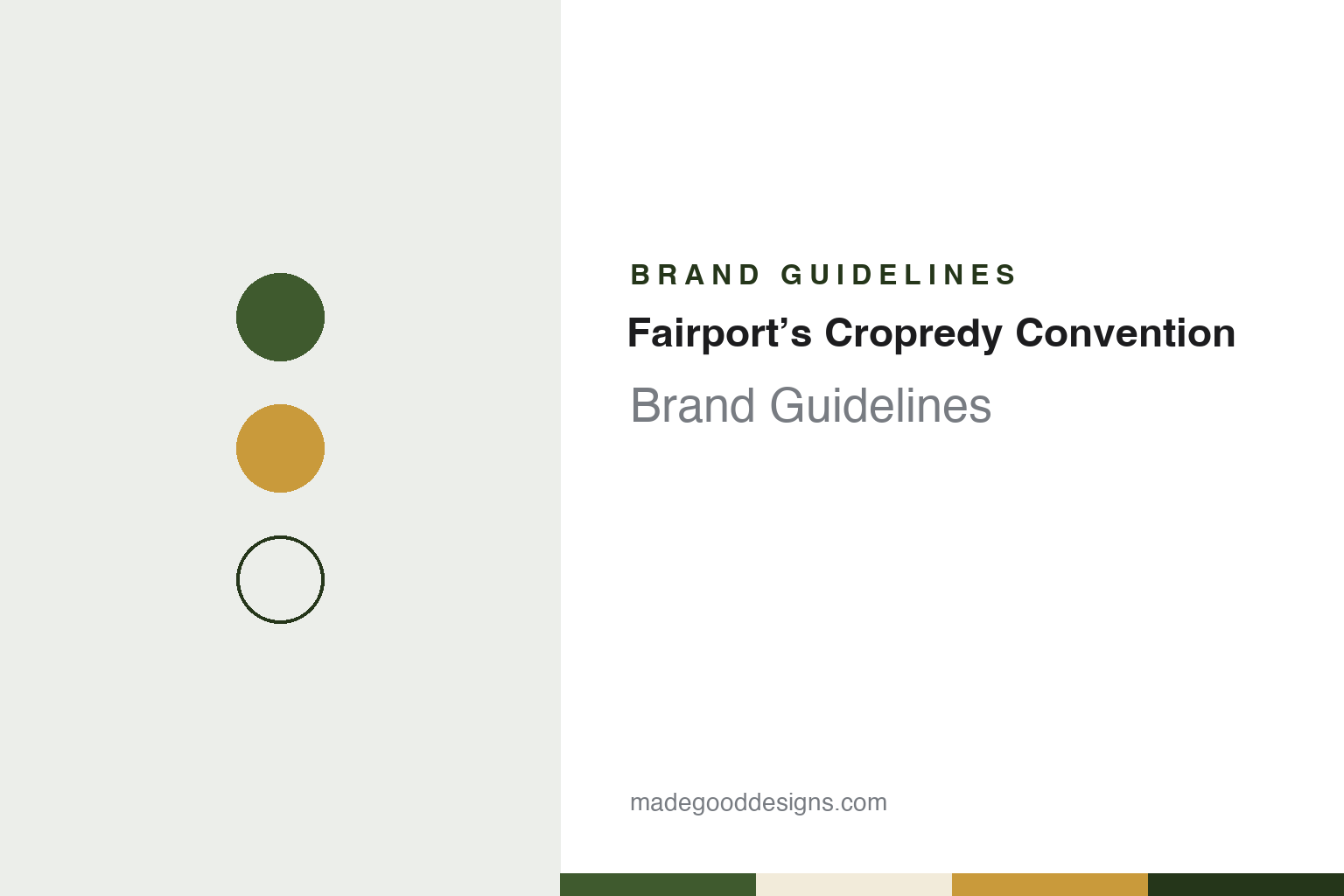
Fairport’s Cropredy Convention Brand Guidelines
A village festival on one stage at the foot of a sloping field.
Aa
Two constants: a field green and harvest gold palette and a Village serif register. Abstract homage — not a Fairport’s Cropredy Convention mark; no logo, poster or programme is reproduced.
From a garden to a field
A village performance that became an annual reunion.
Fairport’s Cropredy Convention takes place every August on farmland at the edge of Cropredy, a village on the River Cherwell about four miles north of Banbury in north Oxfordshire. Its roots go back to 1976. English Wikipedia describes a private performance that July for about 750 people in a village back garden, and The Independent, writing in August 1998, said the event began that summer as a sing-along to raise money for a new village hall.
The performance was repeated and opened to the public in 1977, English Wikipedia says, and in 1978 it moved to a larger site behind the village school. On 4 August 1979 the host band played what was billed as a farewell concert there to around 4,500 people; the band’s own history places it at Peewit Farm on Station Road. A year later it returned for a reunion with friends, and the organisers count 1980 as the opening year of the Cropredy Festival. The host is the folk-rock band Fairport Convention, which opens and closes each year’s programme.
The early years moved around. In 1981, English Wikipedia says, the event was held in the grounds of Broughton Castle, a performance released as the live album Moat on the Ledge in 1982. It came back to Cropredy the following year and has stayed there, although the site has grown. It was a two-day event from 1981 to 1999 and became a three-day event, Thursday to Saturday, from 2000.
The name changed as the event settled. It was known at first simply as the Cropredy reunion, then as the Cropredy Festival, and in 2005 it was retitled Fairport’s Cropredy Convention, according to English Wikipedia. The Independent reported 23,000 people at the 1997 festival.
Colour
A single stage and a sloping field.
The festival is organised by Fairport Convention Ltd. A visitor guide reproduced on the band’s website names the team as the festival director Gareth Williams with Dave Pegg and Simon Nicol, and English Wikipedia gives the same three names. It is held over the second full weekend of August, from Thursday afternoon until midnight on Saturday.
Its layout has stayed simple. There is one stage, set at the lower end of a sloping arena field, so the audience faces downhill towards the music. The organisers’ own history says the festival “has always stuck to the one stage idea,” which means no act plays to a side tent. The visitor guide describes the arena as Field 9, with food and merchandise stalls along each side, a signing tent where performers meet the audience after their sets, and a white semicircle painted on the grass: chairs go behind it, and the space in front of the stage is kept for standing and dancing. English Wikipedia says a live on-stage video screen was added in 2008.
Most of the audience camps. English Wikipedia counts eight camping fields next to the arena, one set aside for families, and the visitor guide says each field is numbered, with a wristband serving as a three-day pass. Some visitors arrive by narrowboat on the Oxford Canal, which runs between the river and the village.
The bill is wider than folk. The organisers’ history calls Cropredy “a music festival” that “could never be pigeon-holed as a folk festival,” and says the programme follows the host band’s own taste. The 2026 edition ran from 13 to 15 August; a review in At The Barrier, published on 17 August 2026, described a Thursday line-up that included Soft Machine, Turin Brakes and the Québécois band Le Vent Du Nord.
English Wikipedia says Sky Arts showed highlights each year from 2010 to 2012. The 2020 and 2021 editions were not held, and a documentary, Summer by The Cherwell, was released in 2020.
Typography
Setting and calendar.
A folk festival rarely has a single building to stand for it. Its identity is carried instead by a place and a date: a seaside town that turns its gardens and promenade into stages for a week, an island whose villages and halls share the programme, a showground or estate field where marquees go up for a long weekend, a cultural village set in a rainforest, or a run of community halls in the cold months. The setting gives the festival its name, and the calendar fixes it in the memory, whether that is the week that takes in the first Monday in August or a bank holiday weekend at the end of summer.
The programme is the second layer. Concert marquees, standing big tops, dance houses, storytelling tents and children’s areas are usually given names of their own, and those names recur in programmes, on site maps and on stage boards year after year. Dance displays and processions take the festival out into the streets, so that teams of morris, sword, rapper or clog dancers become part of the look of the event as much as any printed material.
Print and lettering then travel from one edition to the next. A festival may commission a new poster each year while keeping the same wordmark, or keep a house style while changing its artwork; edition numbers, founding years and the name of the host town often sit beside the title on programmes, wristbands and listings. When a festival changes its name, moves to a new site or passes to a new organiser, these repeated elements are what carry its identity across the change.
The guides in this group look at folk festivals through those elements: where they are held, when they fall in the year, how their sites and stages are named, and how their names and printed matter have been handled over time. The colours and typefaces shown are our own interpretation, not official assets.
Aa
A warm village serif — a festival named for its host band and its village. (Specimen set in Fraunces, a serif STAND-IN; NOT the Fairport’s Cropredy Convention logo.)
Cropredy
A church clock, a bell and a T-shirt.
Much of Cropredy’s identity is carried by ritual rather than graphics. In 2026, At The Barrier reported, the festival opened at 4pm on the second Thursday of August as the village church clock struck the hour, with a short acoustic set by the host band. Its opening song, “Festival Bell,” had been used to start the festival for about fifteen years. English Wikipedia’s article on the village records that two new treble bells were added to the church tower in 2007, and that one of them is named the Fairport Convention Festival Bell.
The printed and worn pieces are just as consistent. The visitor guide on the band’s website describes a pocket-size programme sold at the wristband exchanges, with a signing schedule inside, and a commemorative T-shirt made for each year, which regulars collect. Exits from the arena are marked by illuminated signs, and the fields are numbered rather than named. The giant screen beside the stage carries the signing times during the day.
The village is part of the experience. The Independent reported in 1998 that the local Scout troop helped with litter-picking and traffic, and that a festival service was held at the village church. The visitor guide says the church still hosts a service on the festival Sunday, and that the weekend ends with a cricket match between members of Fairport Convention, their guests and a Cropredy village side at the sports pavilion. Food stalls and breakfasts are run around the village, at the village hall and the primary school as well as on the campsites.
For a design guide, Fairport’s Cropredy Convention shows how a festival can hold its identity through a fixed format — one stage, one field, one weekend — and through objects that change a little every year, like the programme and the T-shirt. Compare Warwick Folk Festival, in neighbouring Warwickshire, which also dates its opening edition to 1980, and Cambridge Folk Festival, another long-running English summer festival. For this guide we use a field green and a harvest gold with a serif, an unofficial interpretation; no product or logo is reproduced.
Explore & save
Keep Fairport’s Cropredy Convention’s identity on hand — save it to a board in the Made Good inspiration library.
Fairport’s Cropredy Convention identity set
Pin the field green and harvest gold palette and the Village serif register to your own board.
Source & notes
Frequently Asked Questions
What font can I use to match the Fairport’s Cropredy Convention look?
This guide describes Fairport’s Cropredy Convention’s type as “A warm village serif — a festival named for its host band and its village”. Its type specimen is set in Fraunces from Google Fonts as a stand-in; Fraunces is not Fairport’s Cropredy Convention’s own lettering.
What colours are in the Fairport’s Cropredy Convention palette?
This guide’s Fairport’s Cropredy Convention palette is Arena green #3F5A2E, Hedgerow #25361A, Harvest gold #C99A3B, Canvas #F2EBDA and Paper #FAF7F0. The tones are the guide’s own unofficial interpretation, not official Fairport’s Cropredy Convention hex codes.
When was Fairport’s Cropredy Convention founded?
Fairport’s Cropredy Convention was founded in 1976 (reunion from 1980), in Cropredy, Oxfordshire.