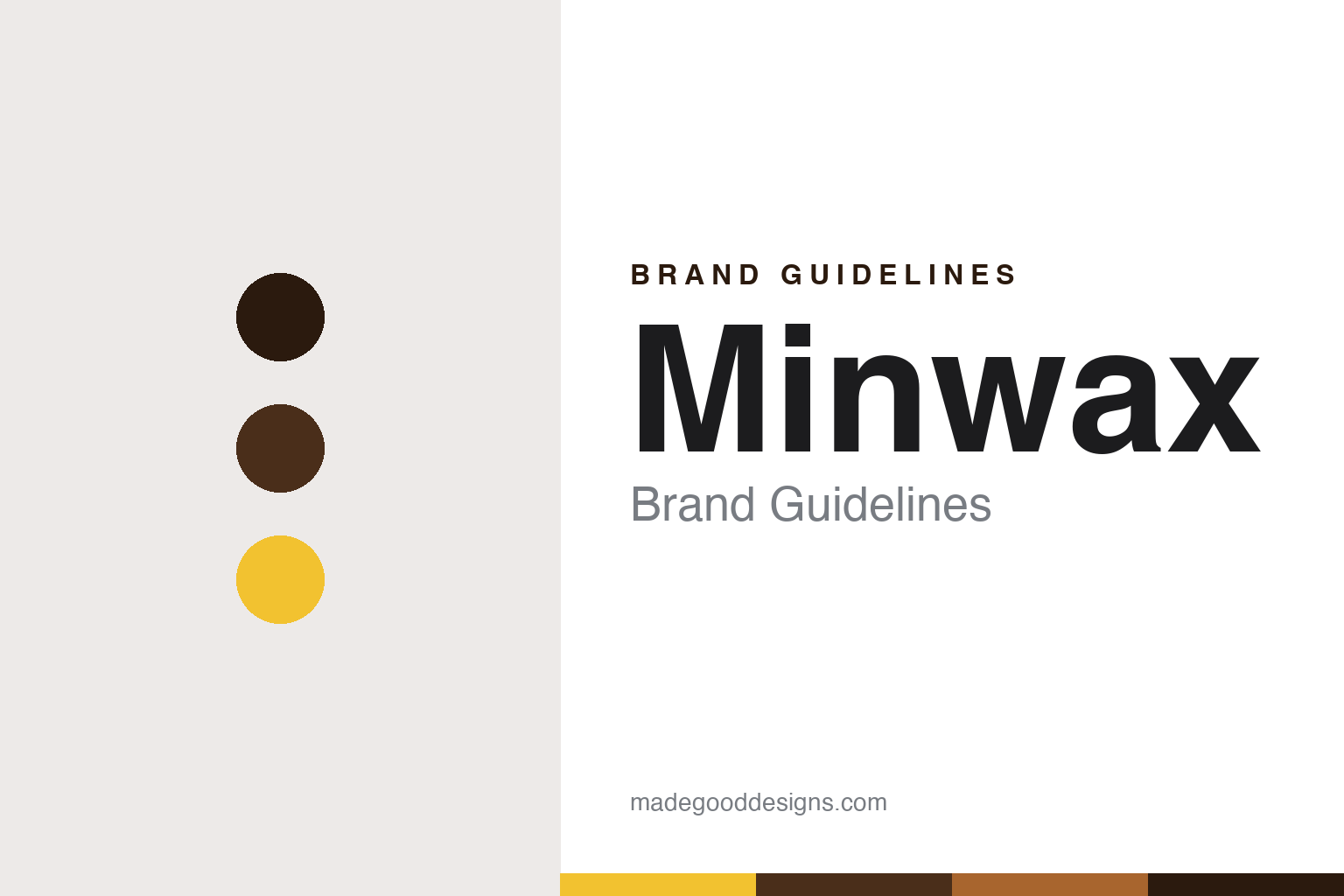
Minwax Brand Guidelines
The Brooklyn waterproofing firm behind the yellow-label wood finish.
Aa
Two constants: a Minwax yellow and wood-tone palette and a condensed sans register. Abstract homage — not a Minwax product or mark; no can, label or logo is reproduced.
Waterproofing first
A plaster maker’s employee and a line of damp-proofing materials.
Minwax began as a waterproofing business, not a wood-finish brand. The company’s own history, headed “The Story Behind the Familiar Yellow Label,” says it was founded in Brooklyn, New York, by Arthur B. Harrison. In 1904, it says, Harrison persuaded his employer, the Clifford I. Miller Company, a plaster manufacturer, that a plant making his waterproofing and damp-resisting materials could pay its way, and Miller agreed. English Wikipedia gives the same founder and year.
According to the company, Harrison bought out the Miller interests in 1910 and incorporated his business under the name Minwax in 1914. By 1916, it says, the firm had moved across the Hudson River to a larger plant in Clifton, New Jersey, and Harrison had become an authority on waterproofing; the company counts membrane waterproofing among his early work. Its early customers, in the company’s telling, were architects and engineers, and it was sometimes asked to waterproof buildings and monuments of historical importance.
The best-known of those jobs, as Minwax tells it, was Cleopatra’s Needle, the Egyptian obelisk in New York’s Central Park. The company says stone was then usually waterproofed by burning paraffin wax into it, which would have blackened the obelisk’s carved surface, so Harrison developed a liquid paraffin formula that could be brushed on instead. Workers on the wooden scaffold, the company says, noticed that drips of the formula made the boards look as if they had been given a paste-wax finish. It dates its brush-on paraffin formula for sealing stone to 1916, and says it was later adapted for wood floors and specified by architects for floors and woodwork in public buildings and homes.
Colour
From architects’ specifications to the homeowner’s shelf.
The turn towards the homeowner came after the Second World War. Minwax says it moved into the consumer market in the late 1940s and early 1950s, and that its Wood Finish was redesigned for home use, with the wax in the formula replaced by varnish gums. The company quotes R. W. Harrison Jr., a grandson of the founder who was president from 1962 to 1978, as saying the growth came from realising it had a product the average person could use successfully. It also quotes a later president, Donald H. Henderson, recalling that the new Wood Finish was first marketed in a low-key way and spread by word of mouth.
From there, the company says, colours were added to the line and companion products followed, until Minwax described itself as a complete wood-finishing products company. English Wikipedia describes the Minwax Company as a maker of architectural coatings such as wood putty and epoxy.
The family business later became part of a larger group. Under the name Thompson Minwax, it was bought by Sherwin-Williams in 1997, according to the Encyclopedia of Cleveland History published by Case Western Reserve University, which places the purchase in a run of acquisitions that began in 1995 and also brought in the paint maker Pratt & Lambert. Sherwin-Williams, which English Wikipedia says dates from 1866 and is based in Cleveland, Ohio, has owned Minwax since 1997.
The buyer had its own long history. English Wikipedia says Sherwin-Williams dates from 1866, when the Cleveland bookkeeper Henry Sherwin invested in a paint distributorship, Truman Dunham & Co., and that after that partnership dissolved in 1870 he formed Sherwin, Williams & Co. with Edward Williams and A. T. Osborn; the company was incorporated in Ohio in 1884. The Encyclopedia of Cleveland History credits John G. Breen, who led Sherwin-Williams for two decades and retired in 1999, as the architect of the growth that brought Thompson Minwax into the group.
Inside Sherwin-Williams, Minwax sits among a long list of consumer brands. English Wikipedia names Minwax alongside Krylon, Thompson’s WaterSeal, Purdy, Dutch Boy, Ronseal and Valspar among the company’s brands. The Minwax website still carries the company name in its copyright line, “Minwax Company,” and gives the brand its own retailer finder, project ideas and product catalogue for retailers.
Typography
Paint sundries and wood finishes.
The brands in this group sell the things that sit around a tin of paint rather than the paint itself: masking tape, brushes, primers, wood stains, clear finishes and spray paint. In a hardware aisle they compete for attention on crowded shelves, so their identities are carried by a few repeated signals — the colour of a roll of tape, the band of colour on a can, a label that customers can find again on the next visit.
Wood-finish brands also have to show colour that is not their own. A stain only makes sense once it is on wood, so swatch cards, sample boards and finished projects often do as much of the visual work as the logo. Tape brands, by contrast, can make the product itself the signature, with one colour of roll standing for the whole name.
Many of these names have changed hands over the years, and the business behind a familiar label may now be part of a much larger coatings group. Each guide sets out who started the brand, who owns it now and how it presents itself, and marks plainly what rests only on the company’s own word.
Aa
A condensed sans for a yellow-label brand. (Specimen set in Oswald, a sans STAND-IN; NOT the Minwax logo.)
Minwax
The familiar yellow label.
The one visual element the company itself names is colour. Its history page is headed “The Story Behind the Familiar Yellow Label,” treating the label as the thing customers recognise before the name. Its website header carries the line “Wood Deserves Minwax,” and its pages invite visitors to get inspired, share projects and find a retailer.
The Minwax story is also a story about continuity of name. The business has moved from Brooklyn to Clifton, from waterproofing stone to finishing wood, and from family control to a Cleveland paint group, yet the name incorporated in 1914 is still the one on the label. The company’s history keeps the founder at its centre, from the Miller partnership to the Cleopatra’s Needle job, and quotes the founder’s grandson on the move to the consumer shelf.
For a design guide, Minwax shows how a single label colour and a plain name can carry a brand through a change of owners and a change of trade. Compare Krylon, another Sherwin-Williams brand, and Varathane, a wood-finish name now owned by RPM. For this guide we use a label yellow with walnut and golden-oak browns and a condensed sans, an unofficial interpretation; no product or logo is reproduced.
Explore & save
Keep Minwax’s identity on hand — save it to a board in the Made Good inspiration library.
Minwax identity set
Pin the Minwax yellow and wood-tone palette and the condensed sans register to your own board.