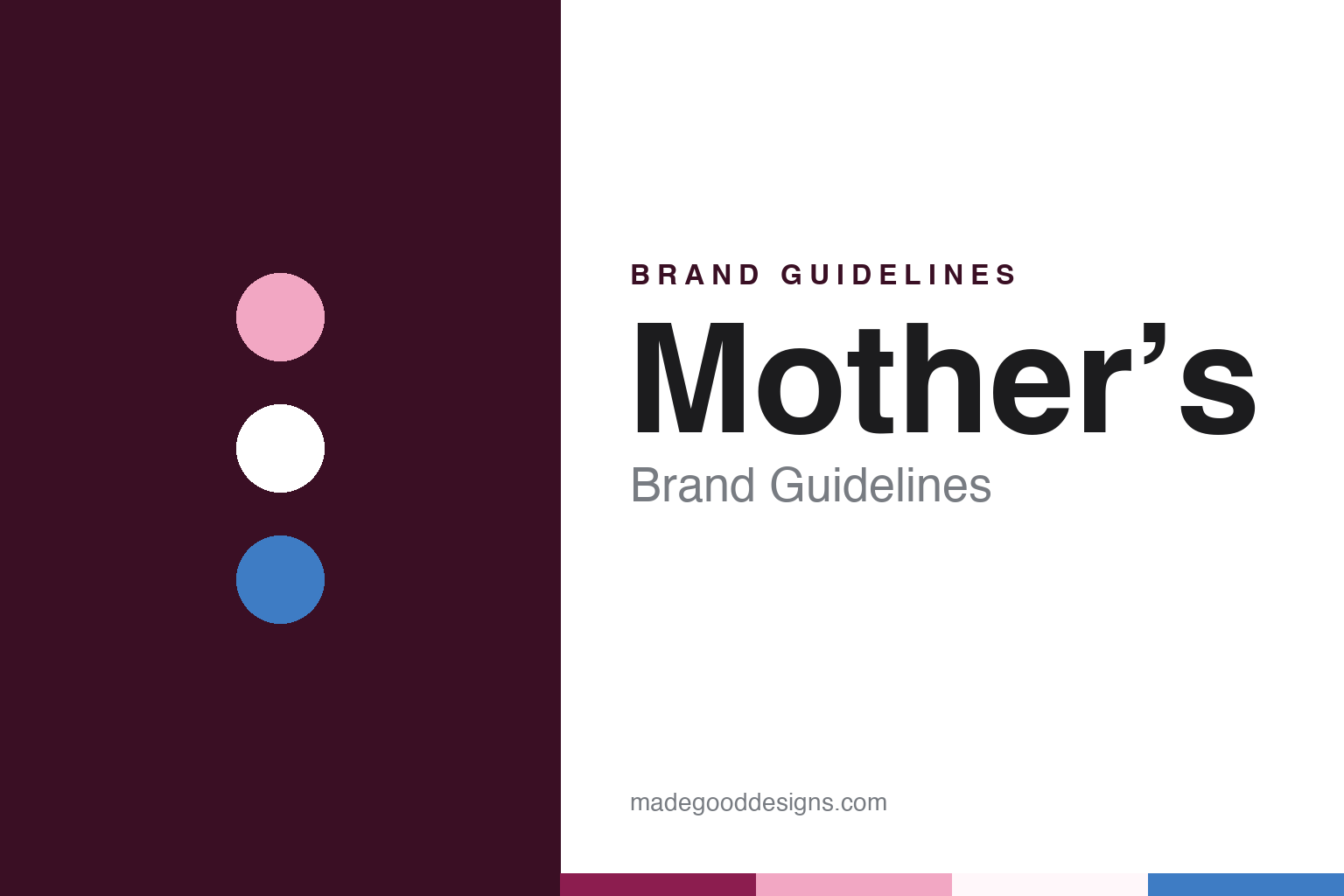
Mother’s Brand Guidelines
An Oakland newspaper stand, a bought recipe and a parade of frosted animals.
Aa
Two constants: a frosting pink, icing white and sprinkle blue palette and a rounded display sans register. Abstract homage — not a Mother’s product or mark; no package, cookie or logo is reproduced.
A newspaper stand in Oakland
A vendor, a customer’s recipe and a holiday that lent the name.
Mother’s is an American cookie brand, sold today in pink-and-white frosted packs under the line “Stop and Taste the Frosting,” and owned by the Ferrero Group. Its story begins in Oakland, California. The brand’s own website says that in 1914 a newspaper vendor named N.M. Wheatley, who ran a stand in the city, bought the recipe for a home-baked cookie from one of his customers. The company says he named the cookies after Mother’s Day, a holiday that had just been created, and that within a year he had sold the stand and was baking in a small bakeshop of his own.
An earlier version of the brand’s history page, preserved by the Internet Archive in July 2021, gives more detail. It names the founder as N.M. (Noah) Wheatley and places his early bakery on 12th Avenue in Oakland. That page says a young woman named Leopoldine helped in the bakery, that the two married, and that they ran the company until their son, Floyd Wheatley, was old enough to take it over. It also says that when the bakery needed more space it moved to 18th Street, and that the Wheatleys sold their home, and even their piano, to pay for the move.
Independent reporting covers the same beginnings in plainer terms. The San Francisco Chronicle reported on 4 April 2006 that, according to industry lore, newspaper vendor N.M. Wheatley started Mother’s Cookies in 1914 as a small shop, and that the business later expanded and moved into a plant on 81st Avenue in Oakland in 1949. The paper’s reporter George Raine repeated the 1914 date and the 1949 move on 9 October 2008. An Oakland city business-development official quoted in the 2006 article said the company had been in the city since 1914 and had employed members of families across different generations.
For much of the twentieth century Mother’s was a West Coast name. Kellogg, announcing its purchase of the brand in December 2008, described Mother’s as a regional brand with a loyal following in the Western United States. The brand’s 2021 history page lists some of the ways it reached that audience: a promotion that put baseball player cards into the hands of fans at games, and television commercials in the early 1980s in which real company employees sang and danced while baking.
Colour
Artal, Specialty Foods, Parmalat, Catterton, Kellogg and Ferrero.
The Wheatley bakery passed through a series of corporate owners from the 1990s onward. The San Francisco Chronicle reported in April 2006 that by 1991 the Mother’s brand, though still baked in Oakland, belonged to a Belgian company, Artal B.V., and that by the late 1990s it was owned by Specialty Foods Corp. of Illinois. In 2000, the paper said, Specialty sold Mother’s together with another cookie brand, Archway, to the Italian firm Parmalat Finanziaria. The Chronicle’s October 2008 report added that Parmalat sold the combined business in 2005 to Catterton Partners, a private-equity firm in Greenwich, Connecticut.
Under that ownership the bakery left its home city. The Chronicle reported on 4 April 2006 that the company, by then run as Archway & Mother’s Cookie Co. from Battle Creek, Michigan, would close its Oakland bakery and distribution site at the end of May 2006 and shift the work to bakeries in Ashland, Ohio, and Kitchener, Ontario. The paper quoted a company statement calling the closure a challenging decision taken to secure the future of the Archway and Mother’s brands. On 9 October 2008 the Chronicle reported that the company had ceased operations and filed for Chapter 11 bankruptcy protection in Delaware.
The name did not disappear. Kellogg Company, which is based in Battle Creek, announced on 3 December 2008 that it was acquiring the trademarks and recipes of Mother’s Cake & Cookie Co., and said it had not bought any other assets. The release said Kellogg planned to reintroduce many of the brand’s popular cookies, listed iced animal crackers, sandwich cookies and wire-cut cookies among its lines, and placed Mother’s in its snacks unit beside Keebler’s cookie brands. The brand’s 2021 history page says the cookies returned to shelves a year after the closure.
Kellogg kept Mother’s for a decade. Ferrero announced on 1 April 2019 that it would buy Kellogg’s cookie, fruit-snack, ice-cream-cone and pie-crust businesses, and the Associated Press, in a report carried by the San Francisco Chronicle that day, said the sale included the Mother’s and Famous Amos brands alongside Keebler. Food Business News reported on 29 July 2019 that the Ferrero Group had completed the acquisition, with a portfolio including Keebler, Famous Amos, Mother’s and Murray cookies. The Ferrero Group has owned Mother’s since 2019, and the brand’s current website carries a Ferrero Group copyright line.
Typography
Design and documentation.
The brands in this group sell chips, pretzels, jerky and cookies, and snack brands in general sit at many different points in the trade, from family companies that still carry a founder’s name to labels that now belong to much larger food groups, and a single name can be sold everywhere from a petrol-station counter to a supermarket aisle.
A snack brand’s identity is usually carried less by any single product than by a bag, a pack and a name, because the company behind the name may have changed hands, moved its baking or frying to another plant, or grown far beyond the town where it started. A chip bag, a jerky pack or a cookie package sits on a crowded shelf, and each guide looks at the colours, lettering and characters a brand uses there. That makes the questions behind each name worth asking plainly: who started it, who owns it now, and where its snacks are actually made.
Each guide separates what independent sources record from what the company says about itself — its founding story, its owners over time, where its products are made and how its packaging has changed — and marks plainly what rests only on the company’s own word.
Aa
A rounded, friendly display sans — the lunchbox register of a frosted children’s cookie. (Specimen set in Fredoka, a rounded display STAND-IN; NOT the Mother’s logo.)
Pink frosting, white frosting and a parade of animals
Circus animals, mythical creatures, dinosaurs and a tagline about frosting.
The product that carries the brand’s identity is a small shortbread animal coated in coloured frosting. The San Francisco Chronicle’s April 2019 report described Mother’s as known for its iced white-and-pink circus animal cookies, a staple of many a childhood lunch box. The brand’s own website now calls them Mother’s Original Circus Animal Cookies and describes pink and white frosting dotted with rainbow sprinkles, with camels, elephants, lions and rhinos among the shapes.
The current website builds its visual language around those animals. Its “About” page tells a short fable about a land of cookie creatures coated in frosting by an erupting “frosting volcano,” and then introduces each shape as a character: an elephant at the carnival ring toss, a camel offering rides, a rhino that gets wild at playtime, a cow, a lion, a bison and a pig. Later lines extend the same idea. The website shows Mythical Creatures cookies with lavender and white frosting and silver sprinkles, in the shapes of dragons, mermaids, unicorns and sea serpents, and Dynamite Dinosaurs, a chocolatey cookie in dinosaur shapes. It also shows a collaboration with NERDS candy, with red and blue frosted cookies topped with the candy, and a limited autumn batch of cat and bat shapes.
The words on the pack have changed with the owners. The 2021 history page, published under Ferrero, carried the tagline “There’s a memory in every bite.” The current site uses the line “Stop and Taste the Frosting” and speaks to parents about making time for children to play, with copy such as “Clear their schedule. It’s cookie time!” The brand name itself still refers back to the 1914 holiday that the company says inspired it.
Kellogg’s 2008 release gives a sense of what the brand covered when it changed hands: iced animal crackers, sandwich cookies and wire-cut cookies. The brand’s 2021 history page shows that the company also marked its past with promotions, including the baseball cards it handed out at games, and with television commercials that used its own bakers as performers in the early 1980s.
For a design guide, Mother’s shows how a single colour pairing, pink and white frosting, can hold a brand together through a change of city, a closure and two new owners, while the animal shapes grow into a cast of characters. Compare it with Famous Amos and Keebler, two cookie brands that moved from Kellogg to Ferrero in the same 2019 sale. For this guide we use frosting pink, icing white, sprinkle blue and berry with a rounded sans, an unofficial interpretation; no product or logo is reproduced.
Explore & save
Keep Mother’s’s identity on hand — save it to a board in the Made Good inspiration library.
Mother’s identity set
Pin the Mother’s frosting pink, icing white and sprinkle blue palette and the rounded display sans register to your own board.