Green Mountain Coffee Roasters Brand Guidelines
A ski-country roaster in Waitsfield, a Waterbury head office and a pod machine.
Aa
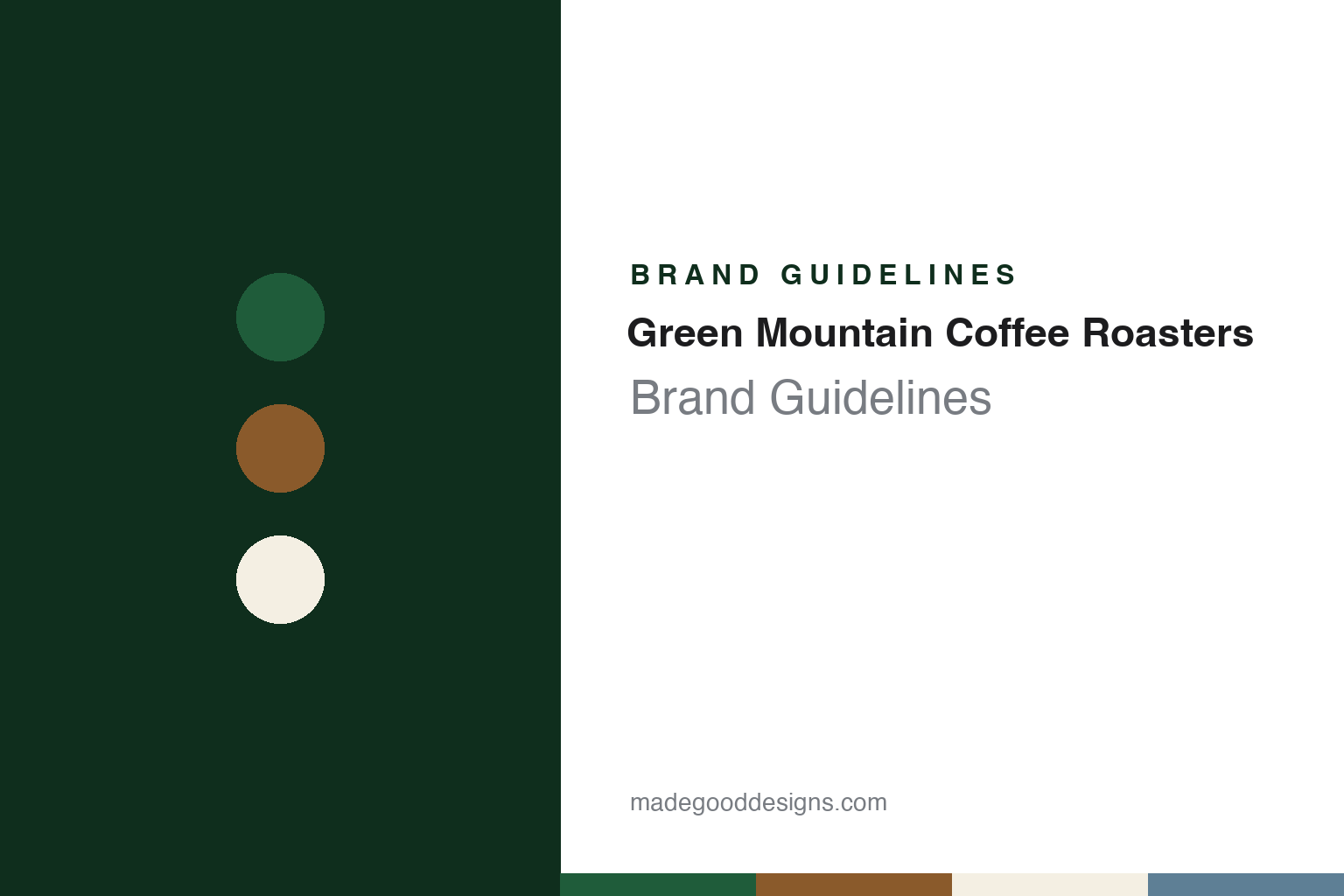
Two constants: a mountain green, roast brown and bag cream palette and a soft display serif register. Abstract homage — not a Green Mountain Coffee Roasters product or mark; no bag, pod or logo is reproduced.
A roaster in the Mad River Valley
A Waitsfield coffee store, a ski condo at Sugarbush and a popcorn popper.
Green Mountain Coffee Roasters is a Vermont coffee brand sold as bagged coffee and as single-serve pods, and today it belongs to Keurig Dr Pepper. Its story begins in Waitsfield, a small town in Vermont’s ski country. English Wikipedia says the business started in November 1979 as a small coffee business owned by Doug and Jamie Baine in Waitsfield, citing a Burlington Free Press article of January 1980. The International Directory of Company Histories, in an entry by Frederick C. Ingram published in 2000, describes Green Mountain as a small specialty store begun in 1981 that sold to the public and to a few restaurants, and records the company as incorporated in 1981 as Green Mountain Coffee Roasters, Inc.
The owner who built the company came from outside the coffee trade. Forbes, in a profile by Luisa Kroll published on 29 October 2001, says Robert “Bob” Stiller had built a rolling-paper brand, E-Z Wider, which he and a partner sold in 1980. Afterwards, the magazine says, Stiller was staying at his ski condo at Sugarbush, wondering what to do next, when he enjoyed a cup of coffee at a restaurant. A couple of days later he visited the small roaster in Waitsfield that supplied the restaurant’s beans.
Forbes says Stiller spent the following months roasting beans of his own, at one point with a hot-air popcorn popper and at another on a cookie sheet, and brewing batches for friends. He then bought the Waitsfield store with a partner, giving the store’s owner an equal share in Green Mountain, and within two years he had bought out both partners to become the sole proprietor. The International Directory of Company Histories tells the purchase more briefly: Stiller bought out the owners, a couple who then went to Florida to start another coffee business.
Forbes describes the early years as hard going, with Stiller working from an office over a movie theater. He added retail stores in Vermont and Maine, insisting on roasting arabica beans and, unable to afford advertising, giving away samples at wine and food festivals and to groups such as the Cub Scouts and the Ronald McDonald House. The company history says Green Mountain was making money by 1985, that advertising in gourmet magazines helped build a mail-order business, and that Stiller persuaded a doubtful convenience-store owner to sell his coffee across the street from a Dunkin’ Donuts. It also records a computerized roaster installed at the company’s store in Winooski, Vermont.
Growth then turned the store into a listed company. According to the International Directory of Company Histories, a holding company, Green Mountain Coffee, Inc., was formed and an initial public offering was completed in September 1993, and in December of that year the company opened a store in Waterbury, Vermont. It began exporting to Canada and Taiwan in 1994, and in March 1997 its shares moved to the Nasdaq National Market. Forbes placed the company’s headquarters in Waterbury in 2001.
Colour
Offices, a brewer maker, a new name and a chain of owners.
In the late 1990s the company pushed its coffee into offices and away from its own cafés. The International Directory of Company Histories says Green Mountain struck a deal with the office-supplies retailer Staples in May 1997, putting its coffee in Staples superstores and in the Staples mail-order catalogue, and in September 1997 teamed with Poland Spring, whose delivery network brought Green Mountain Coffee to offices in the Northeast. In May 1998, the history says, the company announced plans to leave retail entirely, keeping its mail-order business and adding secure ordering to its website that year.
The partnership that would define the company was already in place by 2001. In the Forbes profile of that year, Nick G. Lazaris is quoted as chief executive of Keurig, described as a maker of coffee-brewing machines and a partner of Green Mountain. The Boston Business Journal reported in June 2006 that Green Mountain Coffee had completed its purchase of Keurig, a company in Wakefield, Massachusetts, that had developed single-cup brewing systems for homes and offices. Keurig would remain in Wakefield, the paper said, as a wholly owned subsidiary of Green Mountain Coffee, which was based in Waterbury.
The brewer business eventually gave the parent company its name. USA Today reported on 10 March 2014 that Green Mountain Coffee Roasters Inc. had changed its name to Keurig Green Mountain, after shareholders approved the change at the annual meeting, while its stock symbol, GMCR, stayed the same. Chief executive Brian Kelley said in a statement that the new name better reflected who the company was. CNNMoney reported on 7 December 2015 that Keurig Green Mountain had agreed to be acquired by an investor group led by JAB Holding, joining Peet’s Coffee & Tea, Stumptown Coffee Roasters and Caribou Coffee in JAB’s portfolio.
The present owner took shape in 2018. A release carried by BevNET in July 2018 announced that the merger of Keurig Green Mountain and Dr Pepper Snapple Group was complete, that shares in Keurig Dr Pepper would begin trading on the New York Stock Exchange on 10 July 2018, and that the company would keep dual headquarters in Burlington, Massachusetts, and Plano, Texas. The same release listed Green Mountain Coffee Roasters among the company’s key brands, alongside Keurig, Dr Pepper and Canada Dry. Keurig Dr Pepper has owned the brand since that merger.
The group added another coffee business in 2026. CNN reported on 25 August 2025 that Keurig Dr Pepper would acquire JDE Peet’s, whose brands include Douwe Egberts, Kenco and Peet’s Coffee, and that it then aimed to separate into two listed businesses, provisionally called Beverage Co. and Global Coffee Co. The law firm Cleary Gottlieb, which advised Keurig Dr Pepper on antitrust aspects of the deal, said in a note dated 2 April 2026 that the acquisition had closed on 1 April 2026.
Typography
Design and documentation.
The brands in this group sit on a familiar run of grocery shelves: the boxed side dish and meal helper, the bag of flour and the bag or pod of coffee. Each of these packs is bought quickly and often, and each has to say what is inside, how to use it and whose name stands behind it within a few seconds at the shelf.
A boxed mix carries its identity on a printed carton, usually with a photograph of the finished dish and short instructions on the back. A flour bag is mostly plain paper or film, so its name, colour and type of flour do much of the work. A coffee bag, can or pod carries its name alongside the roast and the grind, and the same mark may also appear on a café sign or a brewing machine.
The names behind these packs have often changed hands. Each guide therefore separates what independent, dated sources record from what the company says about itself — its founding story, its owners over time, where its products are made and how its packaging has changed — and marks plainly what rests only on the company’s own word.
Aa
A soft, warm display serif — the country-store register of a Vermont roaster. (Specimen set in Fraunces, a display serif STAND-IN; NOT the Green Mountain Coffee Roasters logo.)
Green Mountain time
A Vermont promise, a commuter mascot, a bag line and a 2008 packaging reset.
The brand has long tied its identity to its home state. A company statement reprinted in the International Directory of Company Histories in 2000 placed the home of Green Mountain Coffee Roasters “in the beautiful mountains of Vermont,” where, it said, time is measured more by the change in seasons than by a clock. The same statement said the company buys coffee from around the world, roasts it in small batches and vacuum packages it, and closed with a line about taking its time. Those are the company’s own words rather than an independent description of how its coffee is made.
That idea of slowing down reached the packaging in the late 1990s. The company history says that when Green Mountain struck its deal with Staples in 1997 it revamped its packaging, inviting buyers to “Sip and relax — you’re on Green Mountain time.” The same history records two characters from the company’s promotion in the early 1990s. One was “The Green Mountain Coffee Buster,” who became something of a local celebrity by serving rush-hour Boston commuters cups of coffee in seconds. The other was “Dr. Trash,” a figure the company sponsored to speak to children in Vermont.
A fuller reset came in 2008. Food Ingredients First reported on 29 August 2008 that Green Mountain Coffee, then the coffee division of Green Mountain Coffee Roasters, Inc., had unveiled new packaging for its bagged coffees, including its Signature, Fair Trade Organic, Flavored and Seasonal lines. The report said the work completed a packaging makeover that had begun with the Newman’s Own Organics and Single Origin lines, and that the new bags would reach shelves in late August.
The 2008 design, the report said, used a vibrant palette of line-specific colours and illustrations to tell one line of coffee from another, together with clearer labelling of roast level, grind type, certifications and decaf options. The redesign came with an updated logo. Susan Cote, director of brand marketing at Green Mountain Coffee, said the team had used a collaborative approach, listening to consumers, wholesale customers, the sales team and the manufacturing group, and that the new bags gave the coffee a strong visual presence on the shelf.
The company’s later history moved the name onto a second kind of pack. By 2014, USA Today described the business as known for its single-serve coffee makers, and the parent company took the Keurig name that year; in 2018 the Keurig Dr Pepper release named Green Mountain Coffee Roasters and Keurig side by side among its key brands.
For a design guide, Green Mountain Coffee Roasters shows how a brand built on a sense of place, a Vermont store and the phrase “Green Mountain time,” can keep that name through a listing, a brewer acquisition and a chain of corporate owners. Compare it with Dr Pepper, the soft drink it has shared an owner with since 2018, and Douwe Egberts, a coffee brand that joined the same group in 2026. For this guide we use mountain green, roast brown, bag cream and valley slate with a serif, an unofficial interpretation; no product or logo is reproduced.
Explore & save
Keep Green Mountain Coffee Roasters’s identity on hand — save it to a board in the Made Good inspiration library.
Green Mountain Coffee Roasters identity set
Pin the Green Mountain Coffee Roasters mountain green, roast brown and bag cream palette and the soft display serif register to your own board.