Dr Pepper Brand Guidelines
Older than Coca-Cola, invented by a Texas pharmacist — and a clock that told you exactly when to drink it.
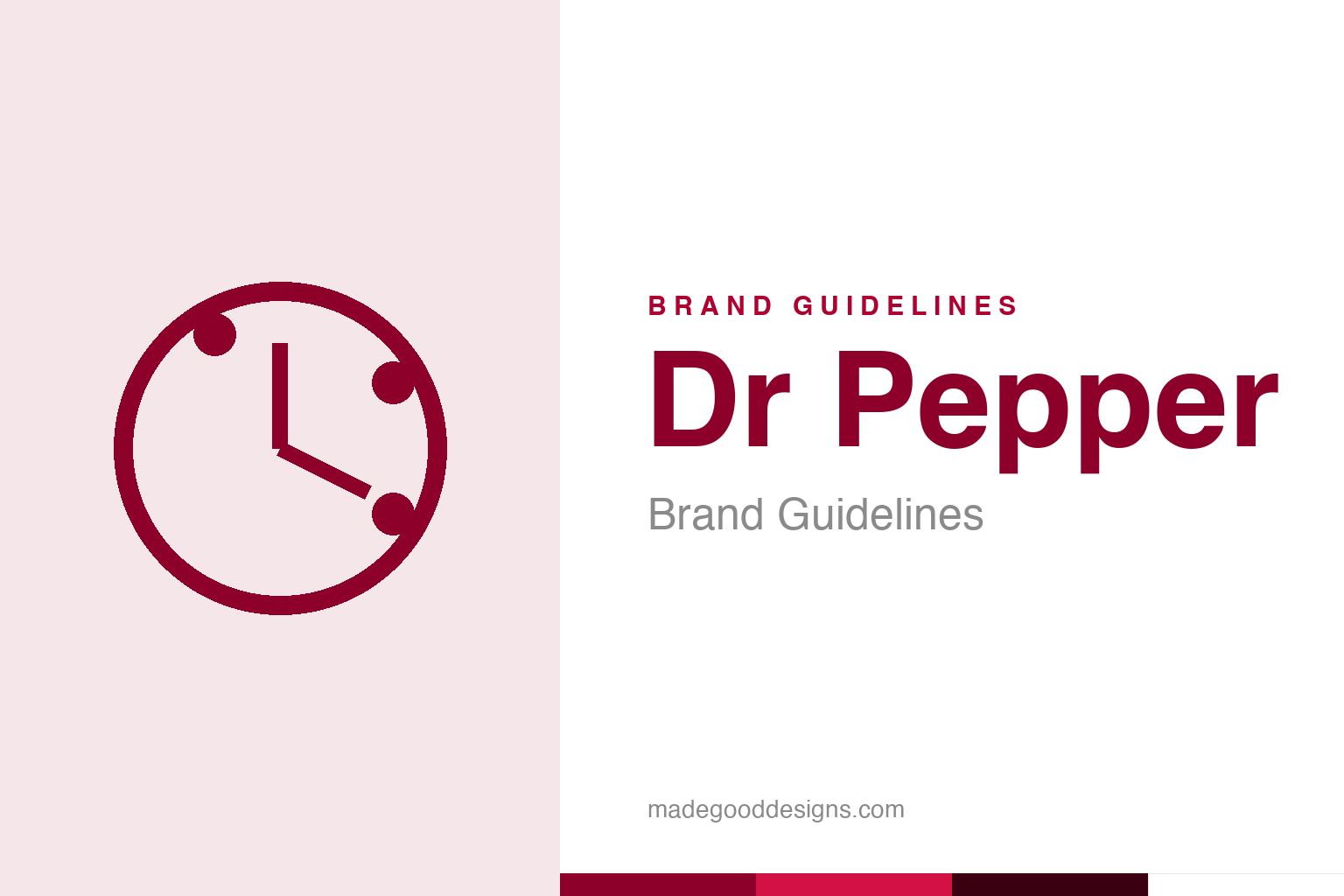
An abstract 10-2-4 clock — the campaign idea, not the script. Deliberately not the Dr Pepper mark.
Older than Coke
Dr Pepper is America’s oldest major soft drink.
Dr Pepper has a heritage claim most soft drinks would kill for: it was created in 1885 in Waco, Texas, by a pharmacist named Charles Alderton at Morrison’s Old Corner Drug Store — which makes it older than Coca-Cola (1886), and it’s often called the oldest major soft drink brand in the United States. That’s a powerful piece of authentic heritage. Like Coke, Dr Pepper was born as a pharmacy soda-fountain drink in the great age of American patent medicines and fizzy tonics; the “Dr” in the name (reportedly after a friend of the drugstore’s owner, Wade Morrison) gives it that quasi-medicinal, turn-of-the-century flavour. Being the oldest is a genuine, ownable distinction, and it anchors the brand in real American history. Our homage nods to the famous 10-2-4 campaign, not the wordmark.
The 10, 2 and 4 o’clock drink
Dr Pepper’s cleverest campaign put it on the clock.
Dr Pepper’s most distinctive branding device is the “10-2-4” — a clock face marking 10, 2 and 4 o’clock, from the 1920s–30s campaign “Drink a Bite to Eat at 10, 2 and 4.” The idea was to sell Dr Pepper as an energy pick-me-up at those three points in the day when people supposedly flag. It was tied to a “scientific” claim about mid-morning and afternoon energy dips — though it’s worth flagging that the pseudo-scientific rationale (blood-sugar lows at 10:30, 2:30, 4:30) was marketing lore, not established physiology. Regardless, it was a brilliant piece of occasion-based branding (much like KitKat’s “break”): it gave people specific times to drink the product, weaving Dr Pepper into the daily routine. The 10-2-4 clock became an iconic, long-lived part of the brand’s visual identity.
A distinctive taste, distinctively branded
Dr Pepper leans into being unlike the colas.
Part of Dr Pepper’s identity is its famously hard-to-describe flavour — a complex blend (marketed as “23 flavours”) that’s unlike the straightforward cola taste of Coke or Pepsi. The brand embraces that uniqueness as a selling point: it’s the drink for people who want something different, a little unconventional, not-a-cola. Its rich maroon/deep-red colour scheme and distinctive script logo set it apart visually from the bright reds of the cola giants, reinforcing that “one of a kind” positioning. It’s smart strategy for a challenger brand in a category dominated by two enormous rivals: rather than trying to out-cola the colas, Dr Pepper owns being the characterful, distinctive alternative — and its darker, richer palette signals exactly that.
Heritage plus distinctiveness
Dr Pepper’s identity marries age with individuality.
Dr Pepper’s branding works because it combines two strong assets: genuine heritage (the oldest major soft drink, a real 1885 pharmacy origin) and clear distinctiveness (a unique flavour, a maroon palette, the memorable 10-2-4 device). That’s a potent pairing — age gives it credibility and roots, while individuality keeps it from being just another old brand blending into the background.
The lesson is that a challenger brand facing dominant competitors is often best served not by imitation but by leaning into what makes it different — and by mining its own history for authentic, ownable stories. Dr Pepper has always known it will never out-spend or out-scale Coca-Cola and Pepsi, so it has instead built an identity around being the original and the unconventional: the drink that came first, tastes like nothing else, and once told you exactly when to enjoy it. The 10-2-4 clock, the maroon, the pharmacy-origin story, the “23 flavours” mystique — all of it reinforces a single confident message: Dr Pepper isn’t trying to be a cola, it’s trying to be Dr Pepper, and it has been, distinctively, since 1885. In a two-horse category, owning your own lane is the smartest move there is.
Type & the wordmark
A bold script in deep maroon.
The Dr Pepper wordmark is a bold, characterful script — a distinctive logotype in deep maroon/red. The specimen below stands in with a strong italic serif (not the Dr Pepper script).
Always one of a kind
Bold, characterful, distinctive — a script that refuses to look like a cola. (Specimen set in italic Newsreader, a neutral stand-in.)
Maroon & red
A rich maroon, distinct from the colas. Click a swatch to copy the hex.
Dr Pepper leans on a rich maroon #8C002A with a brighter red #D31145, over white — darker and more distinctive than the cola reds. Lead with the maroon below.
Explore & save
Keep the 10-2-4 idea on hand — save the clock homage and the maroon to a board.
Dr Pepper identity set
Pin the 10-2-4 clock homage, the maroon palette and the oldest-soft-drink story to your own board.