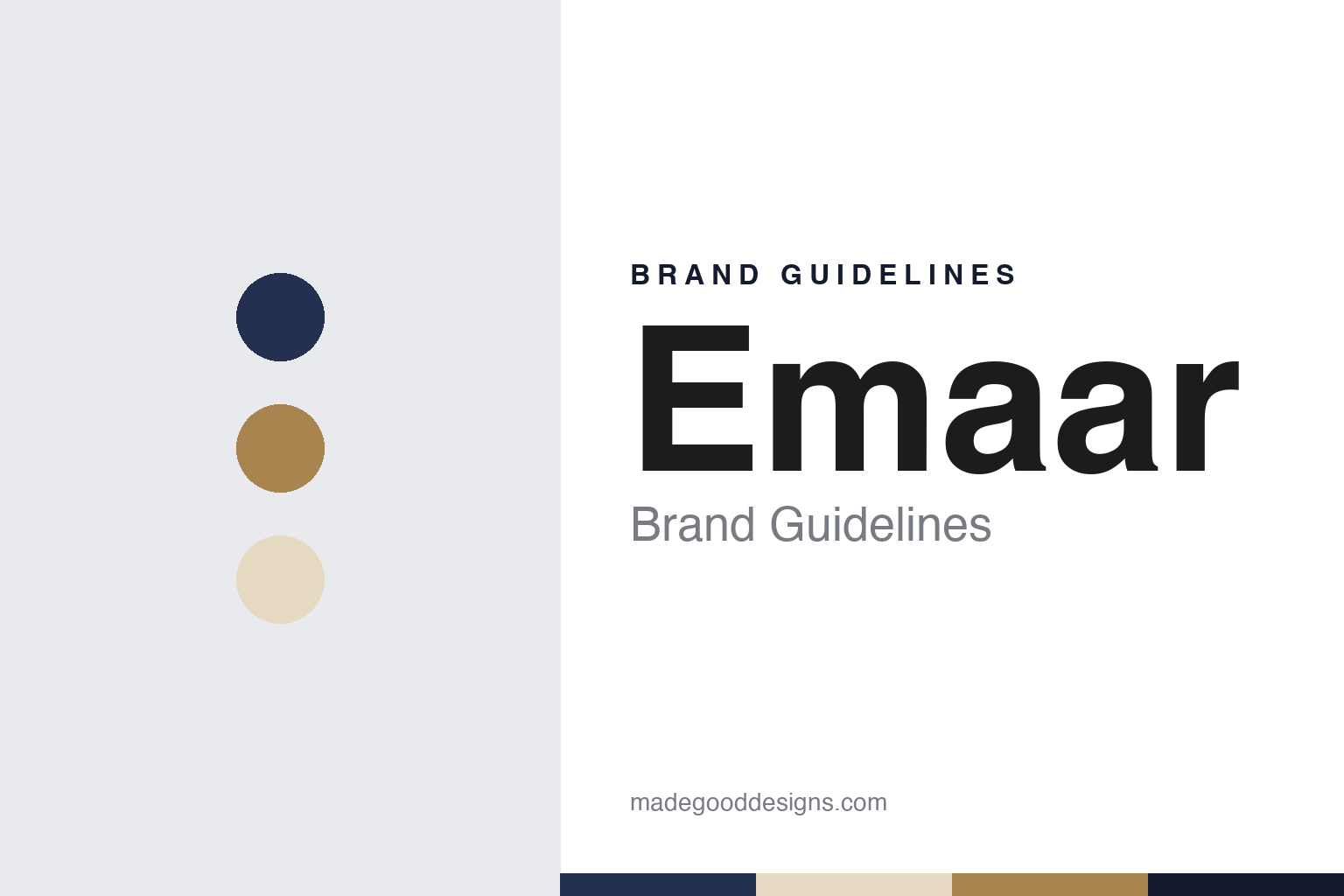
Emaar Brand Guidelines
The Dubai developer behind Burj Khalifa, Dubai Mall and Downtown Dubai.
Aa
Two constants: a night navy, desert gold and warm sand palette and a geometric sans register. Abstract homage — not an Emaar asset or mark; no building, logo or wordmark is reproduced.
A 1997 Dubai Company
From a listing in 2000 to Downtown Dubai.
Emaar Properties was founded and incorporated in Dubai in 1997 by Mohamed Alabbar, then its chairman, according to Wikipedia. Its shares were listed on the Dubai Financial Market in 2000, and Wikipedia says it became the first property company to offer shares to foreign nationals. The company still trades as Emaar Properties PJSC, a public joint-stock company listed on that exchange, and its website presents Mohamed Alabbar as its founder, with a founder’s message on the about page. Wikipedia records that he stepped down as chairman in December 2020 while continuing to oversee day-to-day activities as managing director.
The early projects were residential. Wikipedia says Emaar announced plans to build Dubai Marina in its first years as a listed company and went on to develop neighbourhoods including Arabian Ranches, The Greens, The Meadows and The Springs. In 2003 it revealed the plan for what became Downtown Dubai, built around two projects: a tower and a mall. Emaar International was set up in 2004 to take the company into foreign markets.
The tower is Burj Khalifa. Designed by Skidmore, Owings & Merrill, it was begun in 2004 and opened in 2010 as the centrepiece of Downtown Dubai. Wikipedia describes it as the tallest building in the world and says it was called Burj Dubai until its inauguration, when it was renamed after the UAE’s then president, Sheikh Khalifa bin Zayed Al Nahyan. Wikipedia traces its design to the Islamic architecture of the region and describes a Y-shaped, three-part floor plan. In 2014 Emaar opened an observation deck, At the Top Burj Khalifa SKY, on the 148th floor.
The mall is Dubai Mall, which had a soft opening in November 2008 and was inaugurated in May 2009, Wikipedia says; the Dubai Fountain beside it began operating in the spring of 2009. In October 2014 Emaar listed its malls and retail business separately on the Dubai Financial Market as Emaar Malls Group. The company’s website now names Burj Khalifa, Dubai Mall and Dubai Fountain among its “trophy destinations.”
Colour
Communities, malls, hotels and work abroad.
Emaar describes itself today as a company with businesses in real estate, retail and shopping malls, hospitality and leisure. Its website groups them as Emaar Hospitality, Emaar Malls, Burj Khalifa and Emaar Entertainment, and lists ten communities across the UAE, among them Downtown Dubai, Dubai Creek Harbour, Dubai Hills Estate and Emaar Beachfront. Its residential development arm, Emaar Development, has been listed separately on the Dubai Financial Market since November 2017, according to the company.
Downtown Dubai kept growing after the tower opened. Wikipedia lists residential towers launched there in 2013, including Burj Vista and Boulevard Point, and an Opera District whose centrepiece, Dubai Opera, it calls the country’s first dedicated opera house. In January 2015 Emaar Hospitality opened Manzil Downtown Dubai, a 200-room hotel managed by Vida Hotels and Resorts, Wikipedia says.
Abroad, the company works through subsidiaries and partners. Wikipedia records projects in Egypt, where Emaar Misr began the Uptown Cairo development in 2005 and the Marassi resort on the Mediterranean coast in 2008; in India, through a 2005 joint venture with MGF Developments that Emaar announced in 2016 it would split; in Turkey, where the Emaar Square mall in Istanbul opened in 2017; and in Saudi Arabia, where Emaar, The Economic City, listed on the Saudi exchange, develops King Abdullah Economic City. The company’s website also links to its sites for Pakistan, Morocco and Lebanon.
Not every venture lasted. John Laing Homes, a US homebuilder that Emaar had bought, filed for Chapter 11 bankruptcy in the United States in 2009, Wikipedia says. Closer to home, Emaar was ranked 19th on the Forbes Middle East list of the region’s top 100 listed companies for 2025.
Typography
Developers and their documents.
Property developers in Asia and the Gulf sell places more than products, and their identities are built to be read at the scale of a city. The material to compare is public: corporate websites, project microsites, investor pages and the annual and sustainability reports that listed developers publish each year. In those pages, look at how much work the photography does — towers at dusk, harbour and skyline views, architects’ renderings labelled “artist’s impression”, as on Henderson Land’s brand site — and at how the corporate wordmark, in navy, green, gold or black, is placed against it.
Names are part of the design. Hong Kong developers present themselves in English and Chinese, with short forms that differ between the two languages; Henderson Land, for example, is 恒基兆業地產 in full and 恒地 for short, according to Chinese Wikipedia. In the Gulf the pairing to watch is English and Arabic; in the Philippines, English and Filipino. Hotels, malls and residential estates usually carry names of their own, so a group such as CK Asset sits behind a family of hotel names rather than putting its own name on every door.
The structure of a developer’s website is a portrait of the business. Pages are commonly divided by residential, office, retail and hotel portfolios, by city or country, and by projects for sale, for lease, under construction and completed. Landmark malls and mixed-use districts get their own sites and campaigns, and the newest schemes, such as Henderson Land’s Central Yards on the Hong Kong harbourfront, are introduced with long lists of named architects and landscape designers.
Sustainability is now a standard chapter. Developers name their programmes, publish environmental, social and governance reports beside their annual results, and use shorthand such as Henderson Land’s G.I.V.E. to make a strategy memorable. This guide sets out what can be checked about each company — who founded it, who controls it and what it builds — and marks clearly what rests only on the company’s own word.
Aa
A clean geometric sans for a skyline brand. (Specimen set in Jost, a sans STAND-IN; NOT the Emaar logo.)
Emaar in 2026
A new top shareholder and a pending buyout.
Emaar’s shareholder register changed in 2026. On 12 May 2026 Dubai Holding and the Investment Corporation of Dubai announced that Dubai Holding had completed the purchase of a 22.27% stake in Emaar Properties from the Investment Corporation of Dubai, taking its holding to 29.73% and making it the company’s largest shareholder. The announcement describes Emaar as one of the largest real estate developers in the Middle East, with residential, commercial, hospitality and retail assets.
A second change is pending. In November 2026 Emaar Properties announced a voluntary cash offer for the shares of Emaar Development that it did not already hold, and said it planned to take the unit off the Dubai Financial Market. Reuters reported that Emaar owned just over 79% of Emaar Development, with about 1% more held by a subsidiary. The company said the deal would allow it to manage the domestic development business “on a fully integrated basis within the wider group,” The National reported on 5 November. The offer opened on 6 November and is due to close on 10 December 2026 unless extended; it was announced in November 2026 and had not completed at the time of writing.
Emaar’s website carries the strapline “Built Around Life” and leads with its places: pages on Burj Khalifa, Dubai Mall and Dubai Fountain, new launches by community, and its hotels and malls. Its award list mixes trade honours, such as Developer of the Year at the Arabian Business Achievement Awards, with prizes for Reel Cinemas, the Skyviews observatory and the Dubai Hills Park landscape, the company says. It also runs the Emaar Foundation for its community programmes.
For a design guide, Emaar shows how a developer’s identity can be carried by a skyline, with one tower, one mall and one fountain standing in for the company. Compare Dubai Mall, the Emaar mall with its own identity, and Aldar, the Abu Dhabi developer founded seven years later. For this guide we use a night navy, desert gold and warm sand with a geometric sans, an unofficial interpretation; no product or logo is reproduced.
Explore & save
Keep Emaar’s identity on hand — save it to a board in the Made Good inspiration library.
Emaar identity set
Pin the Emaar night navy, desert gold and warm sand palette and the geometric sans register to your own board.