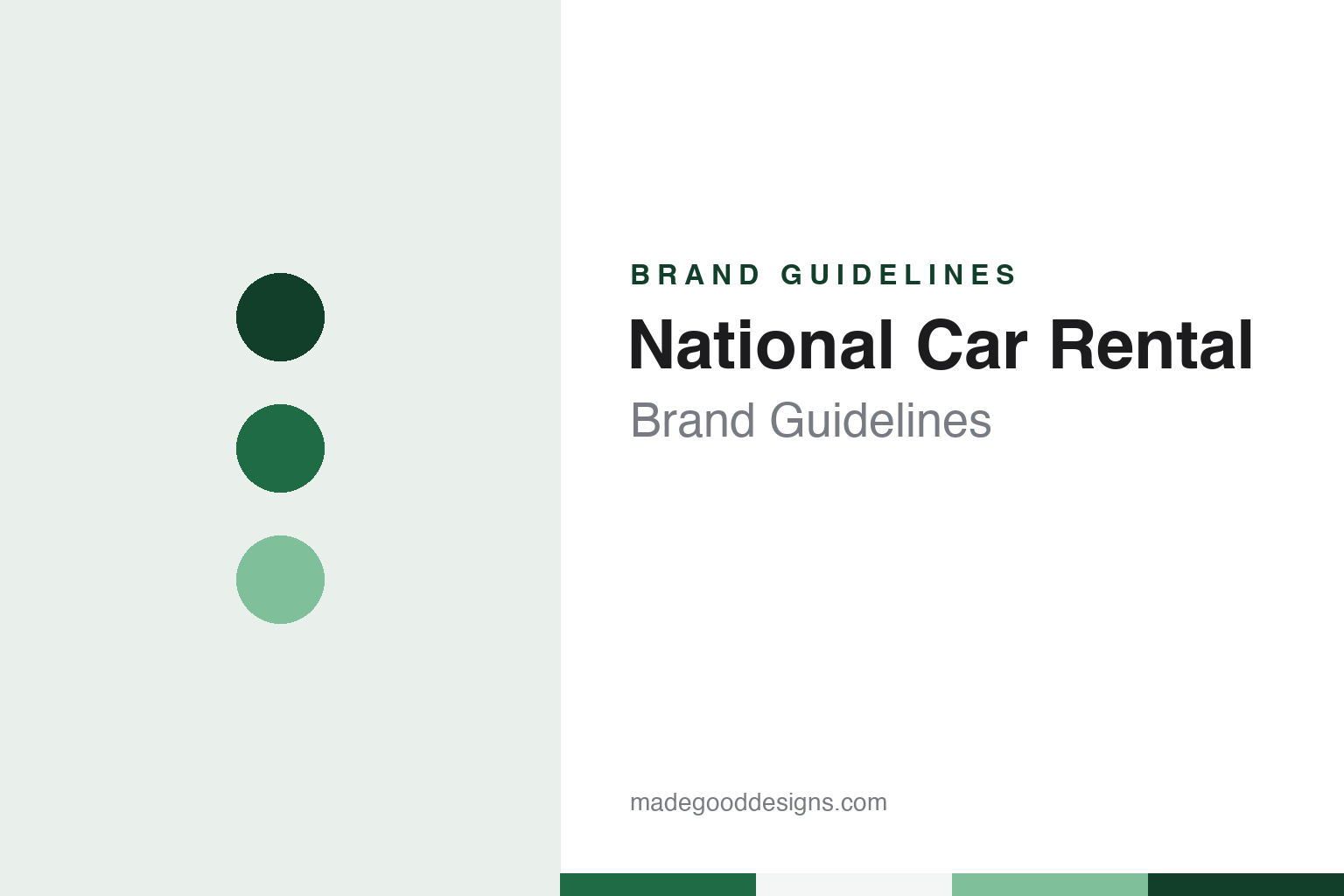
National Car Rental Brand Guidelines
The St. Louis cooperative of 1947 that became an emerald-named business brand.
Aa
Two constants: an emerald, mint and counter white palette and a bold airport sans register. Abstract homage — not a National Car Rental asset or mark; no sign, car or logo is reproduced.
A cooperative of operators
Independent renters pooling a single name.
National Car Rental began as a pooling of names rather than as a single company with a founder. The International Directory of Company Histories, in its 1995 entry on National Car Rental System, says the business was formed in St. Louis, Missouri, on 27 August 1947 by a group of independent car-rental operators who hoped to widen their reach by working together under one name. English Wikipedia gives the same date and describes the founders the same way.
The early decades were shaped by a series of owners and moves. The Directory says National formed an international service agreement with the Canadian rental firm Tilden in 1959, and that the headquarters moved to Jackson, Mississippi, two years later, when an investment group from Minneapolis took charge of the corporation. In 1965 the company relocated to Minneapolis, which remained its home for decades. In 1968, the Directory records, National was held by Greatamerica Corporation when that group was bought by the Dallas conglomerate Ling-Temco-Vought, and before the decade was out the rental business had passed to the Illinois-based Household International.
The international network grew alongside these changes. The Directory says National set up a subsidiary, National Car Rental System International, in 1970 to handle its business abroad, and signed its first agreement with Europcar Interrent in 1974. A further agreement with Nippon Interrent followed in 1988, linking the name to partners in Japan and the wider Pacific region, and the 1995 entry gives the corporate tagline as “National Interrent”. Through the same years the company ran a truck and trailer division under the E Z Haul name and sold cars from its own rental fleet to the public.
One long-running relationship gave the name a place in popular culture. The Directory traces National’s ties with Disney back to 1975, and says a long-term agreement at the end of the 1980s made National the official car-rental company of Disney, with exposure at the resorts and, at times, in films; it cites the film Beaches, in which the character played by Bette Midler rents a National car.
Colour
Buyouts, General Motors, Republic and Enterprise.
In the mid-1980s Household International began selling businesses outside its financial-services core. The Directory says the investment firm Paine Webber recruited Vincent A. Wasik, a former Hertz executive, to lead a leveraged buyout of National, completed in 1986, and that Paine Webber’s interest was sold to General Motors the following year. Wasik left in 1992, when General Motors executives forced his resignation, and a turnaround team followed; by December 1993, the Directory says, National had a new advertising agency in W.B. Doner & Company.
General Motors then sold out. The New York Times reported on 7 January 1997 that in November 1995 GM had sold its stake in National to an investment group led by William Lobeck, a former chief executive of Thrifty Car Rental; the Museum of Tulsa History, which inducted Lobeck into the Tulsa Hall of Fame in 2010, also dates his group’s purchase of National from General Motors to 1995. The same Times report, by Charles V. Bagli, said that H. Wayne Huizenga’s Republic Industries had agreed to buy National, two months after it agreed to buy Alamo, and that the two brands would pair a business-travel name with a leisure one.
Republic later became AutoNation, which, the Fort Lauderdale Sun-Sentinel reported on 7 August 2003, spun off Alamo, National and a smaller brand as ANC Rental Corp. in 2000. ANC filed for Chapter 11 bankruptcy protection in November 2001, and in August 2003 a bankruptcy judge approved the sale of most of its assets to Cerberus Capital Management, which planned to hire Lobeck to run the business. The company that emerged was Vanguard Car Rental, based in Tulsa.
On 31 March 2007 The New York Times reported that Enterprise Rent-A-Car, based in St. Louis and led by Andrew C. Taylor, had said it was acquiring Vanguard, the owner of the National and Alamo brands; the Times described Vanguard as focused on corporate customers at major airports. Enterprise Holdings has owned National since 2007, and English Wikipedia gives the brand’s base today as Clayton, Missouri, in St. Louis County.
Typography
Counters, buses and lots.
A car-rental brand is met in a handful of places before anyone sits behind the wheel: an airport sign pointing to a counter or a garage level, the counter itself, a shuttle bus that loops between terminals and lots, and the lot signage that marks rows, return lanes and exits. Each is a different surface with a different job, from a backlit panel read from across a terminal hall to a painted bus side seen in motion and a small paper or plastic key tag handed over at the end of the process.
That spread of surfaces is what a rental wordmark, its colours and any symbol beside it have to cover, at very different sizes and distances. The same name may appear on a uniform, a bay marker, a receipt and a mobile app, and the business behind it may have changed hands more than once since the sign was first painted.
Each guide that follows sets out who started the name, who has owned it since and how its marks have changed, and separates what independent sources record from what the company says about itself.
Aa
A bold airport sans — the register of an overhead sign and a lot row marker. (Specimen set in Archivo, a sans-serif STAND-IN; NOT the National Car Rental logo.)
National Car Rental
A plain word, a gemstone and a business traveller.
National’s name is a plain word, and much of the brand’s own colour comes from the vocabulary built on top of it. The International Directory of Company Histories says that under Vincent Wasik, in the second half of the 1980s, National set out to win business travellers who rented often, and launched the Emerald Club, a frequent-renter programme that charged an up-front fee and rewarded members for their rentals. The same entry says that in 1987 the company streamlined its rental agreement, a step it describes as foreshadowing the Emerald Aisle, which offered paperless transactions through what the company called Smart Key Machines.
English Wikipedia describes the Emerald Club today as the loyalty programme that lets frequent customers choose their own vehicles without stopping to fill in forms or speak to a representative. The brand uses one gemstone word for its members and another for a place on the lot where they pick up their cars.
National has also shared its owners with other rental names for much of its life: Alamo since the Republic deal of the late 1990s, and Enterprise since 2007.
For a design guide, National Car Rental shows how a generic name can be given character by the words built around it, and how a loyalty programme can become part of the physical layout of a lot. Compare it with Enterprise Rent-A-Car, the group that has owned it since 2007, and Alamo, its sibling since the late 1990s. For this guide we use emerald, mint and counter white with a sans, an unofficial interpretation; no product or logo is reproduced.
Explore & save
Keep National Car Rental’s identity on hand — save it to a board in the Made Good inspiration library.
National Car Rental identity set
Pin the National Car Rental emerald, mint and counter white palette and the bold airport sans register to your own board.