Travelodge Brand Guidelines
Scott King’s San Diego motels and the Sleepy Bear.
Aa
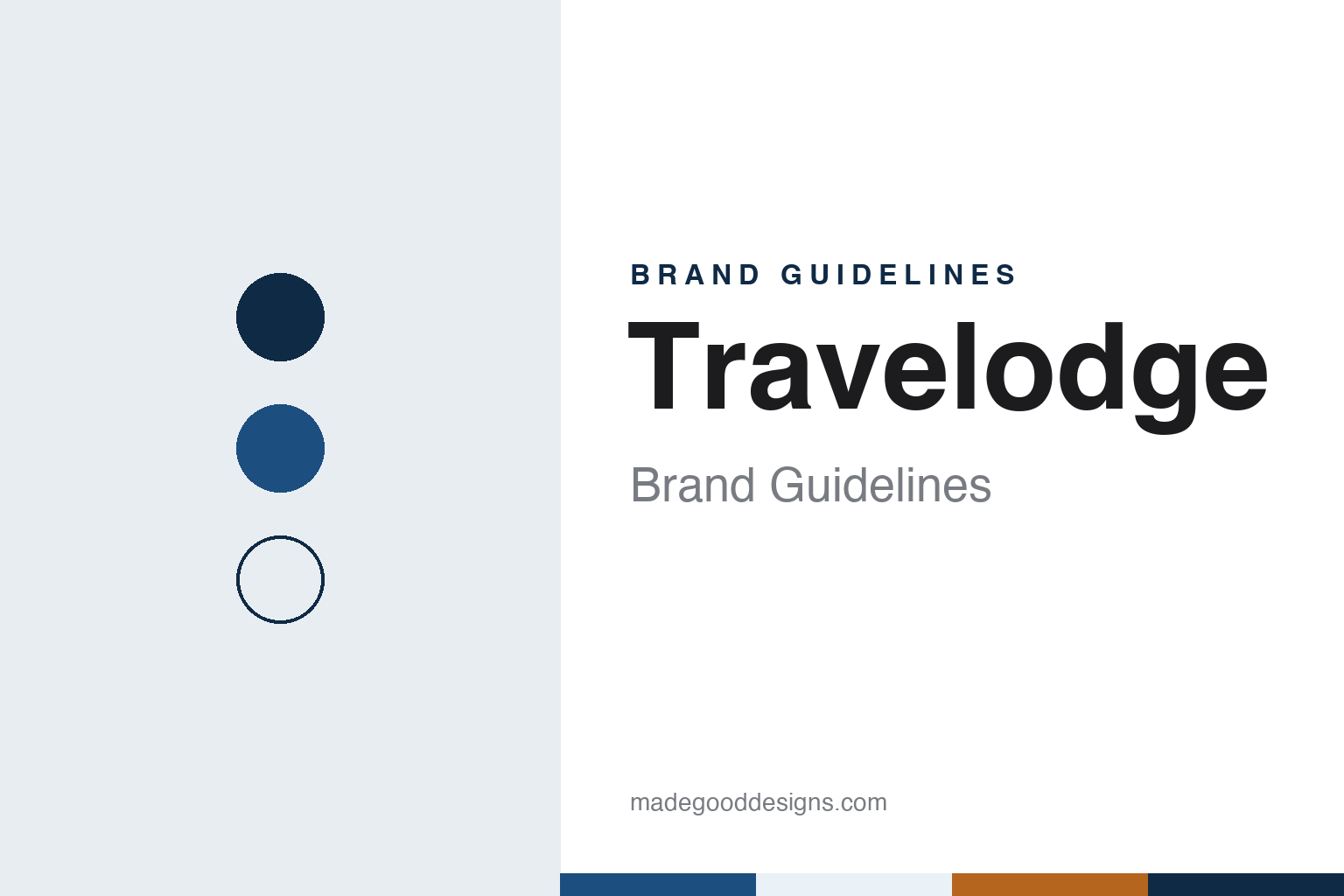
Two constants: a Travelodge night blue and bear brown palette and a Friendly rounded sans register. Abstract homage — not a Travelodge sign or mark; no logo, mascot or sign is reproduced.
King’s Auto Court
A contractor in San Diego.
Travelodge is a Southern California name. The brand’s own history, published by its owner Wyndham Hotels & Resorts, begins with Scott King, a building contractor who opened King’s Auto Court in San Diego to coincide with the 1935 world’s fair there. The company says the fair kept the motel full that year, and that King went on to build more motels across Southern California. It says a motel under the Travelodge name opened in 1940.
English Wikipedia says King incorporated the Travelodge Corporation in Southern California in 1939, and that a motel under the name — spelled TraveLodge, with a capital L, in its early years — opened in San Diego in 1940. For many years, the encyclopedia adds, the company had its headquarters in El Cajon, east of San Diego.
The early pitch was about location. English Wikipedia describes the chain presenting its motels as economical and placing them in or near downtown areas, close to restaurants, churches, theatres and shops. The company tells the same story in a modern register: it now calls its hotels a “basecamp” for adventure and says the brand partners with the National Parks Conservation Association and hangs artwork from the See America Project in its lobbies.
Today both the American and the British businesses write the name as the single word Travelodge, with a lower-case l, and the American company’s history still opens with the founder’s own name, in King’s Auto Court.
Colour
The Sleepy Bear.
Travelodge’s best-known visual asset is a mascot. The company says its Sleepy Bear — which it now calls the brand’s “Ambassador of Adventure” — was introduced in 1954. English Wikipedia credits the character to Robert Hale, working at the time for the San Diego agency Dan Lawrence Advertising, and describes him as a smiling, sleepwalking teddy bear in a nightcap bearing his name, a nightshirt carrying the Travelodge logo, and slippers.
The bear spread across everything the chain printed. A 1970s button in the collection of the Busy Beaver Button Museum in Chicago carries a Sleepy Bear Club badge; the museum’s catalogue notes that the bear appeared in print advertisements, brochures, postcards and motel signs, that children staying at a Travelodge were enrolled in the club, and that the drawing changed over the years from a more illustrated bear to the silhouette on its button. The button itself, two and a quarter inches across, carries white and orange lettering over the bear, according to the catalogue, and the museum says the club continues as Sleepy’s Adventure Club.
English Wikipedia adds that the chain once kept a “Sleepy Bear Den” room with a toy bear for children, that the mascot has largely been retired from everyday use but survives on some older signs and in some advertising, and that a lower-priced sister name, Thriftlodge, had its own bear, a freckled cub called TJ in a baseball cap.
Wyndham still uses the character. Its Travelodge history page names Sleepy Bear in the same sentence as the 1940 opening, and Sleepy’s Adventure Club gives the bear a role on the brand’s website, decades after the 1954 drawing.
Typography
Signs, lobbies and rooms.
The brands in this group are motel and economy hotel names: chains of roadside and city lodgings, many of them run by franchisees under a name owned by another company. A brand of this kind lives in a sequence of physical places rather than in a single package, and each place carries the name in a different way.
The pylon sign is one of them: a tall post or panel set beside a highway or an exit ramp, designed to be read from a moving car and often lit after dark, so a wordmark and its colours have to work at a distance. Closer in, a canopy over the entrance, a sign on the building itself and the lobby door repeat the mark at a smaller scale. Inside, the front desk, the key card, the room directory and the linen take the same name into the room. Some chains add a mascot, which can appear on signs and in advertising alike.
Each guide separates what independent sources record from what the company says about itself — its founding, its owners and franchisors, and changes to its name, sign and identity — and marks plainly what rests only on the company’s own word.
Aa
A rounded, friendly sans for a brand with a bear. (Specimen set in Nunito, a sans STAND-IN; NOT the Travelodge logo.)
Travelodge
One name, several owners.
The Travelodge name is held by different companies in different parts of the world. In North America, English Wikipedia records that the Forte Group sold its Travelodge operation in 1996, and that the trademark rights and franchise system went to HFS Inc., then the owner of Days Inn and Ramada; HFS later merged into Cendant, whose hotel business was spun off as Wyndham Hotels and Resorts in 2006. In April 2018, HOTELS magazine reported, Wyndham began adding a “by Wyndham” extension to its brand names and signs, and the American chain is now Travelodge by Wyndham. The magazine reported that Wyndham gave hoteliers five years to meet the new signage standards, promised to pay for new sign faceplates at properties that met certain quality benchmarks, and began showing the updated names and logos across its websites, mobile sites and third-party listings from 16 April 2018, with owners in North America able to order the new signs at once. In Canada, English Wikipedia says, the brand’s master licence is administered by Travelodge Canada, a company based in Calgary.
The British chain began in 1985. The Caterer reported in November 2010 that Trusthouse Forte had brought the Travelodge concept over from the United States that year, opening a hotel beside a Little Chef restaurant on the A38 at Barton under Needwood in Staffordshire; for the 25th anniversary the company’s chairman, Grant Hearn, unveiled a plaque in that hotel’s reception. Travelodge in the UK now operates in the UK, Ireland and Spain, its website says, and The Caterer reported in April 2024 that the investment firm GoldenTree Asset Management took over the chain in 2012. In Asia, English Wikipedia says, Travelodge Hotels Asia is owned by the Singapore-listed company ICP.
Wyndham’s American Travelodge now presents itself around national parks and adventure, with Sleepy Bear as its ambassador, while the British company runs its own website, its own campaigns and its own history page, which begins in 1985 at Barton under Needwood.
For a design guide, Travelodge shows how a mascot can carry a brand through decades of changing owners. Compare Days Inn, another HFS-era name now with Wyndham, and Super 8. For this guide we use a night blue, a pale sky and a bear brown with a rounded sans, an unofficial interpretation; no product or logo is reproduced.
Explore & save
Keep Travelodge’s identity on hand — save it to a board in the Made Good inspiration library.
Travelodge identity set
Pin the Travelodge night blue and bear brown palette and the Friendly rounded sans register to your own board.