Wawa Brand Guidelines
The dairy name that became a Delaware County food market.
Aa
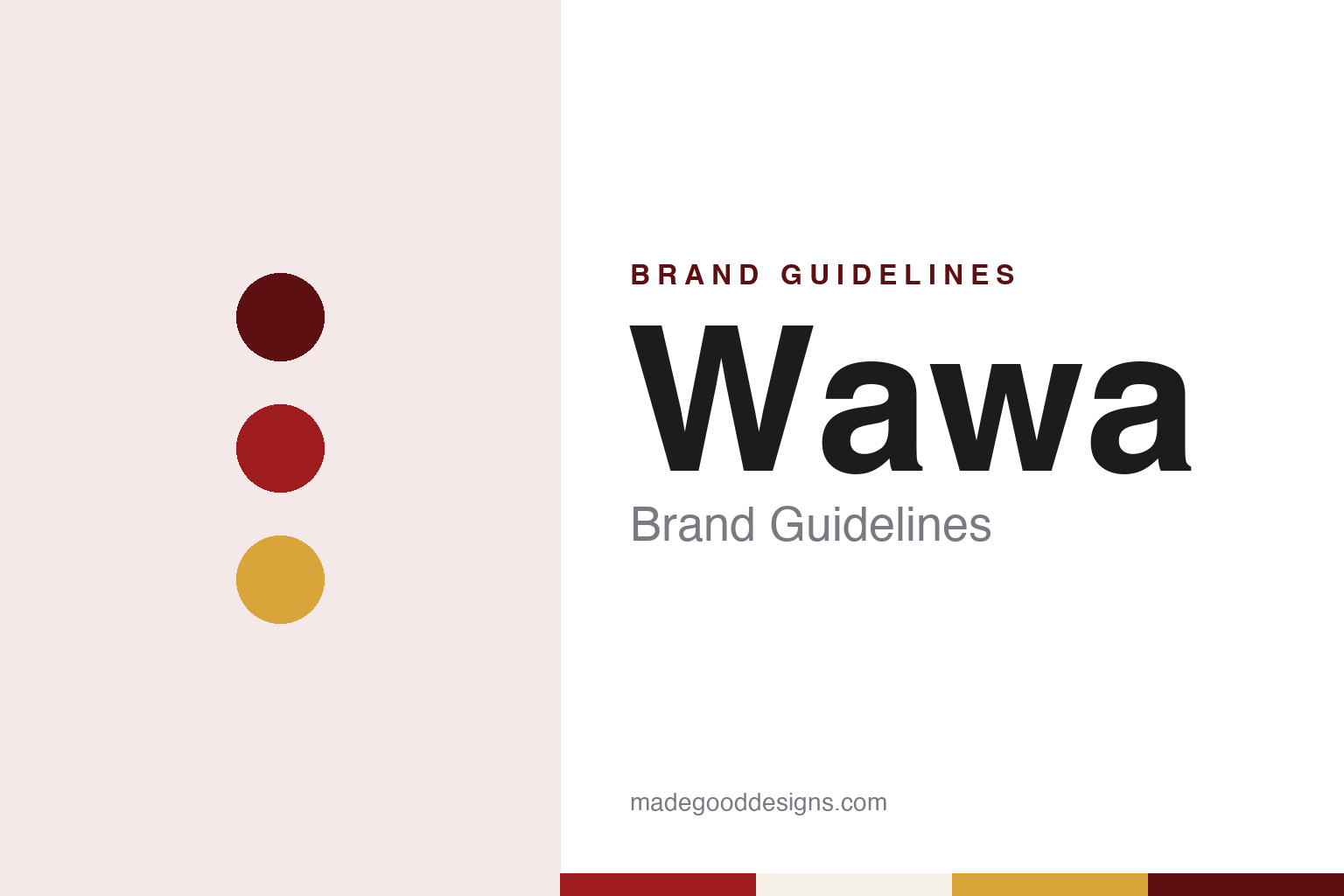
Two constants: a goose red, amber and milk white palette and a bold storefront sans register. Abstract homage — not a Wawa product or mark; no goose, sign or logo is reproduced.
From the dairy
An iron foundry, a milk business and a food market in Folsom.
Wawa’s story starts long before its first store. CSP Daily News, writing for the company’s 60th anniversary in retail in April 2024, said Wawa Inc. began in 1803 as an iron foundry in New Jersey, that toward the end of the 19th century its owner, George Wood, took an interest in dairy farming, and that the family began a small milk-processing plant in Wawa, Pennsylvania, in 1902. The Philadelphia Inquirer, in an anniversary feature published on 16 April 2009, described the same lineage: a 19th-century New Jersey iron foundry owned by George Wood, who moved to Wawa and took up dairy farming, which led to a home-delivery milk business.
For decades the name meant milkmen. The Inquirer’s 2009 feature recalled uniformed men delivering glass bottles of milk to doorsteps across the region. By the early 1960s, CSP reported, home delivery was declining, and Grahame Wood, George Wood’s grandson, opened the first Wawa Food Market on 16 April 1964 in Folsom, Pennsylvania, as an outlet for the dairy’s products. The Inquirer placed that store on MacDade Boulevard in the Folsom section of Ridley Township and said the move into convenience stores had been Wood’s idea, at a time when supermarkets were competing with home delivery and customers were leaving the old urban centres for the suburbs. The paper added that the stores had an early advantage because convenience stores were exempt from Pennsylvania’s old “blue laws” on Sunday trading.
The same article traced how coffee arrived. Vic Russo, then managing the chain’s second store, in Aston Township, brought in a percolator to make coffee for his staff; a customer asked to buy a cup, Grahame Wood noticed the pot on one of his regular stops, and headquarters liked the idea, with Wawa stores selling coffee from 1975, the Inquirer reported. In the late 1970s, the paper said, Wawa reshaped its food business around lunch and sandwiches, after partnerships with Taco Bell and Pizza Hut did not last.
Ownership has stayed private. CSP described Wawa in 2024 as a privately held company. English Wikipedia says the company began sharing ownership with its associates through profit-sharing plans in 1977 and formalised it in 1992 with an employee stock ownership plan, while members of the Wood family remain active in the business; it names Richard “Dick” Wood Jr. as chairman and Chris Gheysens as chief executive since January 2013. The headquarters stands in the Wawa area of Chester Heights, in Delaware County, Pennsylvania, along Baltimore Pike.
Colour
Store No. 1, a parade and two anniversaries.
The Folsom store became the centre of company ceremony. For the 50th anniversary in April 2014, CSP Daily News reported, Wawa decorated the original store with historical photographs and original signage from 1964, unveiled an original pole sign, dressed associates in vintage store uniforms and had chairman Dick Wood re-enact the first store transaction before unveiling a plaque dedicated to the founder, Grahame Wood. The display also included original advertisements and an antique Wawa truck, and a photo exhibit traced the history of the hoagie, which CSP called Wawa’s signature sandwich.
The same day, CSP said, Philadelphia’s mayor, Michael Nutter, proclaimed 16 April Wawa Day in the city at the 17th and Arch Street store, the company launched The Wawa Foundation to handle its charitable giving, and the former chief executive Howard Stoeckel signed copies of his new book, The Wawa Way. In his remarks the mayor noted that the company lends its name and support to the city’s Wawa Welcome America festival around the Fourth of July.
Two years later the original building closed. PhillyVoice reported on 16 June 2016 that Wawa held a parade to mark the relocation of Store #1 to a new Super Wawa down the road at MacDade Boulevard and Kedron Avenue in Folsom. A band led the procession along 2nd Avenue, the company’s 1918 “autocar” milk truck went at the front, and the mascot Wally Goose walked with representatives of Philadelphia sports teams. Chief executive Chris Gheysens spoke alongside chairman Dick Wood and local officials, and inside the new store, PhillyVoice said, Wawa installed a photo timeline, a selfie-station monument to the original Wawa Food Market and a plaque honouring its founder.
The 60th anniversary, on 16 April 2024, repeated the pattern in central Philadelphia. CSP reported events at the 6th and Chestnut Street store and at the National Constitution Center, stores decorated with vintage décor and special cups, a “Day Brightener” customer chosen in each store, an exhibit on Wawa through the years and the 1918 milk truck on display outside the Constitution Center. The article also recorded the company’s plans to open stores in new states in the Midwest and the Southeast.
Typography
Design and documentation.
A convenience-store chain carries its identity across a wide range of surfaces. The fascia above the door, the tall pole sign at the roadside, the fuel canopy and the price board on the forecourt all repeat the same name and colours, and each has to read from a moving car as well as from the pavement. Inside, the same marks return on cups, bags, shelf strips, uniforms and the menu boards behind the counter.
Some chains build that identity around a letterform or a simple shape; others lean on a drawn character or a building silhouette that doubles as a logo, and some keep a compact symbol that can stand alone on a small surface such as an app icon or a cup lid. Because a fascia and a canopy are expensive to change, a new logo usually arrives store by store over several years, so old and new versions can stand side by side for a long time.
Each guide below sets out who started the chain, who owns it now and how its name, logo and signage came about, separating what independent sources record from what the company says about itself.
Aa
A bold storefront sans — the register of a pole sign and a coffee cup. (Specimen set in Archivo, a sans-serif STAND-IN; NOT the Wawa logo.)
Wawa
A place name, a goose and a milk truck.
The name is a place name. The Philadelphia Inquirer wrote in 2009 that the stores kept the name Wawa — defined as “wild goose” in Henry Wadsworth Longfellow’s The Song of Hiawatha — taken from the section of Middletown Township where the original farm stood. English Wikipedia says the chain’s name comes from the site of its first milk plant and headquarters in the Wawa area, and that the town’s name derives from the Ojibwe word we’we, meaning snow goose. It quotes the line from Longfellow’s 1855 poem in which the west wind “sent the wild-goose, Wawa, northward”, a passage that does not name the species.
The mark follows the word. The Inquirer said the stores also kept the goose logo from the dairy years, and wrote that it dated from a time when a Canada goose was a welcome sight. Wikipedia describes the corporate logo as an image of a Canada goose in flight. The bird also became a character: Wally Goose, an anthropomorphic Canada goose wearing a Wawa shirt, appears at store openings and in marketing material, Wikipedia says, and PhillyVoice placed him in the 2016 Folsom parade.
Press coverage of the 2014, 2016 and 2024 anniversaries described the same props from the company’s past: the 1918 milk truck, original 1964 signage and a pole sign, vintage store uniforms and photo timelines of Wawa through the years. Two products recur in that coverage as well. The Inquirer called coffee the chain’s signature product in 2009, and CSP called the hoagie Wawa’s signature sandwich in 2014.
The Wawa name also reaches beyond the stores, on the city’s Fourth of July festival and on The Wawa Foundation, launched on Wawa Day in 2014.
For a design guide, Wawa shows how a place name and the bird it is said to mean can carry a dairy’s identity into a chain of food markets and fuel stops, with a milk truck, a pole sign and a goose brought back for every anniversary. Compare it with Sheetz, the Altoona chain whose founding family, Mental Floss reported, has shared board seats with the Woods, and with 7-Eleven. For this guide we use goose red, amber and milk white with a sans, an unofficial interpretation; no product or logo is reproduced.
Explore & save
Keep Wawa’s identity on hand — save it to a board in the Made Good inspiration library.
Wawa identity set
Pin the Wawa goose red, amber and milk white palette and the bold storefront sans register to your own board.