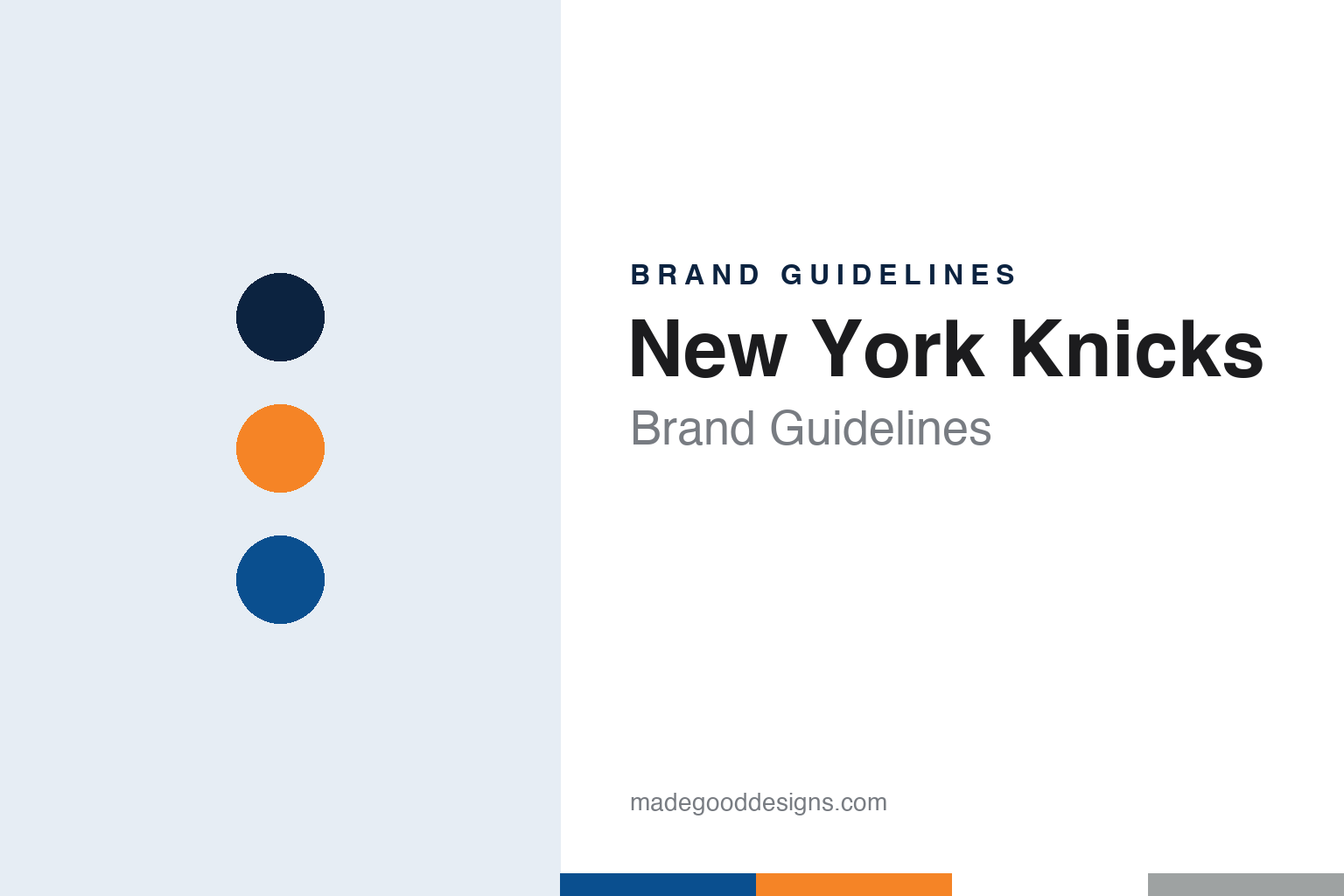
New York Knicks Brand Guidelines
A name from an 1809 literary hoax, worn in blue and orange.
Aa
Two constants: a Knick blue, Garden orange and arena silver palette and an arched serif lettering register. Abstract homage — not a New York Knicks mark; no logo, jersey or wordmark is reproduced.
A literary name
An arena’s team, a vote from a hat and a fictional Dutch historian.
The Knicks were created by an arena. English Wikipedia says the Basketball Association of America was founded on 6 June 1946 at the Commodore Hotel in New York, by arena owners who wanted events for their buildings on nights when hockey teams were away. Ned Irish, a college basketball promoter, former sportswriter and then president of Madison Square Garden, attended. The sportswriter Max Kase had hoped to run the New York franchise himself and lease the Garden, but, Wikipedia says, Irish explained that the rules of the Arena Managers Association of America required the Garden to own any professional team that played there, and the franchise went to Irish.
Irish wanted a name that stood for the city. According to Wikipedia, he gathered his staff and had them cast votes into a hat, and the winner was Knickerbockers, soon shortened to Knicks. The New York City Municipal Archives, in a post on its For the Record blog by Michael Lorenzini dated 5 June 2026, notes that the original name remains the team’s official corporate name and confirms that the “Knickerbockers” won the 1946 vote.
The word itself dates from 1809. Lorenzini explains that Washington Irving borrowed the surname of his friend Herman Knickerbocker, a lawyer from an old Dutch New York family, for a stunt in 1809: Irving placed missing-person advertisements in New York newspapers seeking a Dutch historian called Diedrich Knickerbocker, supposedly vanished from a Manhattan hotel and leaving a manuscript behind. On 6 December 1809 Irving published A History of New York from the Beginning of the World to the End of the Dutch Dynasty under that name, a satire of the city’s history and politics.
The name then spread across the city. Lorenzini lists its use by an Albany newspaper, a New York literary magazine, a publishing house, a hotel built by the Astors, a style of baggy short trousers, a baseball club and a beer brand, and says it became shorthand for a resident of Manhattan. From 1877, he adds, Puck magazine drew a character called Father Knickerbocker as a symbol of New York City in the way Uncle Sam stands for the United States, and the figure went on to appear in editorial cartoons, sheet music and city government publications.
Colour
Garden owners, from the Madison Square Garden Corporation to MSG Sports.
The club’s owners have been the Garden’s owners. Wikipedia’s ownership table lists the Madison Square Garden Corporation from 1946 to 1977, then Gulf+Western, later Paramount Communications, from 1977 to 1994, Viacom briefly in 1994, ITT Corporation and Cablevision from 1994 to 1997, Cablevision alone from 1997 to 2010, and Madison Square Garden Sports from 2010. Wikipedia names James L. Dolan as the executive chairman of the owning company.
The colours were set early. Wikipedia says that from the beginning the home uniforms were white with blue and orange trim and the road uniforms blue with orange and white trim, with blue lettering at home and orange on the road, and that a checkerboard pattern was added in the mid-1950s. In the 1960s the lettering became serifed, the blue home numbers gained orange trim, side stripes were added and an “NY” monogram appeared on the left leg of the shorts.
A longer-lived set arrived in 1968. Wikipedia describes an arched “NEW YORK” in orange serif lettering, introduced on the home uniform that year and on the road uniform the next. Player names were set in a straight block style arranged in a “vertical arch,” which Wikipedia credits to Gerry Cosby and his sporting goods company; the arrangement was later taken up by several baseball and hockey teams. In 1978–79 an interlocking “NY” inside an apple went onto the shorts.
One period broke with blue and orange. Before the 1979–80 season, Wikipedia says, the Knicks replaced royal blue and orange with navy and crimson red, with a free-flowing “Knicks” script at home. The change was initiated by the team president E. Michael Burke, whose alma mater, the University of Pennsylvania, wore those colours. The arched 1968 design came back for 1983–84 and stayed until the late 1990s.
Typography
Design and documentation.
A sports team’s visual identity works across surfaces that rarely sit still. The crest or primary mark has to hold up on a jersey chest, a cap front, a centre-court decal and a phone-sized app icon, so designers tend to favour bold silhouettes, a limited set of flat colours and outlines that survive embroidery, screen printing and paint. Secondary marks and monograms carry the identity where the full crest would be too busy, such as a sleeve, a helmet side or a social-media avatar.
Wordmarks do a different job. A team name set in custom lettering has to read from the upper deck and on a television graphic at once, which is why many wordmarks use condensed or slab-serif letterforms, generous tracking and a consistent arch or baseline. Uniform numbers follow league rules on size and contrast, and teams often commission a dedicated numeral set so that a 6 and an 8 stay distinct at a distance. Arena and stadium signage then repeats the same palette and letterforms on scoreboards, concourse wayfinding and court or field markings, turning the venue itself into part of the brand system.
Aa
An arched serif — the register of a “NEW YORK” chest wordmark and a Garden marquee. (Specimen set in Roboto Slab, a slab serif STAND-IN; NOT the New York Knicks logo or wordmark.)
New York Knicks
A cartoon Dutchman, a roundball and a triangle.
The Knicks’ marks have tracked their name closely. The Municipal Archives post says the original logo, used from 1946 to 1964, showed Father Knickerbocker dribbling a basketball, and that it was drafted by the sports cartoonist Willard Mullin; Wikipedia adds that Mullin drew for the New York World-Telegram and that the figure appeared in the team’s blue and orange.
In 1964 the cartoon gave way to type. Wikipedia credits Bud Freeman with the “classic roundball” logo, the word “Knicks” laid over a brown basketball, which with small changes, such as a maroon wordmark and an orange ball, served until 1992. An alternate putting the full team name inside an orange ball was used from the late 1960s into the 1970s.
Before the 1992–93 season the roundball was redrawn. Wikipedia says the new logo, with “Knicks” in a futuristic letterform over a basketball and a silver triangle behind it, was designed by Michael Doret and overseen by Tom O’Grady. For 1995–96 the city name in a matching script was added above it, and an alternate “subway token” logo appeared. In 2012 the club updated the triangle again, removing black from the scheme and making grey the accent colour, and introduced uniforms drawn from the 1968 set, with the phrase “Once A Knick, Always A Knick” inside the collar. An orange alternate unveiled on 25 October 2013 was soon withdrawn. Under Nike, the league’s supplier since 2017, Wikipedia says the white and blue sets were kept almost intact, with the roundball returning on the waistband.
For a design guide, the New York Knicks show how a name lifted from a nineteenth-century satire can supply a whole visual vocabulary, from a cartoon Dutchman to an arched serif, while blue and orange hold the identity together across owners and redesigns. Compare it with the NBA, whose uniform rules shape the Knicks’ kit, and the New York Yankees, whose interlocking “NY” the Knicks’ shorts once echoed. For this guide we use Knick blue, Garden orange and arena silver with a slab serif, an unofficial interpretation; no product or logo is reproduced.
Explore & save
Keep New York Knicks’s identity on hand — save it to a board in the Made Good inspiration library.
New York Knicks identity set
Pin the New York Knicks Knick blue, Garden orange and arena silver palette and the arched serif lettering register to your own board.


