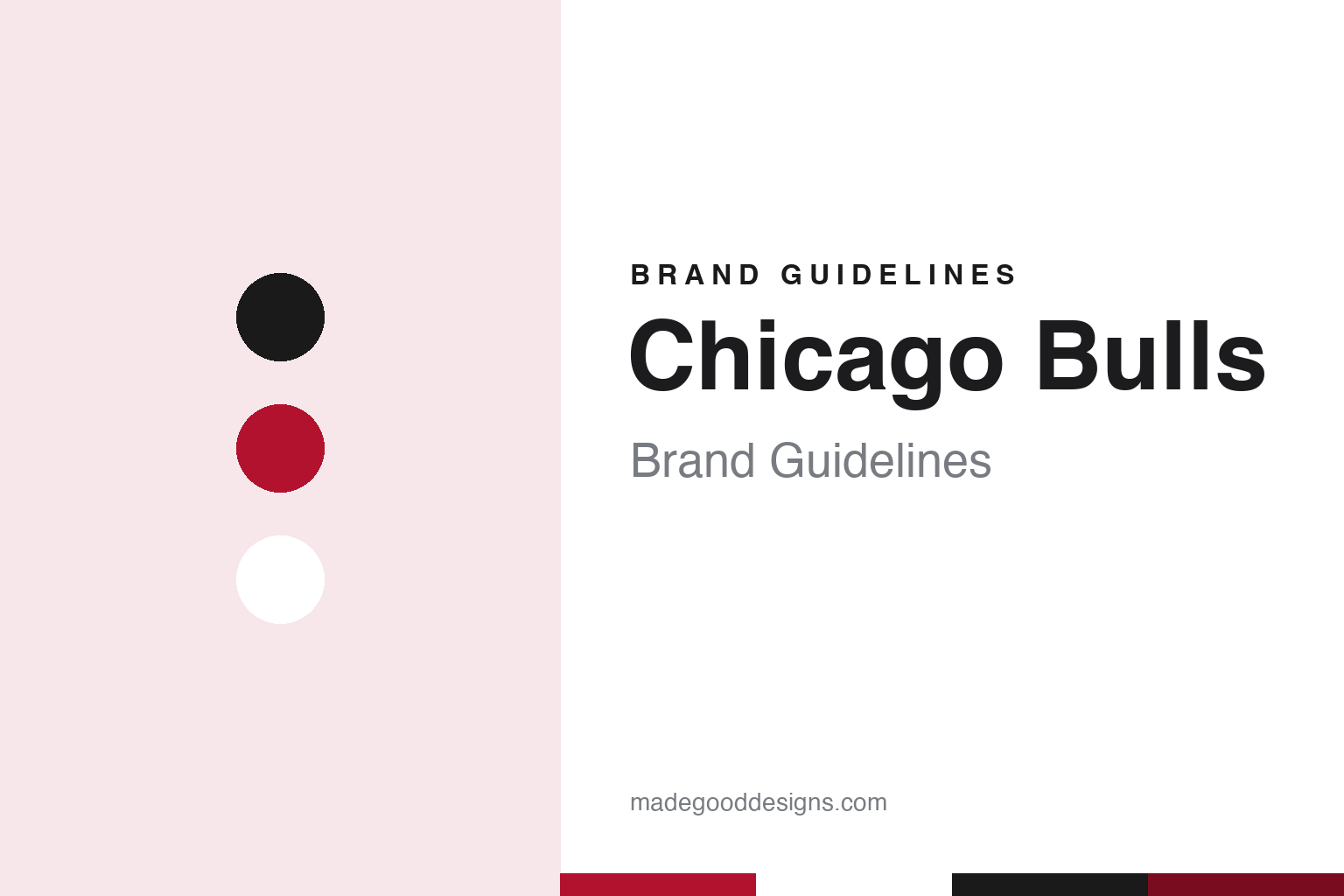
Chicago Bulls Brand Guidelines
A stockyard name and a red bull with blood on its horns.
Aa
Two constants: a bull red, horn black and court white palette and a condensed block lettering register. Abstract homage — not a Chicago Bulls mark; no logo, jersey or wordmark is reproduced.
A stockyard name
Dick Klein, an expansion franchise and a word picked at the dinner table.
The Chicago Bulls were granted an NBA franchise on 16 January 1966. English Wikipedia names Dick Klein as the founder; he had played professionally for the Chicago American Gears and ran the new club as its general manager and president in its early years. Writing for the Chicago History Museum in January 2024, Heidi Samuelson records that Klein, determined to bring professional basketball back to the city, was awarded the expansion team in 1966 after winning the support of the American Broadcasting Company and other backers.
Chicago had NBA teams before. Wikipedia lists the Chicago Stags, who played from 1946 to 1950, and the Chicago Packers, renamed the Zephyrs, who played from 1961 to 1963, which makes the Bulls the city’s third franchise in the league. The new club played its first game on 15 October 1966, and Wikipedia says it began at the International Amphitheatre before moving to Chicago Stadium.
The name came from the city’s industry. The Chicago History Museum says Klein gave the team the nickname “bulls” because he wanted to call up images of Chicago’s stockyards. Wikipedia adds that Klein wanted something tied to the meat-packing trade, as the earlier Packers name had been, and to the Union Stock Yards near Chicago Stadium; that he considered and rejected Matadors and Toreadors because he thought three-syllable nicknames were unlucky; and that he settled on Bulls after his son Mark, hearing the family discuss names, said the ideas were “a bunch of bull.”
Klein then needed a mark. He turned to a friend rather than an agency. In a Chicago Tribune report published on 23 June 1993, Jon Hilkevitch described how Dean Wessel, a commercial designer and Klein’s former neighbour in Kenilworth, had been offered free tickets in exchange for designing the new franchise’s emblem. Wessel told the paper he never received royalties on the design and that most people were surprised to learn it had come from his pen.
Colour
From a founder’s club to Jerry Reinsdorf’s group.
Ownership later passed to a group of partners, and on 9 February 1985 the Chicago Tribune reported an agreement under which Jerry Reinsdorf, already a co-owner of the Chicago White Sox baseball club, would become majority owner of the Bulls by 1 March. The paper said Lester Crown, then chairman of the board, announced the deal, and that part of the stake came from the estate of Arthur Wirtz. Reinsdorf told the Tribune he would work on the business side and leave basketball decisions to the general manager and coach. Wikipedia lists him as owner from 1985 to the present.
The home court moved as the club grew. Wikipedia records three main arenas: the International Amphitheatre in the first season, then the Chicago Stadium, and the United Center, which the team has used since 1994. The charging bull has followed the team through each of them.
Uniforms have changed far less than the buildings. Wikipedia describes the first set, worn from 1966 to 1973, as already close to today’s: block lettering and a diamond around the bull logo on the shorts, with black drop shadows and side stripes that were later dropped. For the 1973–74 season the club moved the front numbers to the left chest and gave the red road uniform a script “Chicago” wordmark; that set was later revived as a throwback in the 2003–04 and 2015–16 seasons. From 1985–86 the numbers were centred again under a vertically arched “Bulls” wordmark, the look the team still wears.
When Nike became the NBA’s uniform supplier in 2017, Wikipedia says, the Bulls kept the design, trimming the shoulder striping and adding the four stars of the Chicago city flag to the waistband. A black alternate uniform with red pinstripes first appeared in 1995–96; its pinstripes went away, came back in dark grey for 2019–20 and returned in red ahead of the 2025–26 season.
Typography
Design and documentation.
A sports team’s visual identity works across surfaces that rarely sit still. The crest or primary mark has to hold up on a jersey chest, a cap front, a centre-court decal and a phone-sized app icon, so designers tend to favour bold silhouettes, a limited set of flat colours and outlines that survive embroidery, screen printing and paint. Secondary marks and monograms carry the identity where the full crest would be too busy, such as a sleeve, a helmet side or a social-media avatar.
Wordmarks do a different job. A team name set in custom lettering has to read from the upper deck and on a television graphic at once, which is why many wordmarks use condensed or slab-serif letterforms, generous tracking and a consistent arch or baseline. Uniform numbers follow league rules on size and contrast, and teams often commission a dedicated numeral set so that a 6 and an 8 stay distinct at a distance. Arena and stadium signage then repeats the same palette and letterforms on scoreboards, concourse wayfinding and court or field markings, turning the venue itself into part of the brand system.
Aa
A condensed block letter — the register of an arched jersey wordmark and an arena scoreboard. (Specimen set in Oswald, a condensed sans STAND-IN; NOT the Chicago Bulls logo or wordmark.)
Chicago Bulls
One drawing, three colours and a request for blood.
The Bulls identity rests on a single drawing. Wikipedia describes the primary logo as a red, charging bull’s face, designed by Dean P. Wessel and adopted in 1966, and says it has changed very little since. Wessel made the same point to the Chicago Tribune in 1993: he said the club had not altered his original red, black and white rendering, and that the only change to the artwork came straight after he first submitted it, when Klein sent the sketch back and asked for blood on the horns. Wessel said he obliged, which is why the tips of the horns are coloured red.
The Tribune piece also records how far the drawing had travelled by the early 1990s. Wessel told Hilkevitch he saw the bull on the scoreboard at the Stadium, on T-shirts in shopping malls, on cocktail napkins and team jackets, and on merchandise in Japan and Italy. The design was made in the first months of a new franchise, in exchange for tickets, and then kept almost untouched as the club changed owners, arenas and uniform suppliers.
The mark has had occasional companions. Wikipedia notes an alternate logo used in the early 1970s that put the same bull’s head above a cloud reading “Windy City.” The club’s mascot, Benny the Bull, a red bull who wears number 1, was introduced in 1969, according to Wikipedia; a second mascot, Da Bull, appeared in 1995 and was later retired. The diamond on the shorts and the arched wordmark carry the same red, black and white onto the uniform.
For a design guide, the Chicago Bulls show how a mark drawn quickly by one designer for one owner, in three flat colours, can stay almost unchanged since 1966 through new buildings, new suppliers and new owners. Compare it with the NBA, the league whose uniform rules the Bulls’ kit follows, and the Boston Celtics, another NBA team covered in this series. For this guide we use bull red, horn black and court white with a condensed sans, an unofficial interpretation; no product or logo is reproduced.
Explore & save
Keep Chicago Bulls’s identity on hand — save it to a board in the Made Good inspiration library.
Chicago Bulls identity set
Pin the Chicago Bulls bull red, horn black and court white palette and the condensed block lettering register to your own board.