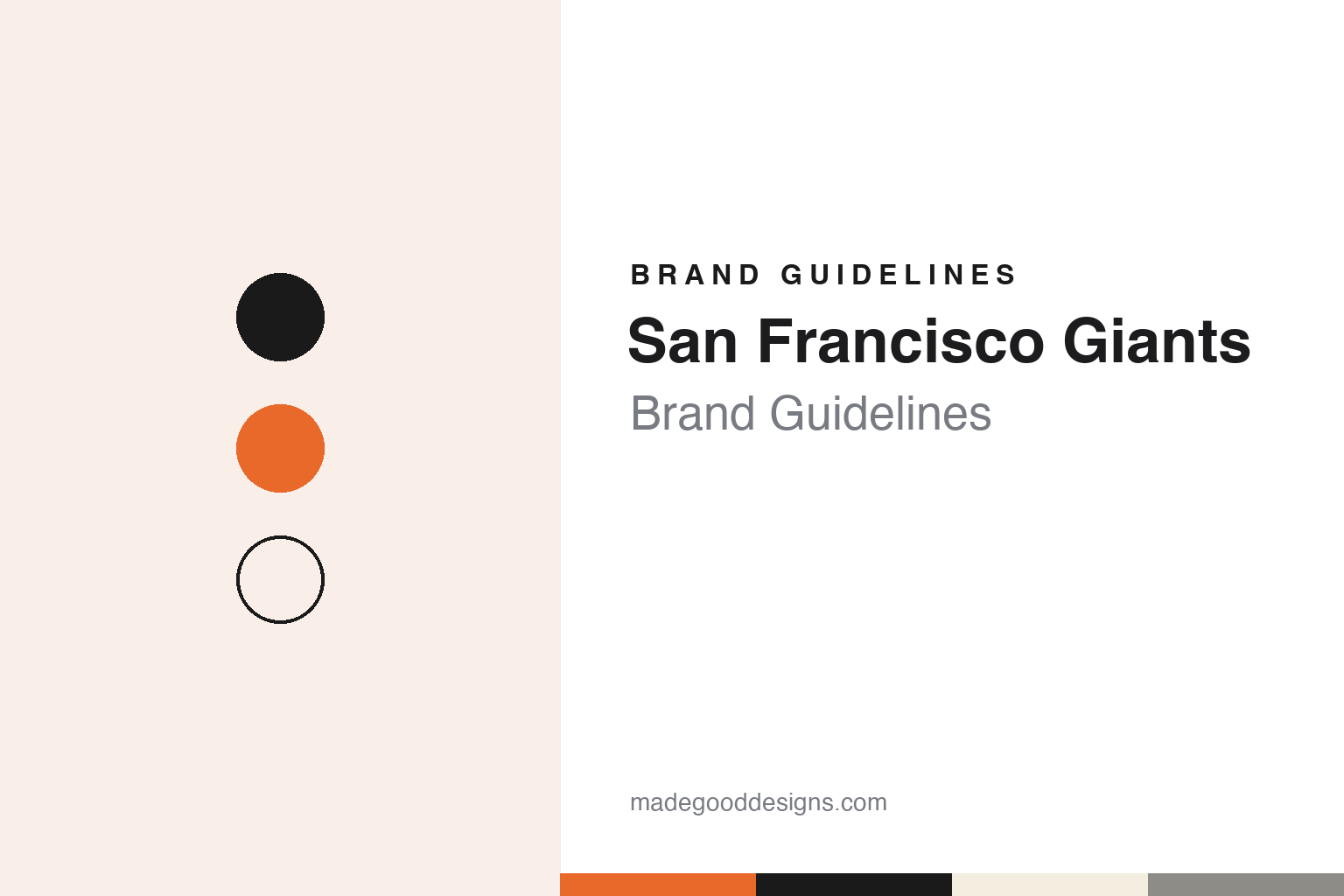
San Francisco Giants Brand Guidelines
A New York name carried west in 1958, and an orange that the club treats as its own.
Aa
Two constants: a Giant orange, dugout black and home cream palette and a block and script jersey lettering register. Abstract homage — not a San Francisco Giants mark; no cap logo, script or wordmark is reproduced.
A New York name
The Gothams, the Polo Grounds and a move to the West Coast.
The San Francisco Giants began on the other side of the country. English Wikipedia records that the club was founded in 1883 in New York City as the New York Gothams, and that it was known as the New York Giants from the mid-1880s until it left the city. For most of its New York years the team played at successive versions of the Polo Grounds in Upper Manhattan. The National Football League’s New York Giants, Wikipedia adds, took their name from the baseball club.
The move came after the 1957 season. The Giants and the Brooklyn Dodgers both relocated to California that winter, the Dodgers to Los Angeles, and the two clubs carried their old rivalry with them. On 15 April 1958 the Giants played their first game in San Francisco, against the Dodgers. They used Seals Stadium, until then the home of the Pacific Coast League’s San Francisco Seals, for two seasons, moved to Candlestick Park in 1960, and opened their own ballpark at China Basin in 2000, first called Pacific Bell Park and now Oracle Park.
The name crossed the country unchanged, and so, largely, did the uniform. Wikipedia says that on arrival in San Francisco the team kept the uniform it had worn in New York with two changes: the cap now carried an interlocking “SF” in orange, and the road jersey read “San Francisco” in black block letters with orange trim. Thin black and orange stripes ran round the neckline, the sleeves and the trousers.
Those two colours have stayed with the club ever since. In an ESPN report on 5 July 2021, Gavin Werner, the Giants’ director of retail and authentication, described how people picture the team: when you close your eyes and think about San Francisco, he said, you think about “the Giant orange,” the colour that visually identifies the club.
Colour
From a group formed to keep the club in town to Greg Johnson.
The current ownership dates from 1993. Writing in The San Francisco Standard on 8 September 2026, John Shea described how the group, San Francisco Baseball Associates, came together after National League owners rejected owner Bob Lurie’s sale of the team to a group from Florida that planned to move it to St. Petersburg. Bay Area investors banded together to keep the Giants in San Francisco, and Peter Magowan agreed to act as the group’s control person, with Larry Baer as his chief assistant. The Standard says ten of the original investors, or their heirs, are still part of a much larger partnership.
The frontman has changed since then. Shea lists Magowan, Bill Neukom, Baer and Rob Dean as earlier leaders, and records that Greg Johnson was approved as the Giants’ control person in November 2019 and now serves as chairman. The Standard adds that former catcher Buster Posey joined the ownership group and board in September 2022 before taking charge of baseball operations.
On the field the uniform has moved in cycles. Wikipedia says the 1973 double-knit set reversed the lettering to orange with black trim and added player names; in 1977 the club switched to pullovers, changed the home “Giants” from serifed block letters to a cursive script and made the road uniform orange; and in 1978 it added a black alternate. Before the 1983 season the Giants returned to a buttoned uniform designed by the design firm Sidjakov Berman & Gomez, close to the early San Francisco look but with rounder lettering.
The move to the new ballpark in 2000 brought another reset. Wikipedia says the home uniform turned cream, the “Giants” wordmark was set in a radial arch with gold drop shadows, and a sleeve patch carried the words “San Francisco Baseball Club,” while the grey road set went back to the 1960s “San Francisco” wordmark. An orange alternate for Friday home games followed in 2010, and the late-1970s script returned on it in 2014. A black alternate added in 2015 carried a sleeve patch with the Golden Gate Bridge above the “Giants” wordmark; for 2026, Wikipedia says, the black set was redrawn with a “Gigantes” chest wordmark based on the 1983–93 lettering.
Typography
Design and documentation.
A baseball or basketball team carries its identity in a small number of places, and each one has its own rules. On a baseball cap the mark is usually reduced to a monogram or a single letter, sized to sit on a front panel and to read from the stands. On a jersey the same team may switch to a script wordmark, a looping hand-lettered name stitched across the chest, or to straight block lettering for numbers and player names on the back.
Basketball adds a large printed surface: the court. Centre-circle logos, painted keys, baseline wordmarks and the colour of the wood stain all become part of how a club looks on a broadcast. Arena signage, scoreboards and seat colours follow the same palette.
Mascots turn a logo into a costumed character for families and for merchandise, and they are often redesigned more freely than the crest itself. In recent seasons, city-edition uniforms and alternate sets have given clubs room to borrow local colours, neighbourhood names and period lettering without changing the primary mark. The guides in this series look at how each team handles those layers.
Aa
A heavy slab letter — the register of a block road wordmark and a ballpark sign. (Specimen set in Alfa Slab One, a slab-serif STAND-IN; NOT the San Francisco Giants logo, script or wordmark.)
San Francisco Giants
A cap monogram, a script and a uniform made of fog.
The cap mark runs through every era of the San Francisco club. Wikipedia’s uniform history traces the interlocking “SF” from the 1958 move through each redesign: it stayed the same through the 1970s, was redrawn in 1994 to match a change to pointed block lettering on the jerseys, and appears in black with orange trim on the all-black caps of the early 2000s. The 1983–93 road uniform and a second grey road set worn between 2012 and 2019 both put the “SF” on the chest in place of the city name.
One recent uniform drew on the weather. When Major League Baseball and Nike launched the City Connect programme in 2021, the Giants unveiled their set on 5 July. ESPN described an orange and white design with a silhouette of the Golden Gate Bridge and a fog gradient running across the front, the sleeves and the numbers. Mario Alioto, then the club’s executive vice president of business operations, told ESPN that the team had focused on what stood out about the city: the bridge, which he called a sign of welcome, and the fog, which he said makes San Francisco different. He explained that the gradient sits at one level all the way round the jersey, as fog does against the bridge.
The same report says the club built the design around the “G” from its logo, stretching the letters to suggest the bridge’s towers and adding the bridge’s silhouette to the side of the cap. Werner said the team wanted a balance between trying something new and keeping a traditional foundation, and that leaning into orange on the headwear, the socks and the undershirts did that. The set was worn at Tuesday home games. Wikipedia records a second City Connect design in 2025: a dark grey jersey with a “Giants” script outlined in a purple and orange gradient and sleeve lettering in the style of 1960s San Francisco concert posters.
For a design guide, the San Francisco Giants show how a club can carry a name, two colours and a cap monogram across a continent and then vary everything around them, from serifed block letters to script, cream to black, and fog to concert-poster lettering. Compare it with MLB, whose City Connect programme produced the fog uniform, and the Los Angeles Dodgers, the rival that moved west in the same winter. For this guide we use Giant orange, dugout black and home cream with a serif, an unofficial interpretation; no product or logo is reproduced.
Explore & save
Keep San Francisco Giants’s identity on hand — save it to a board in the Made Good inspiration library.
San Francisco Giants identity set
Pin the San Francisco Giants Giant orange, dugout black and home cream palette and the block and script jersey lettering register to your own board.