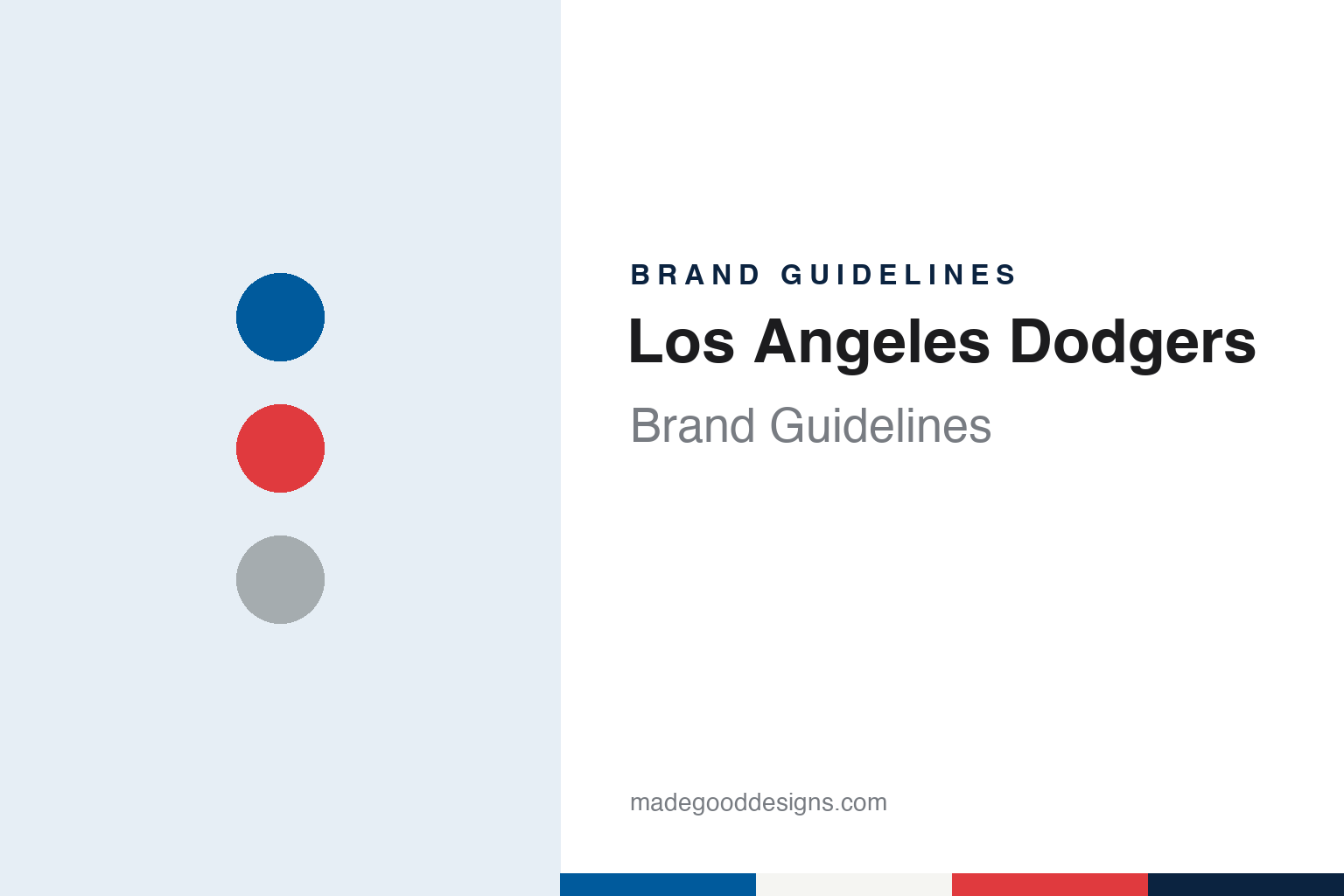
Los Angeles Dodgers Brand Guidelines
From Brooklyn trolley tracks to Chavez Ravine, in royal blue, red and white.
Aa
Two constants: a Dodger blue, number red and home white palette and a condensed athletic sans register. Abstract homage — not a Los Angeles Dodgers product or mark; no cap, uniform or logo is reproduced.
Trolley Dodgers
Grays, Bridegrooms, Superbas, Robins, then Dodgers.
The Dodgers began in Brooklyn, then a separate city from New York, in 1883. English Wikipedia says the club was formed that year as the Brooklyn Baseball Association and played its first season in the Interstate League, before joining the American Association in 1884 and the National League in 1890. The group behind it included the Brooklyn real-estate man Charles Byrne and Ferdinand Abell, who supplied most of the capital, and its staff in that first season included a young bookkeeper and scorecard seller named Charles Ebbets, whose name would later go on the club’s ballpark.
For half a century the team had no fixed nickname. Writing for MLB.com on 21 December 2020, Ken Gurnick listed the names that came and went: the club dates its own start to 1884 as the Grays, after the colour of its uniforms; it became the Bridegrooms after several players married around the 1888 season; and the arrival of manager Ned Hanlon brought the Superbas, borrowed from a popular vaudeville act of the day. From 1915 to 1931 the team was also known as the Robins, after its manager Wilbert Robinson.
Running underneath all of them was the name that stuck. Gurnick wrote that, according to the club, it originated in 1896 as the Brooklyn Trolley Dodgers, because heavy construction of electric trolley tracks in front of Eastern Park forced fans to dodge the trolleys to reach the ground; those fans became known as Trolley Dodgers, and the name was shortened. Wikipedia dates sportswriters’ use of “Trolley Dodgers” for the team to early in the 1895 season, and says Brooklyn residents were being called trolley dodgers before the term attached to the club.
The name became formal in the early 1930s. Wikipedia says that on 22 January 1932 the Brooklyn baseball writers, invited by the club to choose a permanent name, picked Dodgers, with Kings the only other name seriously considered. Gurnick wrote that 1933 was the first year “Dodgers” was written on the club’s uniform, and that the club brought the nickname with it when it moved to Los Angeles for the 1958 season. Wikipedia adds that the team kept the name even though pedestrians in Los Angeles were not known for dodging trolleys.
Colour
Ebbets, O’Malley, Fox, McCourt and Guggenheim.
Ownership in Brooklyn passed through a handful of hands. Wikipedia says Ebbets became president in 1898 and bought out Abell and the remaining outside interests in November 1907. To pay for a new ballpark he sold half the club in August 1912 to the contractors Edward and Stephen McKeever, and Ebbets Field opened on 9 April 1913. In October 1944 a group including Branch Rickey, the attorney Walter O’Malley and the Pfizer president John L. Smith bought the McKeever estate’s quarter share, and in August 1945 the same three bought the Ebbets estate’s half. Wikipedia says O’Malley acquired majority control in 1950, when he bought Rickey’s share.
O’Malley wanted a new privately financed ballpark in Brooklyn and did not get one. Wikipedia records that National League owners voted on 29 May 1957 to let both the Dodgers and the Giants move to the West Coast, that the Brooklyn Dodgers played their final game at Ebbets Field on 24 September 1957, and that the Los Angeles Dodgers played their opening home game on 18 April 1958 at the Los Angeles Memorial Coliseum, against the Giants. The club spent four seasons there before Dodger Stadium opened on 10 April 1962 in Chavez Ravine, land that had been cleared for a public housing project; Wikipedia says the last residents of the ravine were evicted on 9 May 1959.
The O’Malley family kept control until 1998, when, Wikipedia says, Major League Baseball’s owners approved the sale of the club to Rupert Murdoch’s Fox Group on 19 March. The Boston developers Frank and Jamie McCourt took over in January 2004. During their divorce and amid the club’s debts, Major League Baseball took over day-to-day operations in April 2011, and the Dodgers filed for bankruptcy protection that June. ESPN reported on 2 November 2011 that McCourt had agreed with the league to sell the club, together with Dodger Stadium and the surrounding land, through a court-supervised process.
Guggenheim Baseball Management has owned the Dodgers since 2012. Writing for MLB.com on 1 May 2012, Ken Gurnick reported that the group had closed its purchase of the club and Dodger Stadium from Frank McCourt that day, with Mark Walter, chief executive of Guggenheim Partners, as controlling partner, Stan Kasten as president and chief executive, and Magic Johnson as a part-owner with a public role. Peter Guber, Todd Boehly and Bobby Patton were among the other investors. Wikipedia says the group has since added Billie Jean King and Ilana Kloss, in 2018.
Typography
Design and documentation.
A baseball or basketball team carries its identity in a small number of places, and each one has its own rules. On a baseball cap the mark is usually reduced to a monogram or a single letter, sized to sit on a front panel and to read from the stands. On a jersey the same team may switch to a script wordmark, a looping hand-lettered name stitched across the chest, or to straight block lettering for numbers and player names on the back.
Basketball adds a large printed surface: the court. Centre-circle logos, painted keys, baseline wordmarks and the colour of the wood stain all become part of how a club looks on a broadcast. Arena signage, scoreboards and seat colours follow the same palette.
Mascots turn a logo into a costumed character for families and for merchandise, and they are often redesigned more freely than the crest itself. In recent seasons, city-edition uniforms and alternate sets have given clubs room to borrow local colours, neighbourhood names and period lettering without changing the primary mark. The guides in this series look at how each team handles those layers.
Aa
A condensed athletic sans — the register of a jersey number and a ballpark board. (Specimen set in Barlow Condensed, a sans STAND-IN; NOT the Los Angeles Dodgers logo or script.)
Script and red numbers
A wordmark held steady across two cities.
The Dodgers’ uniform has changed less than its owners. Wikipedia says the home jersey is white with “Dodgers” written in script across the chest in royal blue, and the road jersey grey with “Los Angeles” in the same script. When the word “Dodgers” first went on the home jersey in 1933, the uniform was white with red pinstripes and carried a stylised “B” on the left shoulder; the team wore green-trimmed uniforms and green caps through the 1937 season before going back to blue. Wikipedia dates the current design to 1939, and the red number below the script to 1952, when a detail originally intended for the 1951 World Series was added to the home shirt.
The move west changed the cap and the road shirt. Wikipedia says the stylised “B” was replaced on the cap by the interlocking “LA” in 1958. Joey Nowak, writing for MLB.com on 30 January 2014, set out how the road jersey has swung between team and city: it read “Dodgers” in 1958, switched to “Los Angeles” the following season and kept it until 1969, carried the team name again from 1970 to 1998, and has read “Los Angeles” since. Nowak reported that from 2014 the club would alternate a grey road jersey reading “Dodgers” with the “Los Angeles” version, and noted that in 2011 the club had worn powder-blue Brooklyn jerseys for a run of home games. Wikipedia adds that on 2 April 2026 the club unveiled a blue road alternate in the same make-up as the grey “Los Angeles” jersey, with red chest numbers outlined in grey.
The name itself has been treated as an asset to protect. CBS Los Angeles reported on 20 December 2019 that the club was selling a T-shirt reading “The Los Angeles Dodgers of Los Angeles”, and, citing the Los Angeles Times, explained its origin: when the Anaheim Angels renamed themselves the Los Angeles Angels of Anaheim in 2005, the Dodgers trademarked the longer phrase, and the club has since sold a limited amount of merchandise carrying it to keep the trademark in use.
The script has also been reworked for special uniforms. Juan Toribio, writing for MLB.com on 19 August 2021, described the club’s City Connect uniform made with Nike: an all-blue look with “Los Dodgers” on the cap and jersey as a salute to the club’s Latino fan base, a touch of spray paint referring to the city’s street-art culture, and the team script and red numbers kept as a link to tradition. Toribio reported that the release came with murals by local artists on the loge terraces at Dodger Stadium. Wikipedia says a second, cream-based City Connect uniform followed midway through the 2024 season, with a “Los Angeles” wordmark inspired by the signage of the Coliseum and a cap mark merging the interlocking LA with the script “D”.
For a design guide, the Los Angeles Dodgers show how a nickname taken from Brooklyn street traffic, a script set in 1939 and a single red number can carry a club across a continent and through several changes of ownership. Compare it with MLB, the league whose batter silhouette sits on the same uniforms, and San Francisco Giants, the New York club that moved west for the same 1958 season. For this guide we use Dodger blue, number red and home white with a sans, an unofficial interpretation; no product or logo is reproduced.
Explore & save
Keep Los Angeles Dodgers’s identity on hand — save it to a board in the Made Good inspiration library.
Los Angeles Dodgers identity set
Pin the Los Angeles Dodgers Dodger blue, number red and home white palette and the condensed athletic sans register to your own board.