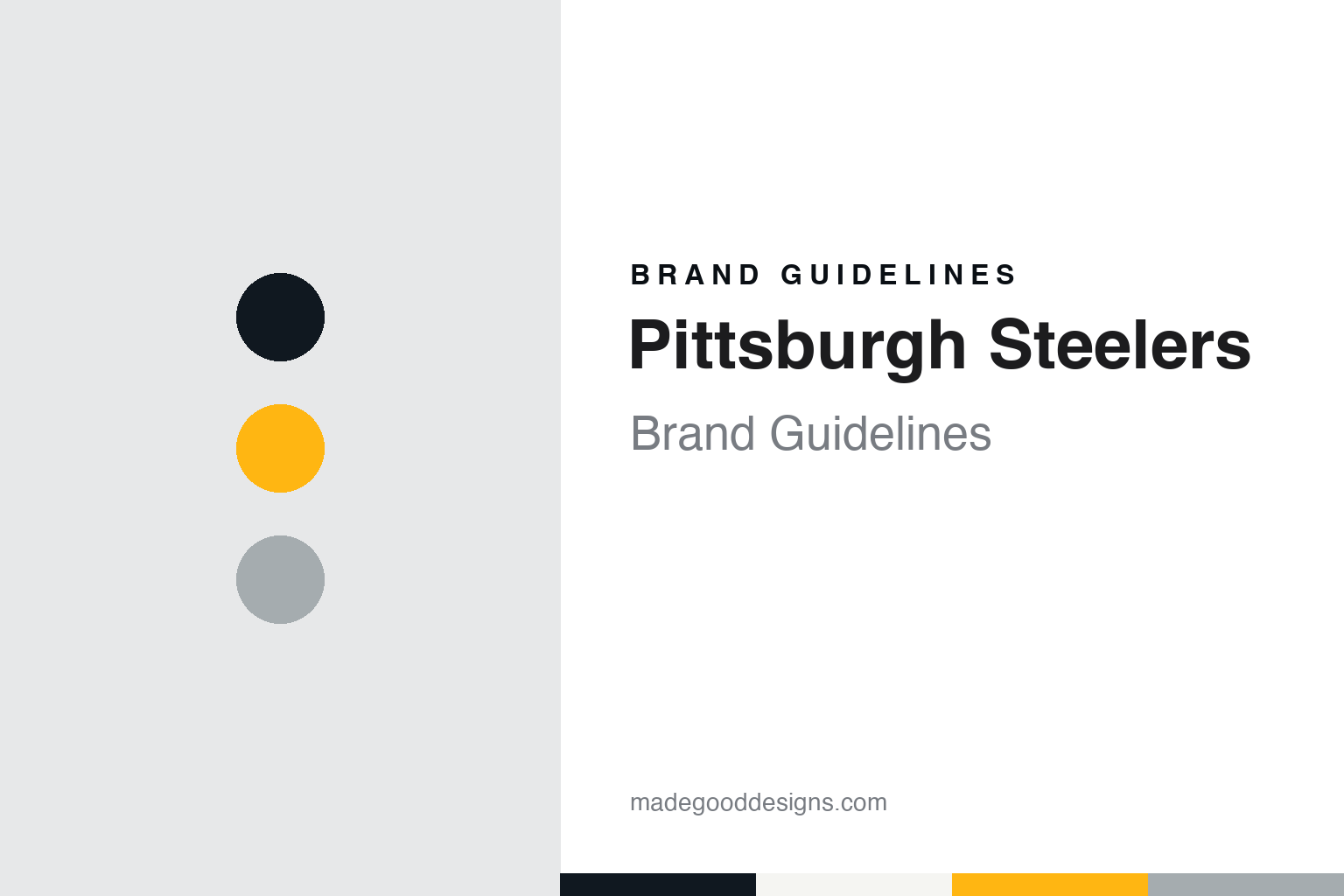
Pittsburgh Steelers Brand Guidelines
A borrowed industry badge, black and gold, and a helmet left half-finished on purpose.
Aa
Two constants: a helmet black, steel gold and mill grey palette and a condensed numeral sans register. Abstract homage — not a Pittsburgh Steelers product or mark; no helmet, uniform or logo is reproduced.
The Pirates
A borrowed baseball name, then a city’s trade.
The Pittsburgh Steelers were founded by Arthur J. “Art” Rooney on 8 July 1933, according to the Pro Football Hall of Fame’s team history, which says the club was known as the Pirates until 1940. English Wikipedia says the team took that first name from the city’s baseball club, as was common for National Football League teams at the time, and that local writers, to tell the two apart, took to calling the football side the “Rooneymen”, an unofficial nickname that outlasted the original name by decades. Wikipedia traces Rooney’s football interest to a semi-professional side he ran as a teenager, the Hope-Harvey Football Club.
The early club was itinerant. The Hall of Fame history says Rooney often took his team away from Forbes Field, the baseball park it shared, to neutral sites such as Johnstown and Latrobe in Pennsylvania, Youngstown, Louisville and New Orleans, to avoid clashing with baseball and college football in Pittsburgh. Wikipedia says the team played at Forbes Field from 1933 to 1963, then at Pitt Stadium at the University of Pittsburgh, before moving in 1970 to Three Rivers Stadium on the North Shore.
Before the 1940 season the Pirates became the Steelers. The war years produced two short-lived hybrids, both recorded by the Hall of Fame: with rosters thinned by the Second World War, Rooney merged his team with the Philadelphia Eagles as Phil-Pitt in 1943 and with the Chicago Cardinals as Card-Pitt in 1944. Wikipedia says the 1943 side, popularly called the “Steagles”, wore Eagles uniforms in green and white.
That season is the one gap in the colour story. Wikipedia says the Steelers have used black and gold since the club’s inception, that the early team wore solid gold-coloured helmets with black jerseys, and that the same two colours are now shared by Pittsburgh’s baseball and ice-hockey clubs and appear on the city’s official flag. Wikipedia adds that the shades differ from team to team, the Steelers’ gold reading as a bright canary yellow beside the baseball club’s darker mustard.
Colour
One family, three stadiums and a hard hat.
The Rooney family has controlled the Steelers since 1933. The Pittsburgh Post-Gazette reported on 7 July 2008 that the family was working to restructure the club’s ownership to separate the team from racetrack and gambling interests also held by family members, which the team said was inconsistent with league policy. The paper said chairman Dan Rooney, the eldest son of founder Art Rooney, and his son Art Rooney II, the club’s president, were arranging to buy out the shares of Dan’s brothers, who planned to concentrate on their racetracks, and that a related family, the McGinleys, also held a minority stake. Wikipedia says the restructuring brought in a number of outside investors while the Rooneys kept control, and that control of the franchise now rests largely with Art Rooney II.
The team moved again in 2001, into a football-only stadium on the North Shore beside the Ohio River. Wikipedia says it opened as Heinz Field and was renamed Acrisure Stadium in 2022, after the naming-rights deal with Heinz expired, and that its rows of yellow seats echo the team’s gold.
The club’s mascot arrived late. The Post-Gazette’s Robert Dvorchak reported on 9 August 2007 that the team had named a mascot as part of its 75th-anniversary season, chosen from fan suggestions: Steely McBeam, a steelworker in a plaid gold shirt, black bib overalls and a hard hat, with a jutting jaw. Dvorchak wrote that the winning entrant, Diane Roles, chose the name for Pittsburgh’s steel history, an Irish “Mc” for the Rooney family and “beam” for the city. Wikipedia credits another fan symbol, the Terrible Towel, to the broadcaster Myron Cope in 1975, and says the rights to it were later given to the Allegheny Valley School in Coraopolis.
The uniform has been steady. Wikipedia says the current design dates from 1968: gold trousers with black or white jerseys. In 1997 the club switched to rounded jersey numbers to match the Futura Condensed numerals on its helmets and added the logo to the left chest; Wikipedia says the Steelers, like the New York Giants, place numbers on both the front and back of the helmet. Throwbacks have revisited the archive, among them a black-and-gold hooped “bumblebee” set modelled on 1934 jerseys, worn from 2012 to 2016, and a 2025 set based on the 1933 gold uniforms. Wikipedia also says that in 1979 the Iowa Hawkeyes coach Hayden Fry modelled his college team’s uniforms on the Steelers’, after the owners sent him replica jerseys.
Typography
Design and documentation.
Visual identity in professional American football works across a few fixed surfaces. The helmet logo is a mark seen often, applied as a decal on a curved shell and read from a distance on television and in the stands, so it tends to be a compact shape with a clear outline that still works when it is small. Many helmet marks are a single letter, a monogram or a simple symbol, set on a shell colour that is part of the identity in its own right.
Uniform colours carry much of the recognition. A team usually works with two or three main colours plus white, used across home and road jerseys, pants, socks and trim, and the stripe patterns on sleeves and pants become recognisable details over time. Alternate and throwback uniforms let a team revisit older looks without replacing its main kit.
Wordmarks are the custom lettering used for team names on merchandise, signage and broadcast graphics, often paired with the helmet logo. Numerals on jerseys follow their own drawn styles. In stadiums, end-zone graphics painted on the turf repeat the wordmark and colours at large scale, and midfield logos give the field its own centrepiece. For a designer, the useful lesson is how one small mark has to hold together across a helmet, a jersey, a field and a screen.
Aa
A condensed numeral sans — the register of a helmet number and a mill-yard sign. (Specimen set in Barlow Condensed, a sans-serif STAND-IN; NOT the Pittsburgh Steelers logo or Futura Condensed.)
The Steelmark
An industry badge on the right side of a helmet.
The Steelers logo did not start as a football mark. The American Iron and Steel Institute, which owns it, says the Steelmark was created by the United States Steel Corporation and contains three hypocycloids, four-pointed diamond shapes, and that U.S. Steel attached a slogan to it: steel lightens your work, brightens your leisure and widens your world. The institute says the mark was used in print, radio and television advertising and on labels for steel products from tanks to tricycles and filing cabinets, and that U.S. Steel handed the Steelmark programme over to the institute in the 1960s, when it came to stand for the steel industry as a whole. In the 1970s, the institute says, the three colours were given a second meaning, standing for the materials used to make steel: yellow for coal, orange for iron ore and blue for steel scrap.
The institute’s account also explains how the badge reached a helmet. In the 1950s the Steelers carried players’ numbers on both sides of their gold helmets; the numbers were later removed, and in 1962 Cleveland’s Republic Steel suggested that the team use the Steelmark as a helmet logo. The mark’s word read “Steel”, and the team says it had to petition the institute before it could change the word to “Steelers”; Wikipedia dates that permission to 1963.
The one-sided helmet followed from caution. The team says the logo was put on only one side, the right, as a temporary measure because the club was not sure it would like the look on an all-gold helmet, and that equipment manager Jack Hart was told to apply it; Wikipedia says the instruction came from Art Rooney. The team says that later in 1962 it changed its helmets from gold to black to make the new logo stand out, and that, because of the interest the one-sided design generated, it decided to leave the logo that way permanently. Wikipedia says the logo still sits on the right side of the helmet alone.
For a design guide, the Pittsburgh Steelers show how a club can adopt an industry’s trade badge, change one word and one helmet colour, and then keep a test placement for six decades because people noticed it. Compare it with NFL, the league on whose shield the club still plays, and New England Patriots, another club whose helmet carried an outsider’s drawing. For this guide we use helmet black, steel gold and mill grey with a condensed sans, an unofficial interpretation; no product or logo is reproduced.
Explore & save
Keep Pittsburgh Steelers’s identity on hand — save it to a board in the Made Good inspiration library.
Pittsburgh Steelers identity set
Pin the Pittsburgh Steelers helmet black, steel gold and mill grey palette and the condensed numeral sans register to your own board.