Naver Brand Guidelines
A search venture from 1997, gothic capitals in green and a building named after its lot number.
Aa
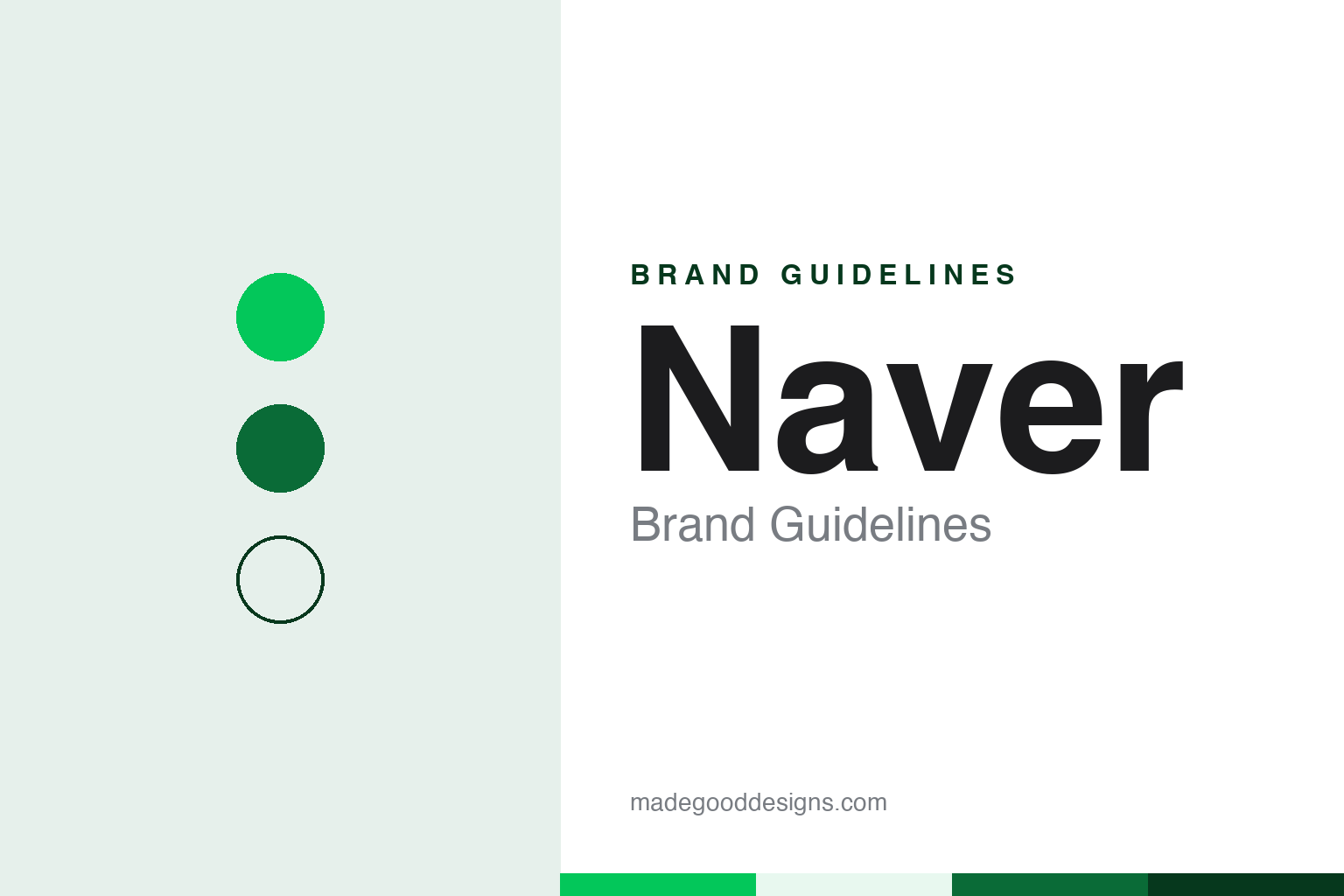
Two constants: a NAVER Green, factory green and mint palette and a Heavy gothic sans register. Abstract homage — not a Naver asset or mark; no logo or wordmark is reproduced.
A venture inside Samsung SDS
Web Glider, 1997.
Naver began as a small project inside a larger company. The Investor, the business publication of the Korea Herald, in a profile of the company’s founders carried on the Daum news portal on 12 August 2017, said that Lee Hae-jin and Kim Beom-su, who later founded Kakao, grew up in the same apartment complex in Seoul, graduated from Seoul National University in 1986 and both started work at Samsung SDS, an IT solutions developer, in 1992.
The paper said Lee and three junior colleagues launched Web Glider, the predecessor of Naver, as an in-house venture of Samsung SDS in 1997. The team then left to set up on its own. The Investor said that the group incorporated Naver.com in 1999 and set out to enter the web portal market, and that Naver began as a four-member start-up. Naver’s own history page dates the incorporation to June 1999 and says the company launched the search portal “NAVER” and a children’s portal, Jr. NAVER, that year, followed in December by the game portal Hangame. Wikipedia says the company was originally registered under the name Naver Comm.
The early company then took a different name for more than a decade. The Investor said Kim Beom-su had set up the online game company Hangame Communications in 1998, and that in 2000 the two men merged Naver.com and Hangame to form NHN, a web portal and online game business. Wikipedia says Naver Comm was renamed NHN Corporation, for Next Human Network, in 2001, while the Naver and Hangame services kept their own names. The search engine kept the Naver name throughout, while the company that ran it was known by three initials.
The original name came back when the company split. Naver’s history page says the separation of Naver Corporation and NHN Entertainment, the former Hangame, was completed in August 2013, and Wikipedia says the company took the name Naver Corporation on 1 October 2013. Wikipedia adds that the company is headquartered in Seongnam, south of Seoul, and that its affiliates include Naver Webtoon, Naver Labs, Naver Cloud and Snow. The Investor said Lee had served as chairman of the board, and Naver’s own news pages describe him as chairman in 2026.
Colour
Green capitals and a messenger in Japan.
Naver publishes its own rules for its name. On its brand resources page, the company says the NAVER logo type consists of solid, gothic-style capital letters in green. Gothic here is the Korean term for a sans serif. Naver says the logo reflects its service philosophy of being a friendly guide to its users and partners, and it asks that the logo be used without any change to its shape, colour or style. The company allows only a white and a black version as alternatives when a background makes the green logo hard to read.
The colour has a name and a published value. Naver says NAVER Green is its representative colour and that it stands for trust and reliability, along with challenge and exploration, friendliness and eco-friendliness. The brand page gives it as HEX #03C75A, with RGB, CMYK and a Pantone 2270 C reference. Naver also lists what may not be done to the mark: no outlines, no gradients, no added effects, no change to its proportions, and no use of the logo as an image frame or inside another company’s name, product, domain or icon.
One of the company’s services carried a different name. The Investor said Naver had launched a Japanese portal, Naver Japan, in 2001, closed it in 2005, and set it up again in 2007, with Shin Jung-ho, a developer who came to Naver with its 2006 purchase of the search start-up First Snow, as head of the Japanese office. The paper said the mobile messaging service LINE started in 2011, and that Shin was credited with a central role in building the messenger business in Japan. Wikipedia says it was launched by NHN Japan in June 2011.
LINE then became a company with its own name. Naver’s history page says NHN Japan changed its corporate name to LINE Corp. in April 2013, that LINE was listed in New York and Tokyo in July 2016, and that LINE was integrated with Z Holdings in March 2021, followed by the establishment of LY Corporation, combining LINE and Yahoo Japan, in October 2023.
Typography
A venture, a green and a building.
Korean corporate identities often carry their history inside their names. Group names can grow out of older company names, shortened over decades until the original words survive only as initials or a contraction. Other identities are built around English-letter abbreviations, which read the same at home and abroad, and which leave room for a holding company to sit above businesses as different as energy, chemicals and telecoms. Founders’ names and place names also turn up, sometimes in the original form and sometimes reduced to a single syllable.
Digital companies add a further layer. For an internet platform or a mobile app, the first point of contact is often not a logo on a building but an app icon on a phone screen: a small square that has to hold a colour, a shape and sometimes a single letter at very small sizes. Many consumer-facing companies also use character mascots as brand surfaces in their own right, appearing in messaging stickers, merchandise, retail stores and advertising, so that a cartoon figure can be as recognisable as the corporate name. A design reading of these companies looks at three layers together: the name, the mark, and the characters and icons that carry them into daily use.
Aa
A heavy gothic sans — after the solid green gothic capitals Naver describes for its logo type. (Specimen set in Archivo Black, a sans STAND-IN; NOT the Naver logo or any Naver typeface.)
Naver
A factory and a lot number.
Naver’s identity is also built into two office towers in Seongnam. Wikipedia says the company moved in 2010 into a new headquarters known as the Green Factory, in the Bundang district, and its article on the building says construction began in 2007 and was completed in March 2010. Naver’s contact page still lists the Green Factory as one of its headquarters sites.
The second tower takes its name from a number. The Asia Business Daily, reporting on 14 April 2022, said Naver had unveiled its second headquarters building, 1784, on which construction began in 2016. The paper said the name came from the building’s original project name, based on its lot address, 178-4 Jeongja-dong in Seongnam. It added that Naver also linked the number to 1784 as a date associated with the beginning of the First Industrial Revolution. Naver’s history page says the company moved into the building in April 2022.
The building doubles as a testbed. The Asia Business Daily said 1784 serves as both a workspace and a testbed for Naver’s work in robotics, autonomous driving, artificial intelligence and cloud computing. It said the building houses Naver staff alongside researchers from a KAIST-Naver AI centre and staff from start-ups backed by Naver’s D2SF programme, and that the robot research lab, previously in Jukjeon, moved to its first and second floors.
The paper also described a robot named Rookie that travels the building providing deliveries to employees. It said Rookie is a “brainless” robot, with its processing handled through the cloud, 5G and a digital twin of the building, and that it was developed on AROUND, an autonomous driving platform from Naver Labs. Deliveries started with parcels, and the paper said the service was planned to expand to lunchboxes and cafés across the building.
For a design guide, Naver shows how a company can hold one name through a merger and a decade under three initials, and how a single published green can run from a gothic wordmark to the name of a headquarters. Compare Kakao, whose founder started out with Lee Hae-jin at Samsung SDS, and Coupang, another Korean internet company. For this guide we use NAVER Green, factory green and mint with a sans, an unofficial interpretation built around Naver’s published green; no product or logo is reproduced.
Explore & save
Keep Naver’s identity on hand — save it to a board in the Made Good inspiration library.
Naver identity set
Pin the Naver NAVER Green, factory green and mint palette and the Heavy gothic sans register to your own board.