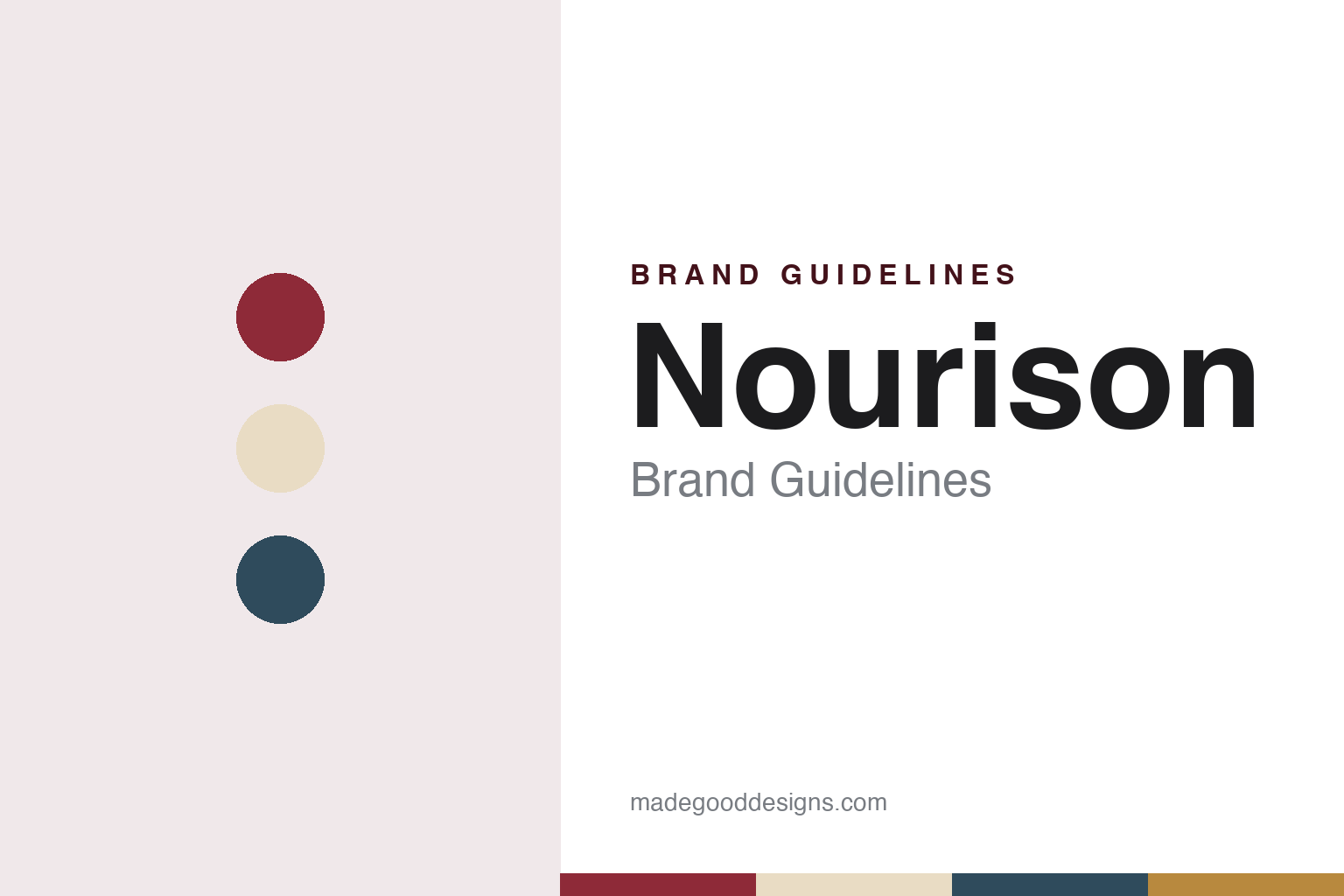
Nourison Brand Guidelines
Hand-knotted imports, a house weave and a family name on the label.
Aa
Two constants: a madder red, wool ivory, indigo and antique gold palette and a classical high-contrast serif register. Abstract homage — not a Nourison product or mark; no rug, label or logo is reproduced.
A family importer in New York
Hand-knotted carpets, brothers in business and a move into production.
Nourison was founded in New York City in 1980 by members of the Peykar family. The company’s own history page says that “brothers Paul, Alex, and Stephen Peykar founded Nourison in New York City in 1980,” and that it opened that year as an importer and wholesaler of hand-knotted carpets. The Home Furnishings Hall of Fame, in its profile of Alexander Peykar, gives a slightly different account of the founders: it says he co-founded the company with his brothers Paul and Edmond, after gaining experience in retail flooring, and that his brother Steven joined later to help build a wholesale source for Persian-style rugs.
From the start the business was about sourcing. The Hall of Fame profile says Nourison’s area rugs, in handwoven, hand-knotted and machine-made styles, come from India and China, and the company’s timeline is largely a record of new ways of making rugs abroad. It lists a hand-knotted programme in 1982 and, in 1983, a reworking of its Chinese production with the release of the Classic 120 line. Between 1988 and 1991, the company says, it developed Persian designs made in China, and between 1992 and 1994 it created the 70 Radj, a range of silk and wool carpets.
The timeline then turns to the company’s own constructions. Nourison says it launched its signature Nourmak weave in 1994, worked on tufted carpets in the late 1990s and in 1999 introduced the Nourison 2000 series. It says it entered the machine-made market in 2001 with a line called Persian Empire, and that in 2003 it established its first power-loom factory in China.
The company is now based in Saddle Brook, New Jersey, according to the Hall of Fame profile, which also says it supplies custom rugs, high-end wool broadloom carpet for hospitality and commercial projects, and decorative accessories such as pillows and throws.
Colour
Broadloom, licences and a range of house names.
In the 2000s Nourison widened from area rugs into wall-to-wall carpet. Its timeline says it entered the broadloom business in 2004 at the high end of the market, released the Heritage Hall collection in 2005 and the Nourison 3000 collection in 2007, and in 2009 introduced the Manhattan and Silk Garden broadloom collections, which the company says used a hand-embossing technique. In 2010, it says, it began mixing machine-made construction with hand-crafted finishes and details.
Licensing has been part of the business for decades. The Hall of Fame profile says Nourison introduced a licensed collection inspired by the paintings of Vasily Kandinsky at the Guggenheim Museum in 1988, and that it later worked with designers and personalities including Calvin Klein, Kathy Ireland, Michael Amini, Barclay Butera and Christopher Guy. In October 2026 the company’s website lists four licensed brands in its rug menu: Calvin Klein, Christopher Guy, DKNY and Michael Amini.
The website also shows how the business is organised today. Its rug menus run from washable and indoor/outdoor rugs to custom programmes, and its carpet menus name four brands, Nourison, Nourtex, Hagaman and J Mish, with a separate category headed “Manufactured in the USA.” A home accessories section adds pillows, throws and poufs, and a hospitality division appears in the site’s header.
The family name runs through the company. Alexander Peykar’s Hall of Fame profile presents him as one of its founders, and the company’s history page names the three brothers as founders.
Typography
Design and documentation.
The brands in this group all make or sell rugs and carpets for the home. Rug and carpet brands in general sit at many different points in the trade, from family firms that still carry a founder’s name to labels that now belong to much larger flooring or furnishing groups, and a single name can cover hand-knotted, hand-tufted, flatwoven and machine-made pieces in wool, cotton, jute or synthetic fibre.
A rug brand’s identity is usually carried less by one design than by a name, a catalogue of patterns and the place or tradition those patterns point to, because the company behind the name may have changed hands, moved its weaving elsewhere or grown far beyond the mill or showroom where it started. That makes the questions behind each name worth asking plainly: who started it, who owns it now, and where and how its rugs are actually made.
Each guide separates what independent sources record from what the company says about itself — its founding story, its owners over time, where its rugs are woven and how its collections have changed — and marks plainly what rests only on the company’s own word.
Aa
A classical high-contrast serif in the spirit of a traditional rug house. (Specimen set in Cormorant Garamond, a serif STAND-IN; NOT the Nourison logo.)
Nourison
A house of collections, weaves and borrowed names.
Nourison’s identity is built from collections rather than a single signature object. Its own timeline reads as a list of named lines, from the Classic 120 of 1983 to the Nourison 2000 and Nourison 3000 series and the Heritage Hall collection, and it presents several of them as signatures. The company’s Nourmak weave, which it says it launched in 1994, gives the house name a place in the name of a construction too.
Its roots in the traditional rug trade still show. The company began, in its own words, as an importer and wholesaler of hand-knotted carpets, and its early milestones are about Persian designs made in China and silk and wool carpets. Those references to classical rug design sit beside a later range of machine-made, tufted, washable and indoor/outdoor products, so the brand moves between two registers: the heritage carpet and the everyday area rug.
Licensed names form a third layer. From the Kandinsky collection shown at the Guggenheim Museum in 1988 to its current menus of Calvin Klein, Christopher Guy, DKNY and Michael Amini rugs, Nourison has repeatedly placed outside names beside its own. Each licensed range is presented under the designer’s or brand’s name, while the company itself acts as maker and supplier.
The carpet side adds another set of labels. Nourtex, Hagaman and J Mish appear beside Nourison in the company’s broadloom menus, and the separate “Manufactured in the USA” category shows the company grouping some carpets by where they are made. For rugs, the Hall of Fame profile names India and China as sources.
For a design guide, Nourison shows how a family importer can build an identity from named collections, house weaves and licensed partners, and keep its founders’ name at the centre while its range widens from hand-knotted imports to broadloom. Compare another American rug house in our Safavieh brand guidelines and a rug maker based in India in our Jaipur Rugs brand guidelines. For this guide we use madder red, wool ivory, indigo and antique gold with a serif, an unofficial interpretation; no product or logo is reproduced.
Explore & save
Keep Nourison’s identity on hand — save it to a board in the Made Good inspiration library.
Nourison identity set
Pin the Nourison madder, ivory, indigo and gold palette and the classical serif register to your own board.