Safavieh Brand Guidelines
An Isfahan export house, a Madison Avenue showroom and a family of rug people.
Aa
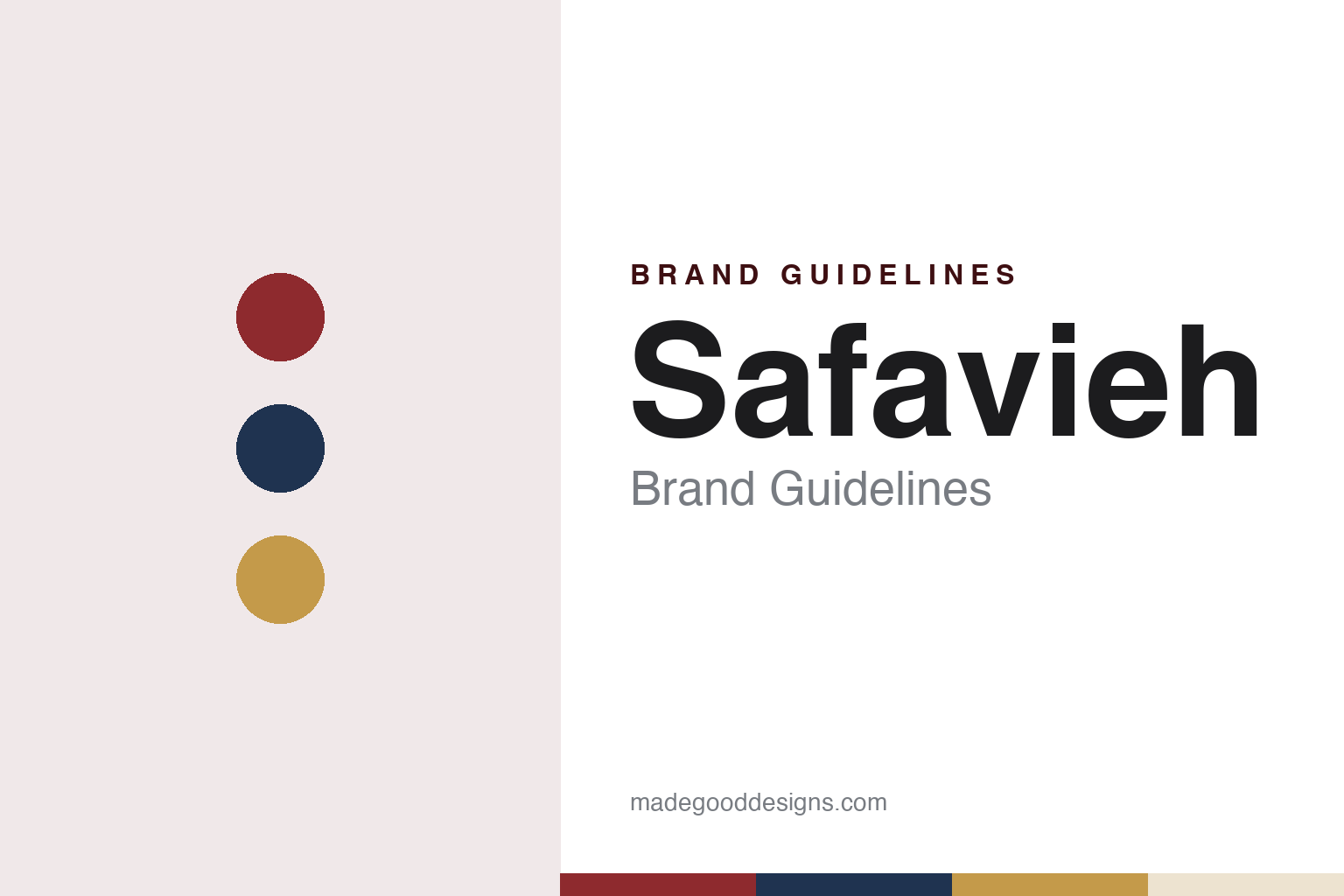
Two constants: a madder red, indigo navy, saffron gold and ivory palette and a classical display serif register. Abstract homage — not a Safavieh product or mark; no rug, label or logo is reproduced.
From Isfahan to Madison Avenue
A Persian rug exporter, a revolution and a showroom for designers.
Safavieh dates itself to 1914. Furniture Today, in a family profile published in November 2024, says that Kazem Yaraghi founded Safavieh that year as an exporter of Persian rugs, based in Isfahan, one of Iran’s historic rug-weaving centres. Rug News, writing in November 2005, gives the same year and city and describes the company as founded in Iran by the grandfather of the family members who run it today. The company’s own account says that Safavieh began as a supplier of antique Oriental rugs to interior designers.
The second generation took the business toward America. Furniture Today says that Kazem’s son Hamid Yaraghi joined in 1952 and helped the family penetrate the United States market for Oriental carpets. Hamid’s sons Ahmad, Cyrus, Arash, Darius and Michael, the magazine says, grew up with the family business.
Revolution in Iran ended that chapter. Rug News reported in 2005 that the family left Iran after the revolution, and quoted a family member as saying that it closed the family rug business in Iran overnight. By then the next generation had already started again in New York. Furniture Today says that Arash Yaraghi and his older brother Cyrus opened their first Safavieh showroom in New York City in 1978, and the company’s own website says it has been based in the United States since that year.
The address matters to the story. Rug News says the first showroom was at Madison Avenue and 32nd Street, opened as a retail operation, and that by 2005 the same space had become the company’s New York wholesale showroom. Furniture Today adds that the brothers did not run it as a typical retail store: they used the showroom to reach the metro-New York designer market for Oriental rugs. That early focus on the trade — decorators, designers and architects — is the thread that runs through much of how Safavieh still presents itself.
Colour
Rugs first, then furniture, licences and a wholesale business.
From one showroom the brothers built a much larger company. Furniture Today says the business expanded its store operations to retail locations across New York, Connecticut and New Jersey, and broadened its range to include furniture, lighting and home décor. The magazine says Safavieh entered the wholesale business in the 1990s, which it serves through permanent, year-round showrooms in Atlanta, High Point and Las Vegas.
The company moved its base out of Manhattan’s orbit. Rug News reported in 2005 that headquarters had moved from Secaucus, New Jersey, to Port Washington, New York, on Long Island, and Port Washington remains the headquarters named on the company’s website and in the Furniture Today dateline. In 2005 Rug News also described a furniture offer that included pieces from established furniture names, and new rug collections by the designer Walter Nicholas.
Licensing gave the name a second life on other people’s labels. Safavieh says its licensing programme began in 2006 with the designer Thomas O’Brien, followed by a Martha Stewart Rugs collection in 2007, a designer programme called Safavieh Couture in 2009, and Ralph Lauren and Lauren Ralph Lauren rug collections introduced in January 2011. The company says it studies fabric, colour and lifestyle trends, including couture fashion and colour forecasts, before developing new collections in its New York design studios.
Where the rugs are made is stated by both the company and the trade press. Safavieh’s website says it creates its rugs in the major weaving centres of Persia, India, Tibet, Nepal, China and Pakistan, and that it produces each design in the region it considers best suited to it. Furniture Today wrote in 2024 that the company has expanded beyond its original base to include its own production lines in India, Tibet, Nepal, China and Pakistan. In 2005 Rug News quoted the company as saying it had facilities in most of the countries where its rugs were produced.
The family is still in charge. Furniture Today says the brothers all remain active owners: Cyrus as the wholesale division’s rug sourcing and design lead, Darius as chief financial officer over logistics and operations, Michael as president of retail, and Ahmad in rug development and retail. The magazine names a fourth generation who joined from 2011 onward, working in furniture and lighting buying, retail marketing and the company’s expansion into Europe through large online platforms.
Typography
Design and documentation.
The brands in this group all make or sell rugs and carpets for the home. Rug and carpet brands in general sit at many different points in the trade, from family firms that still carry a founder’s name to labels that now belong to much larger flooring or furnishing groups, and a single name can cover hand-knotted, hand-tufted, flatwoven and machine-made pieces in wool, cotton, jute or synthetic fibre.
A rug brand’s identity is usually carried less by one design than by a name, a catalogue of patterns and the place or tradition those patterns point to, because the company behind the name may have changed hands, moved its weaving elsewhere or grown far beyond the mill or showroom where it started. That makes the questions behind each name worth asking plainly: who started it, who owns it now, and where and how its rugs are actually made.
Each guide separates what independent sources record from what the company says about itself — its founding story, its owners over time, where its rugs are woven and how its collections have changed — and marks plainly what rests only on the company’s own word.
Aa
A classical serif in the spirit of a rug dealer’s catalogue and showroom card. (Specimen set in Cormorant Garamond, a serif STAND-IN; NOT the Safavieh logo.)
Safavieh
A heritage rug name that also sells the whole room.
Safavieh’s identity rests on a date and a place. The 1914 founding in Isfahan is the first thing the company tells customers about itself, and it frames everything else: a family of Persian rug exporters who became a New York showroom, then a wholesaler, then a home furnishings brand. The name on the label carries that heritage even when the rug beneath it is a fashion design woven far from Iran.
The second pillar is the trade. From the Madison Avenue showroom described by Rug News to the permanent market showrooms in Atlanta, High Point and Las Vegas, Safavieh has presented itself first to designers and retailers. Its own account says it began as a supplier of antique Oriental rugs to interior designers, and that it continues to curate antique rugs and to draw on them as an archive for new collections.
The third pillar is borrowed signatures. A Thomas O’Brien collection in 2006, Martha Stewart Rugs in 2007, Safavieh Couture in 2009 and Ralph Lauren rugs from 2011 put other designers’ names beside Safavieh’s own. Furniture Today notes that the company has opened business with retail brands including West Elm, so a Safavieh design can appear in several shops under several stories at once.
Visually, this is a brand of classical cues: Persian reds and indigos, ivory grounds and gold accents, set alongside the cleaner neutrals of its contemporary ranges. For a design guide, Safavieh shows how a family rug house can keep a century-old origin story at the front of the brand while its catalogue reaches from antique reproductions to licensed designer collections. Compare it with Momeni, another Iranian-American rug family in New York’s trade, and Nourison. For this guide we use madder red, indigo navy, saffron gold and ivory with a classical serif, an unofficial interpretation; no product or logo is reproduced.
Explore & save
Keep Safavieh’s identity on hand — save it to a board in the Made Good inspiration library.
Safavieh identity set
Pin the Safavieh madder, indigo, saffron and ivory palette and the classical serif register to your own board.