Ogilvy Brand Guidelines
A founder’s signature, redrawn in red.
Aa
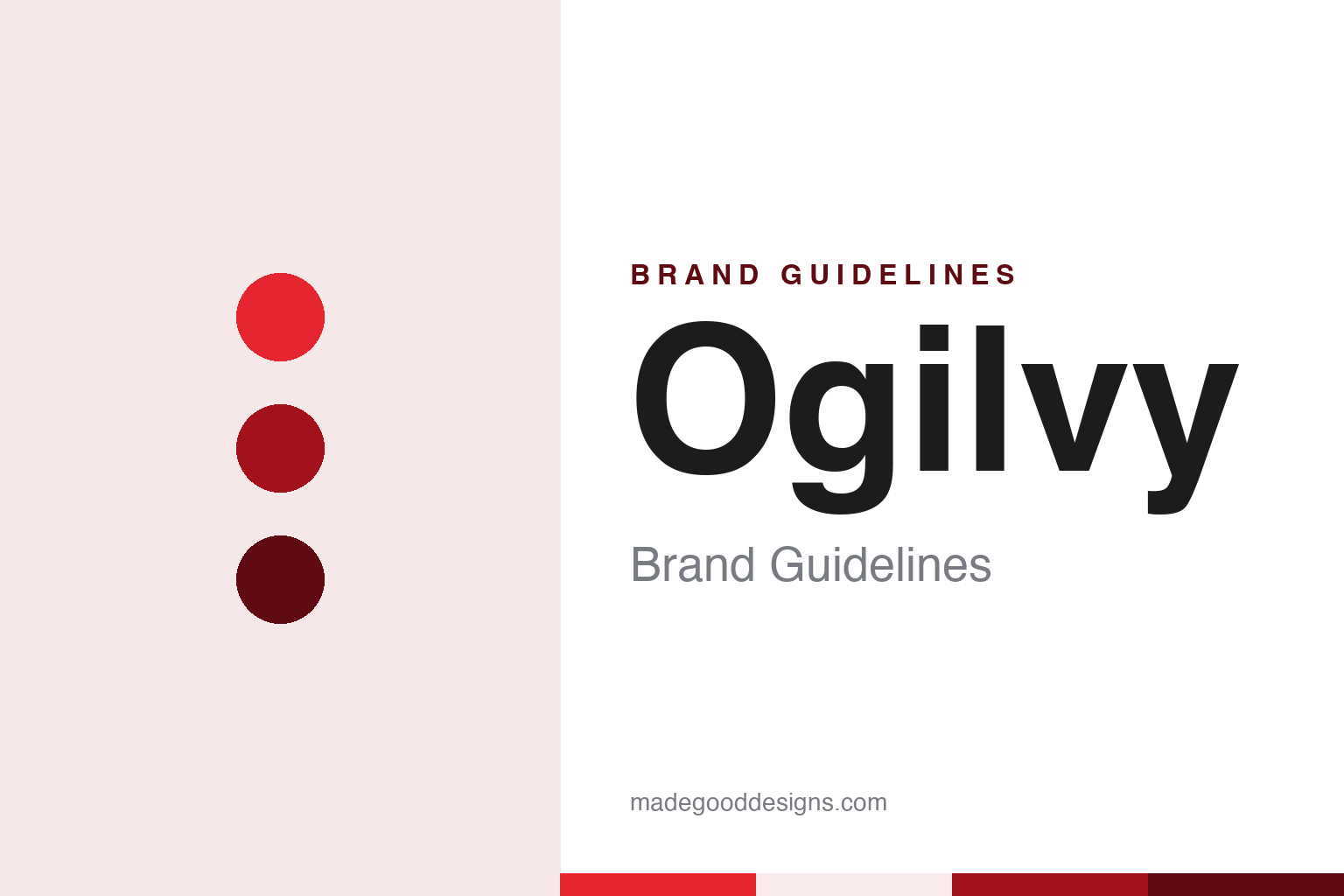
Two constants: a signal red, brick and oxblood palette and a Transitional serif register. Abstract homage — not an Ogilvy asset or mark; no logo, icon or wordmark is reproduced.
A New York agency with London backers
New York, 1948.
Ogilvy is named after David Ogilvy, and its story starts with his route into advertising. The Seattle Times, in an obituary published on 22 July 1999, said he went to Paris as an apprentice chef in the kitchen of the Hotel Majestic, then returned to England as a door-to-door salesman for Aga cookers. He wrote a guide for Aga salesmen, and that work earned him a copywriting job at the London advertising agency Mather & Crowther, where an older brother worked.
The same obituary said Ogilvy moved to the United States in 1938, became an associate director of George Gallup’s Audience Research Institute in Princeton, worked for the British Embassy in Washington during the Second World War, and afterwards farmed among the Amish in Lancaster County, Pennsylvania.
The agency came next. With financial backing from his old London agency but no clients, the Seattle Times said, he founded Hewitt, Ogilvy, Benson & Mather in New York in 1948. Wikipedia says the agency opened on 23 September 1948 on Madison Avenue, that its sponsors were Mather & Crowther and another British agency, S. H. Benson, and that Ogilvy recruited Anderson Hewitt from J. Walter Thompson as president. The long name listed the American partners and the two London backers in a single line.
Wikipedia says the British sponsors passed the new agency a group of clients little known in the United States, among them Wedgwood, Guinness and Bovril. After disagreements between the two Americans, it says, Hewitt left, and the agency reopened as Ogilvy, Benson & Mather in 1954.
The name shortened again in the 1960s. Wikipedia says Ogilvy, Benson & Mather and Mather & Crowther formed a partnership in November 1964 under a new parent called Ogilvy & Mather, and that both agencies took the name Ogilvy & Mather in January 1965. The Seattle Times put it more briefly: the name evolved to Ogilvy & Mather by 1965, when Ogilvy took over his London patron. Wikipedia also traces the Mather side of the name back to an advertising business that Edmund Mather started on Fleet Street in London in 1850, so the merged agency joined a New York founder’s name to a London agency’s older one.
Colour
A signature, a red and a recut Baskerville.
For decades the agency was known in full as Ogilvy & Mather, although its staff and clients often shortened it to Ogilvy. The short form became the official one in June 2018. Creative Bloq reported on 7 June 2018 that the agency had launched a rebrand tied to a significant internal restructuring, changing its name from Ogilvy & Mather to Ogilvy. The rebrand was created in partnership with the design company Collins, covered the website, typefaces and logo, and took two years to complete.
The new wordmark looks back to the founder. Creative Bloq said the typeface of the wordmark was adjusted to make it weightier and more in line with a previous handwritten logo based on David Ogilvy’s signature. Collins said the visual identity system “has its roots in Ogilvy history”. The gaps between the letters were reduced so that many of them run into one another; the clearest example, Creative Bloq noted, is the ear of the letter g looping into the dot of the i.
Colour stayed close to what came before. Ogilvy Red remained the core colour, Creative Bloq said, but was shifted to a brighter hue to sit with a new secondary palette of grey, blue, pink and yellow. The typography followed the same pattern of renewal rather than replacement: a pair of recut and customised typefaces, Ogilvy Serif and Ogilvy Sans, both redrawn from Baskerville, the agency’s existing corporate typeface.
The identity was one half of a larger change. Wikipedia says chief executive John Seifert launched a “re-founding” of the company in June 2018, during which the name changed, the business was restructured and a unified brand and logo were rolled out. All but one of the agency’s sub-brands were folded into the single name Ogilvy, it says, while the strategy division was kept and renamed Ogilvy Consulting. Creative Bloq described the same move as waving goodbye to global sub-brands.
The result is an identity in which the founder’s name, his signature and a long-held red all survive, while the second founding name and the separate unit names drop away.
Typography
A name, a signature and a red.
Advertising-agency identities are built from unusual raw material. Many agency names began as the surnames of their founders, set side by side or shortened to a run of initials, and over time those initials can become a wordmark that few people read as names at all. Above the agency brands sit holding-company names, which tend to be shorter, more abstract and designed to work on annual reports, stock listings and conference stages rather than on client work.
Because an agency sells ideas rather than packaged goods, its brand surfaces are unusual too. The lobby and reception area act as a shop window for visiting clients and job candidates. House symbols, small objects or colours associated with a founder, can turn up on desks, award shelves and merchandise. Pitch decks, credentials documents and case-study reels carry the identity into rooms the agency does not own, so the type, colour and layout rules have to survive being projected, printed and shared as files.
For a designer, the useful lesson is how a business-to-business identity balances heritage, signalled by founders’ names and dates, against the need to look current to the next client in the room.
Aa
A transitional serif — after an agency whose house typefaces were redrawn from Baskerville. (Specimen set in Libre Baskerville, a serif STAND-IN; NOT the Ogilvy logo, Ogilvy Serif or any Ogilvy typeface.)
Ogilvy
Campaigns, books and an owner.
The agency’s early reputation was built on campaigns that the Seattle Times obituary of 1999 recalled by name. It cited the Hathaway Man with his black eye patch, created for the shirt maker C. F. Hathaway, and Commander Edward Whitehead, who appeared in advertising for Schweppes tonic. It also quoted a line Ogilvy wrote for Rolls-Royce: “At 60 miles an hour, the loudest noise in this new Rolls-Royce comes from the electric clock.” The obituary listed Shell Oil, Sears, KLM, American Express, IBM and Pepperidge Farm among the other brands his campaigns marketed.
Ogilvy also wrote about the trade. The Seattle Times named three books: Confessions of an Advertising Man in 1963, an autobiography titled Blood, Brains & Beer in 1978, and Ogilvy on Advertising in 1983. The books carried his name to readers who never saw an Ogilvy & Mather office, and they kept the founder’s voice attached to the agency long after he stepped back from running it.
Ownership changed at the end of the 1980s. Wikipedia says Ogilvy & Mather International was renamed the Ogilvy Group in 1985, and that the British holding company WPP acquired the Ogilvy Group in 1989. David Ogilvy initially resisted the sale, Wikipedia says, but accepted the title of honorary chairman of WPP, which he gave up in 1992. WPP has owned Ogilvy since 1989.
David Ogilvy died on 21 July 1999 at his home in Touffou, France, the Seattle Times reported the next day, citing an announcement from his New York agency. Later chief executives, Wikipedia says, include Charlotte Beers from 1992, Shelly Lazarus from 1996 and Devika Bulchandani from September 2022; in March 2024 the agency gathered its customer experience and relationship services under the name Ogilvy One.
For a design guide, Ogilvy shows how an agency can carry its founder’s signature into a modern wordmark and keep one red as its constant across a name change. Compare WPP, the group that has owned Ogilvy since 1989, and Schweppes, the tonic brand behind the Commander Whitehead advertising. For this guide we use signal red, brick and oxblood with a serif, an unofficial interpretation; no product or logo is reproduced.
Explore & save
Keep Ogilvy’s identity on hand — save it to a board in the Made Good inspiration library.
Ogilvy identity set
Pin the Ogilvy signal red, brick and oxblood palette and the Transitional serif register to your own board.