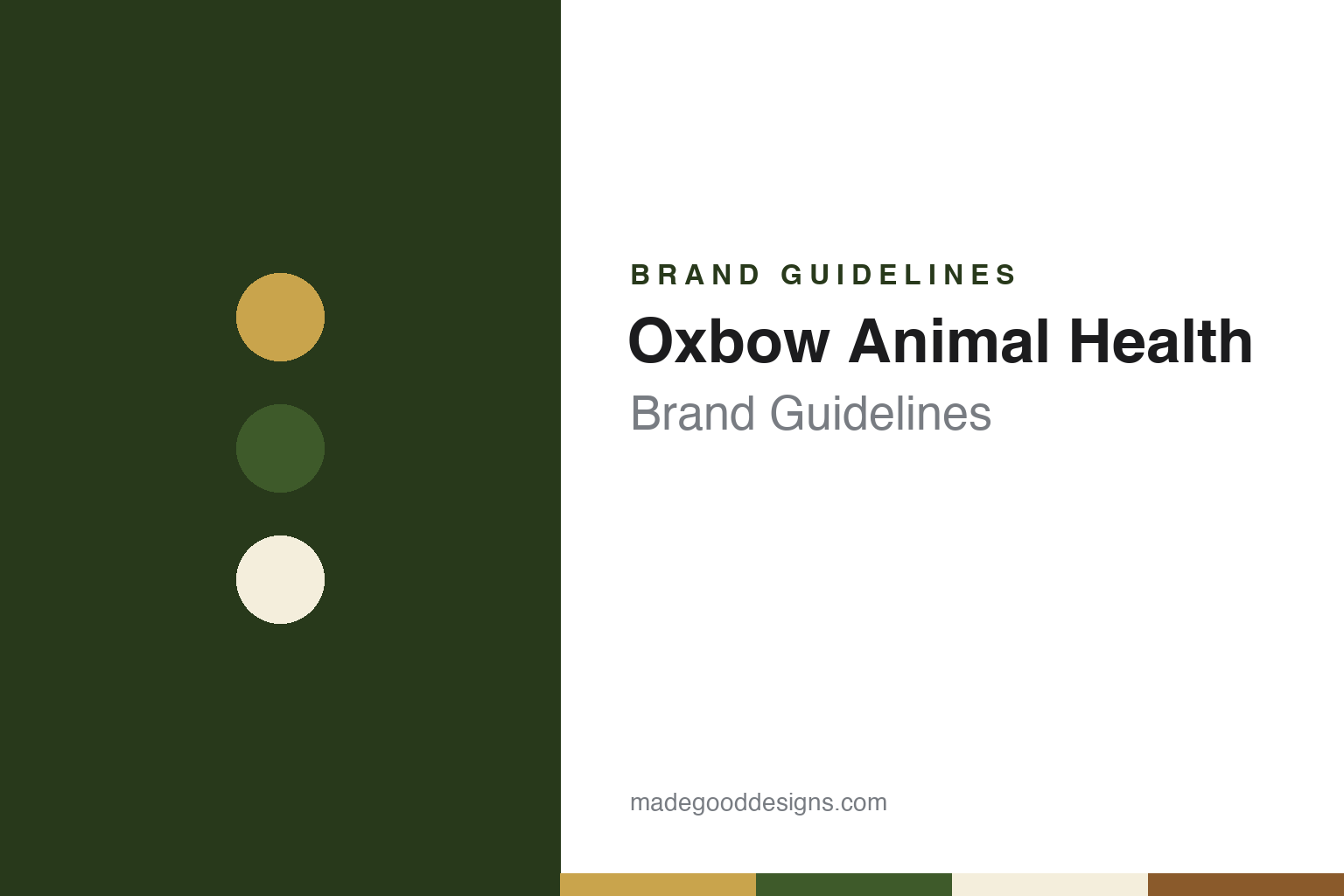
Oxbow Animal Health Brand Guidelines
John Miller’s Nebraska hay farm, owned by Manna Pro since 2022.
Aa
Two constants: a timothy gold, prairie green and bale cream palette and a warm farmhouse serif register. Abstract homage — not an Oxbow product or mark; no bag, logo or label is reproduced.
A hay farm at Murdock
An engineer, a family farm and a crop for small pets.
Oxbow Animal Health makes food, hay, treats and supplies for small pets — rabbits, guinea pigs, chinchillas, hamsters and their relatives — and it began as a hay business on a Nebraska farm. The University of Nebraska–Lincoln’s Department of Animal Science, in a profile published when it honoured him in 2024, says founder John Miller graduated from the university in 1972 with a degree in agricultural engineering and that he and his wife, Pat, returned to the family farm at Murdock, Nebraska, in 1973. The farm, the university says, was a traditional grain, hay and livestock operation.
Miller’s interest in marketing and in adding value to what the farm grew led him, according to the same profile, to start Oxbow Hay Company in 1980. The company’s own account puts its start in 1980 too and describes Miller as a fifth-generation hay farmer who spent years learning to cut hay in the right conditions, “even if it meant harvesting beneath the stars,” as its website puts it. The step from farm crop to pet brand came twelve years later. The university says that after researching the pet food market and testing whether his alfalfa hay could be sold there, Miller set up Oxbow Pet Products in 1992 and introduced a product called Alfalfa Nibbles.
Miller’s engineering training shaped the business as well. The University of Nebraska–Lincoln says he designed many of the machines and systems the company used to make its products, including the machine that produced its “Harvest Stacks” hay. The same 2024 profile describes him as the founder and former president of Oxbow Animal Health, and says he remained active at the university, serving on advisory boards there.
Colour
From a farm address to a new home near Omaha.
For its first decades the company was based at Murdock. In 2017 it moved. The Sarpy County Chamber of Commerce listed a ribbon cutting at Oxbow Animal Health for 27 October 2017, welcoming the company “to the Sarpy County business community,” with Nebraska’s governor among the scheduled speakers. The event was held at the company’s new site in Sarpy County, which uses an Omaha mailing address.
By then the business had a chief executive from outside the founding family. Deb Buhro was Oxbow’s chief executive when the company changed hands in 2022, according to the announcement of that deal. Its website opens its company story with the line “We are big lovers of small pets,” and describes a goal to “celebrate and inspire the love and care of small animals.”
The website’s company page also returns to the founder. “Oxbow began with a farmer, his craft, and a passion for perfection,” it says, before describing Miller’s hay and his decision to turn to small-pet nutrition and education. The page says the company has built a team of experts who share what they learn, and it names pet owners, retailers, rescues and volunteers among the people it aims to support with products and knowledge.
Typography
Design and documentation.
The seven brands in this group all make food, hay, treats or bedding for small pets and birds: Kaytee, Oxbow, Supreme Petfoods, Vitakraft, Burgess, carefresh and Versele-Laga. Brands like these sit at many different points in the pet trade, from family businesses that still carry a founder’s name to labels that now belong to much larger pet-products groups, and a single name can be sold everywhere from a supermarket shelf to a specialist pet shop.
A small-pet brand’s identity is usually carried less by a single product than by a pack, a name and a label, because the company behind the name may have changed hands, moved its production or grown far beyond the place where it started. That makes the questions behind each name worth asking plainly: who started it, who owns it now, and where its food and bedding are actually made.
Each guide separates what independent sources record from what the company says about itself — its founding story, its owners over time, where its products are made and how its packs and names have changed — and marks plainly what rests only on the company’s own word.
Aa
A warm, slightly old-style serif for a brand that tells a farm story. (Specimen set in Fraunces, a serif STAND-IN; NOT the Oxbow logo.)
Oxbow
A farm brand inside a pet-care group.
In January 2022 Oxbow was sold. A release issued on 4 January 2022 announced that Manna Pro Products, a St. Louis-based maker and marketer of pet care and nutrition products, had acquired Oxbow Animal Health, and the trade site Pet Worldwide reported on 11 January 2022 that Manna Pro was owned by funds managed by the investment firm Carlyle. Manna Pro has owned Oxbow since 2022. At the time of the deal Manna Pro’s chief executive, John Howe, described Oxbow as a brand that started with one farmer’s passion, and said it would complement Manna Pro’s range of products for animals “small to large.” The announcement described Oxbow as a small-animal brand of about thirty years’ standing, selling foods, supplements, treats and supplies for rabbits, guinea pigs, gerbils, hamsters, chinchillas and other small pets. Buhro said in the same release that she was delighted to combine Oxbow’s knowledge with Manna Pro’s.
The founder’s part in the story was marked two years later. In March 2024 the University of Nebraska–Lincoln announced that Miller would be the 2024 honoree of the Block and Bridle Club, which, the university says, has recognised people who contributed to Nebraska agriculture since 1938. The university’s profile of Miller traces the line from the Murdock farm to the brand that carries the Oxbow name today.
The look of the brand has been shaped with an outside agency. The agency Kick lists Oxbow Animal Health among its work, crediting itself with branding, packaging and strategy for the brand and describing more than a decade of partnership, including customer education material on what it calls “total pet wellbeing.” On Oxbow’s own website the range is organised into lines such as Essentials foods and Enriched Life toys and accessories, while its company page also names Kindswell and a “Total Herbivore Wellbeing” programme.
For a design guide, Oxbow shows how a single farm crop can anchor a whole small-pet brand, with the hay field kept at the centre of the story. Compare Kaytee, the Wisconsin seed firm that also serves small animals, and Supreme Petfoods, the British small-animal food maker. For this guide we use timothy gold, prairie green and bale cream with a serif, an unofficial interpretation; no product or logo is reproduced.
Explore & save
Keep Oxbow Animal Health’s identity on hand — save it to a board in the Made Good inspiration library.
Oxbow identity set
Pin the Oxbow timothy gold, prairie green and bale cream palette and the warm farmhouse serif register to your own board.


