carefresh Brand Guidelines
The paper-fibre small-pet bedding from Washington State.
Aa
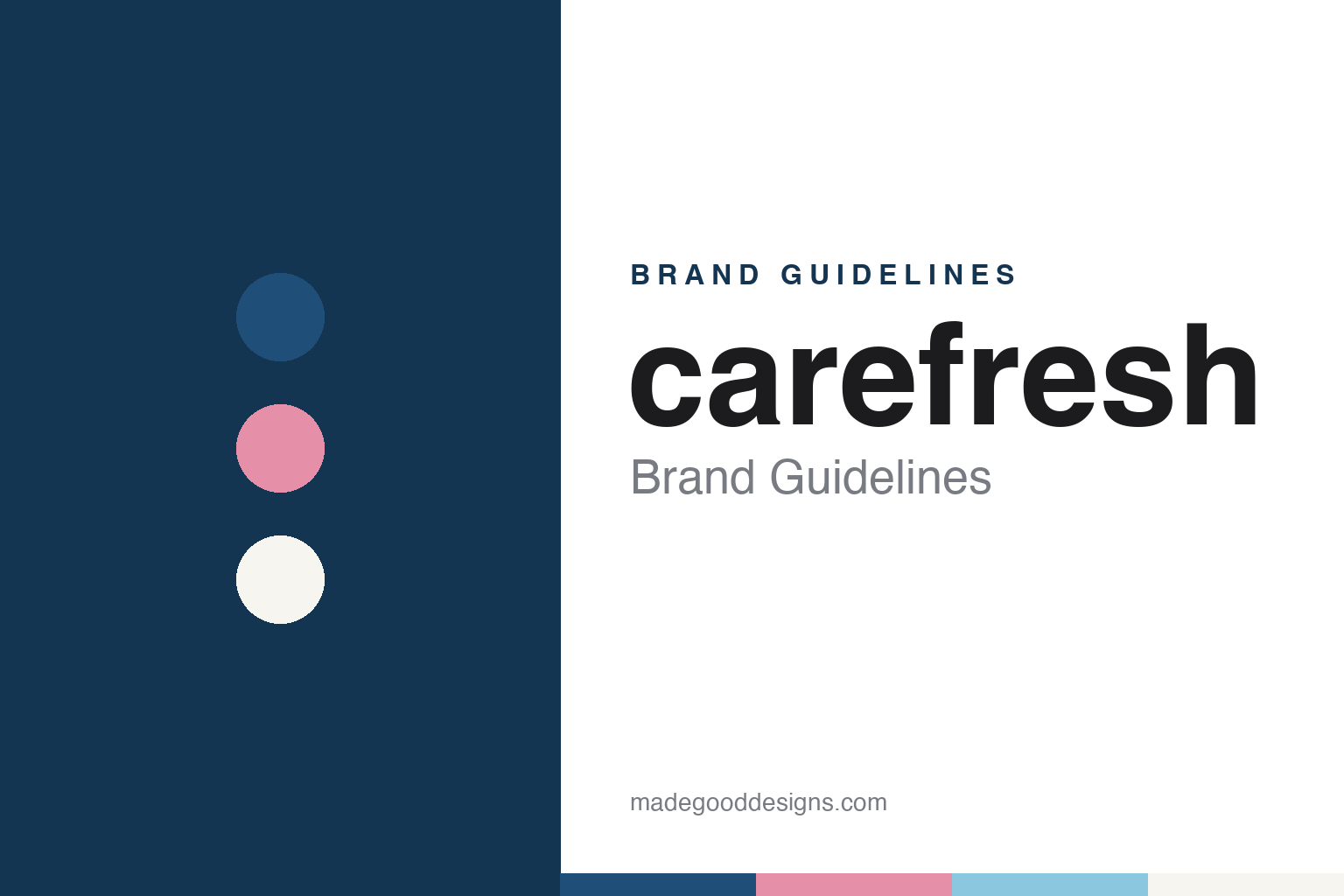
Two constants: a harbour blue, confetti pink and paper white palette and a soft rounded sans register. Abstract homage — not a carefresh product or mark; no pack, logo or bedding is reproduced.
Pulp into bedding
A Canadian company and a plant on the Bellingham waterfront.
carefresh is a bedding for small pets — rabbits, guinea pigs, hamsters and the like — made from paper fibre, and today it is sold by Healthy Pet of Ferndale, Washington, alongside the CritterCare, ökocat and Puppy Go Potty brands. Its story begins with a company that made products from what the paper industry threw away.
That company was International Absorbents Inc., which its annual report for the year to January 2004 says was incorporated in British Columbia on 13 May 1983, with offices in North Vancouver. Almost all of its business was carried on by a United States subsidiary, Absorption Corp, incorporated in Nevada on 25 July 1985 and licensed in Washington State. Industrial Info Resources, reporting on the company in October 2004, also dated its start of operations to 1983.
The early product was made on the Bellingham waterfront. The company’s annual report for the year to January 1998 described CareFRESH as “a cellulose-based bedding/litter product manufactured in Bellingham, Washington,” at a plant the company had built in 1987 on land leased from the Port of Bellingham. It said its products were made from “waste short fiber pulp” using its own technology, and by 2004 it described its raw material as a cellulose fibre by-product bought from pulp and paper mills in British Columbia and the north-western United States.
Colour
From Bellingham to Ferndale and Jesup, and to Germany.
The business grew out of Bellingham. Its 2004 annual report records that it bought land at Ferndale, a few miles north, in October 2002, and finished a production, warehouse and office building there in its 2004 financial year; it had also bought land at Jesup, Georgia, in August 2003. Industrial Info Resources reported in October 2004 that a new plant at Jesup was due to start commercial operation that December, and named careFRESH and HealthyPet as the company’s animal-bedding lines, alongside Absorbent W, an industrial product used to contain oil-based spills, including at sea. The pet side was already a family of brands: the 2004 annual report lists Healthy Pet, CRITTER Care, ECO fresh and Puppy Go Potty beside CareFRESH, including a version of the bedding for laboratories.
Ownership then changed twice. On 12 May 2010, according to a filing with the US Securities and Exchange Commission, International Absorbents’ shareholders approved its sale to companies affiliated with Kinderhook Industries, a private-equity firm. In March 2013 Pet Worldwide reported that Kinderhook, which had owned Absorption Corp since 2010, had sold its parent and operating companies to J. Rettenmaier & Söhne (JRS), the German fibre manufacturer known in pet shops for Cat’s Best cat litter. JRS, which gives its headquarters as Rosenberg in Baden-Württemberg, saw the business as a “platform for consumer products growth in North America,” the magazine reported. A year later, in May 2014, Pet Worldwide reported that JRS was handling European distribution of the American bedding, then sold as Carefresh Ultra, Natural, Colors and Confetti.
The business now trades as Healthy Pet. Its website describes its parent as a natural-fibre company with more than 100 years of history, and its careers page says that all of its manufacturing and warehouse jobs are now at Jesup, with offices remaining in Ferndale.
Typography
Design and documentation.
The seven brands in this group all make food, hay, treats or bedding for small pets and birds: Kaytee, Oxbow, Supreme Petfoods, Vitakraft, Burgess, carefresh and Versele-Laga. Brands like these sit at many different points in the pet trade, from family businesses that still carry a founder’s name to labels that now belong to much larger pet-products groups, and a single name can be sold everywhere from a supermarket shelf to a specialist pet shop.
A small-pet brand’s identity is usually carried less by a single product than by a pack, a name and a label, because the company behind the name may have changed hands, moved its production or grown far beyond the place where it started. That makes the questions behind each name worth asking plainly: who started it, who owns it now, and where its food and bedding are actually made.
Each guide separates what independent sources record from what the company says about itself — its founding story, its owners over time, where its products are made and how its packs and names have changed — and marks plainly what rests only on the company’s own word.
Aa
A soft rounded sans — a lowercase name. (Specimen set in Quicksand, a sans STAND-IN; NOT the carefresh logo.)
carefresh
Three spellings of one name.
The name itself has changed shape over the years. The 1998 annual report, a plain-text filing, set it in capitals as CAREFRESH, with a registered-trademark mark; the 2004 trade report wrote it as careFRESH, with the second half in capitals, beside a sister line written as HealthyPet; and the 2014 trade report wrote Carefresh. The same 2004 report says the company also distributed a premium line of small-animal foods with alliterative character names — Russel Rabbit, Gerty Guinea Pig and Reggie Rat — through a marketing alliance with the British maker Supreme Petfoods. Healthy Pet’s current website writes the bedding’s name entirely in lowercase, as carefresh, with a registered-trademark sign — the form this guide follows.
Colour is part of the product as well as the pack. Healthy Pet sells the bedding in a natural shade and in white, and in coloured mixes with names such as confetti, sprinkles, tutti frutti and sea glass; its pages present the range by these colour names. It also gives its fibre a trade name, comfyfluff, and says the bedding is “derived from 100% reclaimed natural paper fiber,” made from raw paper pulp; we give that as the company’s description.
Healthy Pet’s pages also promote a carefresh Gives Back programme alongside the bedding, keeping the brand’s voice close to the owners of small pets rather than to the paper mills its fibre comes from.
For a design guide, carefresh shows how an industrial by-product can be turned into a soft, colourful consumer brand, and how a wordmark can drift between capital and lowercase forms as a company changes hands. Compare Kaytee, another American small-pet brand, and Oxbow, the Nebraska small-animal food maker. For this guide we use a harbour blue, a confetti pink and a paper white with a sans, an unofficial interpretation; no product or logo is reproduced.
Explore & save
Keep carefresh’s identity on hand — save it to a board in the Made Good inspiration library.
carefresh identity set
Pin the carefresh harbour blue, confetti pink and paper white palette and the soft rounded sans register to your own board.