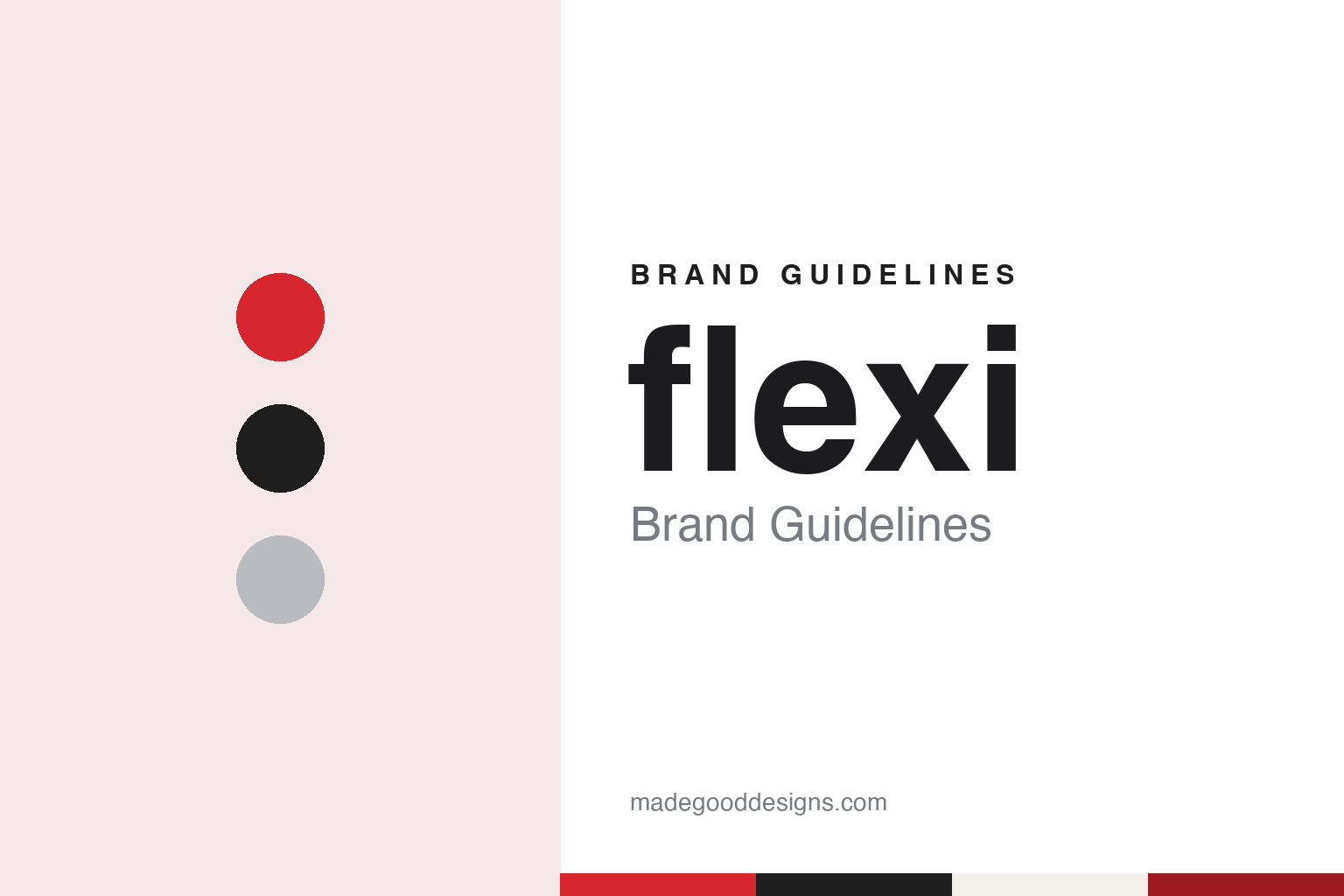
flexi Brand Guidelines
A leash on a spring, from a family firm near Hamburg.
Aa
Two constants: a signal red, deep red and housing black palette and a lower-case grotesque sans register. Abstract homage — not a flexi product or mark; no lead, housing or logo is reproduced.
A walk in Hamburg, 1972
A wooden housing, a spring and a dog called Purzel.
flexi — the company writes its name in lower case — is the retractable-lead brand of flexi – Bogdahn International GmbH & Co. KG, which describes itself as a family business in Bargteheide, a town just north-east of Hamburg. Its origin story is the story of one man and one dog. The company says its founder, Manfred Bogdahn, had the idea on “a warm summer day in 1972” while out walking his dog, Purzel, and it calls him the inventor of the retractable flexi leash.
The trade magazine PET worldwide retold the story in its second issue of 2023. It reported that Bogdahn was seen strolling the pavements of Hamburg with his dog in 1972, testing a lead that paid out and wound back on its own; that the prototype housing was made of wood; and that the mechanism used a spring from a chainsaw, which the magazine called the cornerstone of the business. German Wikipedia’s article on the retractable lead, the Rollleine, illustrates that wooden prototype.
The company followed quickly. PET worldwide dated the start of the business to 1 April 1973, and German Wikipedia says production and marketing began that year under the brand name flexi. On 25 October 1973 Bogdahn filed a United States design patent for a “Retractable dog leash”; it was published on 29 April 1975, according to the record held by Google Patents.
The breakthrough, PET worldwide reported, came the following year at Interzoo 1974, the pet-trade fair, where Bogdahn showed the lead on a stand of four square metres. The first production site, north of Hamburg, was soon outgrown, the magazine said, and in 1990 the company decided to build a production plant in Bargteheide, the town that is still its home.
Colour
A plastic housing, a thumb brake and a name in lower case.
The idea of a lead that reels itself in is older than flexi, and the patent record shows it. A United States patent for a “Leading device” by Mary A. Delaney, filed in January 1907, was published on 12 May 1908, and David E. Gottlieb’s patent for a “Dog leash” was published on 19 November 1940, both according to Google Patents. Germany had its own precedent: a patent for a Hundeleine, or dog lead, by Wilhelm Peters of Duisburg was filed in April 1951 and published on 19 February 1953, Google Patents shows, and German Wikipedia says that design was never brought to market. What Bogdahn’s 1973 design filing protected was a particular object: a hand-held housing with the line wound inside it.
That object remains the brand’s emblem. The company today sorts its leads by that line — tape or cord — and by collection, with ranges it calls Classic, Comfort, Xtreme and Giant, alongside accessories designed to clip on to the housing.
The name is the other constant. The company sets “flexi” in lower case in its own copy and on its site. Colour and finish change from range to range — the company lists a Neon collection and a Black Design collection among its current lines.
The company says its leads are designed and produced in Bargteheide, and PET worldwide reported in 2023 that production there is “Made in Germany.”
Typography
Design and documentation.
The seven brands in this group are all dog toy and accessory names: Outward Hound, FURminator, flexi, Nylabone, Benebone, Rogz and EzyDog. Brands like these sit at many different points in the pet trade, from family firms that still carry a founder’s idea to names that now belong to much larger pet-products groups, and a single brand can be sold everywhere from a supermarket aisle to an independent pet shop.
A dog toy or accessory brand’s identity is usually carried less by a single product than by a name, a shape and a colour on a hang-tag or a box, because the company behind the name may have changed hands, moved its production or grown far beyond the place where it started. That makes the questions behind each name worth asking plainly: who started it, who owns it now, and where its toys, leads and tools are actually made.
Each guide separates what independent sources record from what the company says about itself — its founding story, its owners over time, where its products are made and how its packaging and marks have changed — and marks plainly what rests only on the company’s own word.
Aa
A lower-case grotesque sans for a short, soft word. (Specimen set in Barlow, a sans-serif STAND-IN; NOT the flexi logo.)
flexi
A family firm, a fair stand and a town north of Hamburg.
flexi has stayed close to the place it began. The company describes itself as a family business, and the legal name it trades under, flexi – Bogdahn International, still carries the founder’s surname more than half a century after the April 1973 start date that PET worldwide recorded. Bargteheide, a small town in the district of Stormarn in Schleswig-Holstein, sits between Hamburg and Lübeck, and it is where the company says its leads are both designed and made.
The company’s own account of its history still begins with the founder rather than the factory: its site retells, in Bogdahn’s own words, the summer walk with Purzel in 1972 and the moment the idea came to him.
The trade fair that made the lead’s name has also stayed part of its story. Interzoo, the international pet-trade fair in Nuremberg, is where PET worldwide placed the 1974 breakthrough, and the magazine’s 2023 profile, published as the company passed its fiftieth year, was titled “From bright idea to global market leader.”
The name needs a little care online. “Flexi” is also an everyday word used in many unrelated brand and product names; the lead company’s own site is flexi.de, and the full name, flexi – Bogdahn, identifies the lead maker.
For a design guide, flexi shows how a single mechanical idea — a lead wound inside a hand-held housing — can carry a family brand for more than fifty years, under a short name the company always writes in lower case. Compare EzyDog, the Australian lead and harness brand, and Rogz, the South African collar and lead maker. For this guide we use signal red, deep red and housing black with a lower-case grotesque sans, an unofficial interpretation; no product or logo is reproduced.
Explore & save
Keep flexi’s identity on hand — save it to a board in the Made Good inspiration library.
flexi identity set
Pin the flexi signal red, deep red and housing black palette and the lower-case grotesque sans register to your own board.