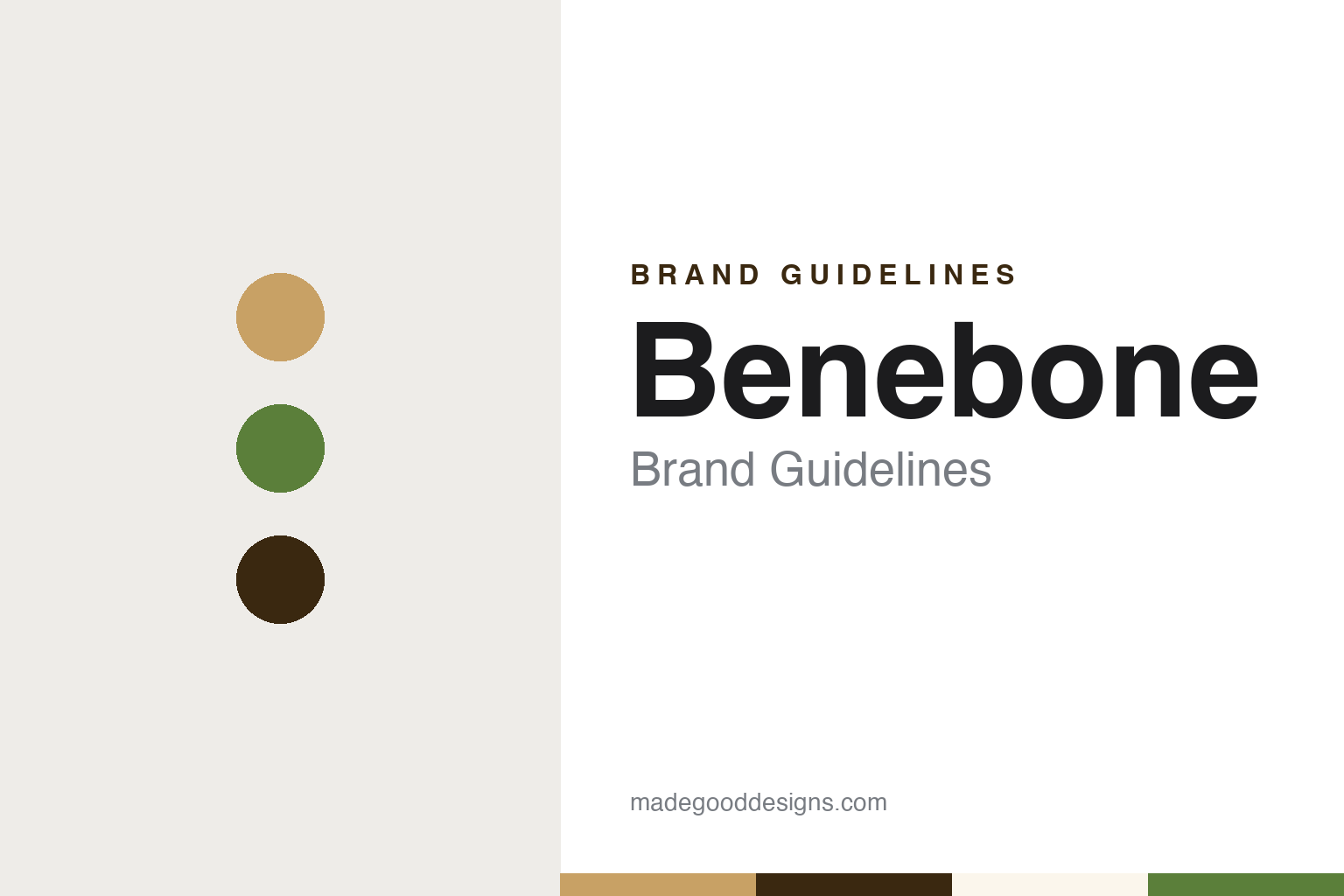
Benebone Brand Guidelines
The family-owned US maker of the curved wishbone chew.
Aa
Two constants: a wishbone tan, roast brown and leaf green palette and a friendly grotesque sans register. Abstract homage — not a Benebone product or mark; no chew, logo or package is reproduced.
A curved wishbone
A chew built around a shape.
Benebone is an American dog-chew company built around one object: a curved, bacon-flavoured wishbone. On its website the company says that “over a decade ago” it “turned the chew toy category on its head” with that product, and that “today, Benebone remains family-owned.” The business trades as Benebone LLC, and the copyright line on its website in 2026 gives an address in Philadelphia, Pennsylvania.
The company tells its origin as a reaction to what it saw on the shelf. Its “Our Story” page says it began “with the notion that pet parents want the best for their dogs,” but that “pet store aisles made us dizzy with neon colors and squeaks, much of it made overseas.” Benebone says it “started fresh,” and that it “zeroed in on things that dogs really dig.”
The page then sets out the reasoning behind the flagship in three plain points: that dogs “love real flavor,” that they “push durability to the limit,” and that they “don’t have thumbs.” From those, the company says, it arrived at “real bacon in a quality, USA-made, durable chew designed for a paw-friendly grip.” “By focusing on the basics and sweating the details,” the page goes on, “we knew we were onto something.”
That “USA-made” line is the company’s own description of its manufacturing, and it recurs across the brand’s website, which tells the company’s story through the product rather than through its people.
Colour
Good, loosely translated.
The name is part of the brand’s voice. Benebone’s “Our Dogma” page explains it with a joke at its own expense: “‘Bene’ is Latin for ‘good vibes’ (we took some liberties here).” The word does mean “well” or “good” in Latin; the company says the name is “a reminder of our guiding principles,” which it describes as “caring for dogs, connecting with people, and creating a better world for all.”
The same page lists six principles under short headings. “Nothing but the best” says the company uses “the highest-quality materials we can find” and produces everything “with people we know and genuinely trust.” “Give back” ties the business to charity; “Delight dogs” says it tailors “every aspect” of its products to dogs’ needs, “cleverly and simply.” “Practice good business,” “Stay playful” and “Be human” close the list, the last with the lines: “We began as a small family business and intend to keep it that way. Anyone who reaches out can expect to meet a real person who cares.”
That tone — short headings, puns, a deliberately casual register — runs through the website. The company describes its community work as a central part of the brand: “Dogs bring our guard down,” its story page says; “we are friendlier, more approachable, and more empathetic in the presence of dogs.” The company says and that it fosters “that feeling through events, philanthropy, and developing deep relationships with our fan base.” Its website carries a “Dog of the Year” programme, a scholarship and a recycling page for used chews, alongside a customer loyalty scheme it calls the Wishbone Club.
The product range has grown from the original chew while keeping the wishbone as the anchor. Benebone’s website in 2026 groups its products into durable nylon chews, plant-based chews, puppy and gentle chews, and treat pods it calls Tongue Twister; green-coloured plant-based versions sit beside the original, among them the Green Wishbone and Green Fishbone.
Typography
Design and documentation.
The seven brands in this group are all dog toy and accessory names: Outward Hound, FURminator, flexi, Nylabone, Benebone, Rogz and EzyDog. Brands like these sit at many different points in the pet trade, from family firms that still carry a founder’s idea to names that now belong to much larger pet-products groups, and a single brand can be sold everywhere from a supermarket aisle to an independent pet shop.
A dog toy or accessory brand’s identity is usually carried less by a single product than by a name, a shape and a colour on a hang-tag or a box, because the company behind the name may have changed hands, moved its production or grown far beyond the place where it started. That makes the questions behind each name worth asking plainly: who started it, who owns it now, and where its toys, leads and tools are actually made.
Each guide separates what independent sources record from what the company says about itself — its founding story, its owners over time, where its products are made and how its packaging and marks have changed — and marks plainly what rests only on the company’s own word.
Aa
A rounded, friendly grotesque — the register of a playful, plain-spoken pet brand. (Specimen set in Bricolage Grotesque, a sans STAND-IN; NOT the Benebone logo.)
Benebone
From chews to play.
In March 2025 Benebone moved beyond chews. The trade title Pet Insight reported on 25 March 2025 that the company had launched Benebone Bounce, described as its first major line of interactive toys beyond chews: five natural-rubber toys named Bone, Ball, Tug, Cone and Pawbler, which the report said would be sold through Tractor Supply, specialty pet stores, online retailers and Benebone’s own website. The report quoted Nate Harceg, the company’s chief growth officer: “At Benebone, we know dogs chew like pros, but they also love a good game of fetch and tug.”
The Bounce toys extend the brand’s naming habit of short, literal product names — Wishbone, Fishbone, Bone, Ball, Tug — with the occasional invented word such as Pawbler. In 2026 the company’s website presents them under the heading “toys built for better play,” next to the chews, and its home page sums up the mission as delivering “better for dogs, their people, and the world around them,” with “thoughtful design and flavors dogs dig.”
Through these changes the company has kept the same story about itself: a family-owned business, a product shaped around how dogs hold things, real flavour, and manufacturing it describes as American. Those are the company’s own claims, set out on its own pages.
For a design guide, Benebone shows how a single, distinctive product shape can carry a whole brand, with a plain-spoken voice doing the rest. Compare Nylabone, another American chew brand, and Outward Hound, an American dog-toy brand. For this guide we use a warm tan, a roast brown and a leaf green with a sans, an unofficial interpretation; no product or logo is reproduced.
Explore & save
Keep Benebone’s identity on hand — save it to a board in the Made Good inspiration library.
Benebone identity set
Pin the Benebone wishbone tan, roast brown and leaf green palette and the friendly grotesque sans register to your own board.