Janod Brand Guidelines
The wooden-toy maker from Orgelet in the Jura.
Aa
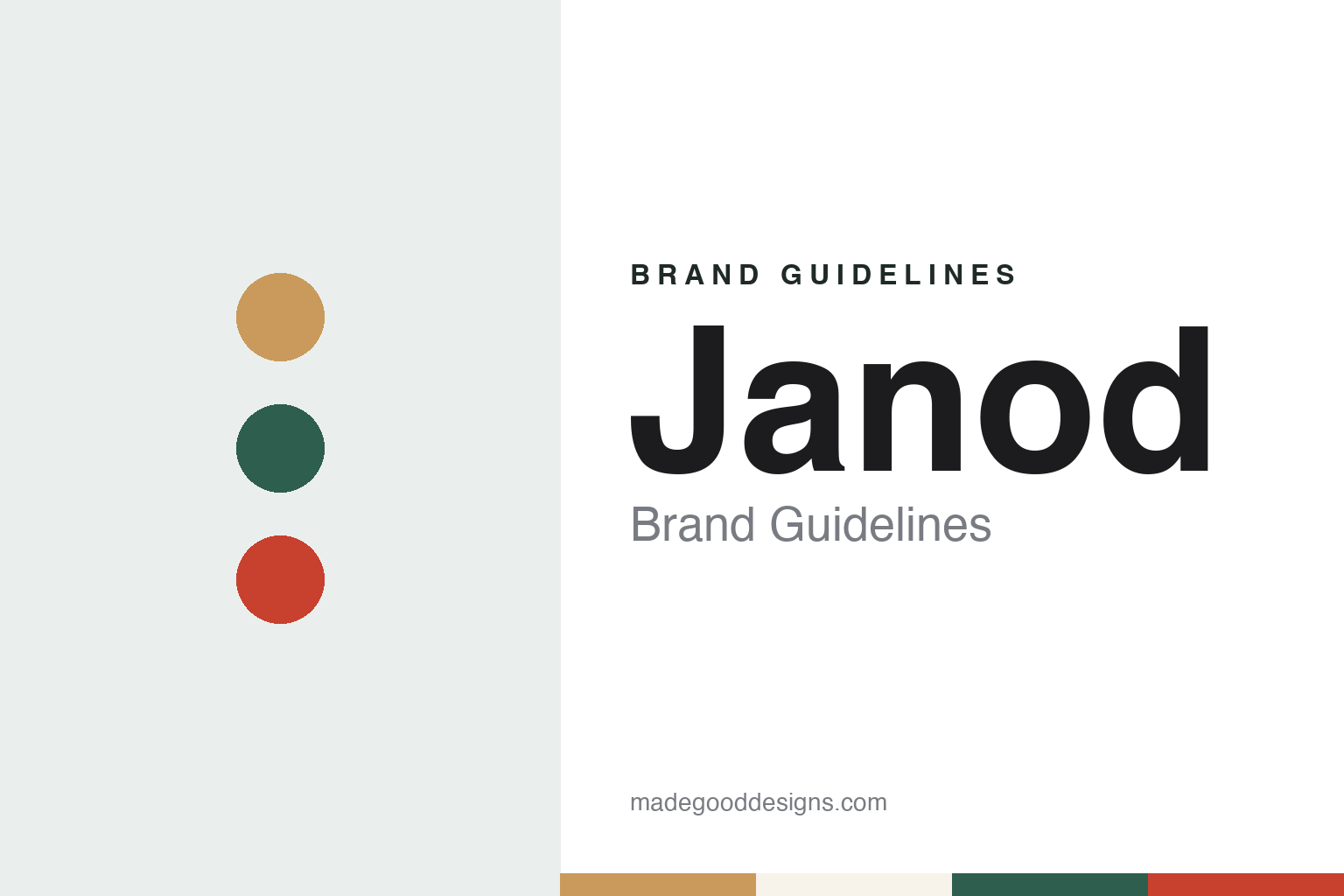
Two constants: a beech, Jura pine and spinning-top red palette and a workshop slab serif register. Abstract homage — not a Janod product or mark; no toy, box or logo is reproduced.
Orgelet, 1970
Spinning tops, yo-yos and skittles in the Jura.
Janod comes from Orgelet, a town in the Jura department of eastern France, and carries the surname of its founder. The games site Krinein, in a profile dated September 2026, says Louis Janod founded the company there in 1970, that he had been a wood turner, and that his first products were traditional wooden toys — spinning tops, yo-yos, skittles and other objects whose use, it writes, is understood simply by picking them up. The Toy Book, the American trade magazine, gave the same founding year in May 2015 and described Janod’s wooden toys as well known throughout Europe.
The workshop became a group. Krinein says the Juratoys group was created in 2004 to support Janod’s international development, and that the range widened from wood into cardboard, puzzles, magnetic games, pretend-play toys and creative crafts, naming the Magneti’book and a magnetic world-map puzzle among the products of that shift. By 2012 the group was also selling in the United States: the Besançon news site macommune.info reported in October 2012 that Janod toys had been on sale there since the start of that year through a subsidiary in Fort Lauderdale, Florida, sold through specialist shops and online.
Crossing the Atlantic changed the product and the box. macommune.info reported that the toys had been adapted to the American ASTM toy standard, which required specific testing, and that the packaging used in the United States differed from the French packaging, while ranges such as play kitchens and puzzles were the same in both markets.
Colour
Three owners in seven years.
Janod has changed hands three times since 2015. On 28 May 2015, The Toy Book reported that Alex Brands, the American toy group backed by the private-equity firm Propel Equity Partners, had acquired Juratoys, then “based in Orgelet, France,” as its first move into Europe. At that point Juratoys was the parent of two brands: Janod and Kaloo, which The Toy Book described as a plush brand making stuffed toys for babies. The same report said Juratoys had offices in the United Kingdom, the United States, Hong Kong and China.
Three years later the business returned to European ownership. The Toy Book reported on 25 July 2018 that Alex Brands had sold Juratoys to Argos Wityu, which it described as an independent private-equity group, and Real Deals, the private-equity journal, reported the acquisition two days later. In that report The Toy Book described Janod as a French wooden-toy brand offering pretend-play items and construction kits, and Kaloo as a maker of plush toys and bedding accessories.
In October 2022 the group passed to a French industrial owner. Maped, the family-owned French maker of colouring materials and school supplies, announced that it was acquiring Juratoys; Nursery Today reported the deal on 21 October 2022, quoting Maped’s chief executive Romain Lacroix on bringing in “the heritage brands Janod, Kaloo, and Lilliputiens.” Maped has owned Janod since 2022, and the deal made Juratoys part of what Nursery Today called a French family group.
Orgelet kept its role in that arrangement. According to Nursery Today, the Juratoys site in Orgelet “will remain the excellence centre for games and toys,” while Maped’s school-supplies business continues to be run from Argonay, in Haute-Savoie. The article named Ludovic Martin as chief executive of the Juratoys group and said the combined business would draw on Maped’s industrial experience and on local and regional purchasing.
Typography
Design and documentation.
The seven brands in this group are all toy names: Djeco, Janod, Tegu, Kapla, SmartGames, goki and Le Toy Van. Toy brands in general sit at many different points in the trade, from family firms that still carry a founder’s idea to labels that now belong to larger groups, and a single brand can be sold everywhere from a small independent shop to a department store.
A toy brand’s identity is usually carried less by a single object than by a box, a name, a colour and a way of drawing, because the company behind the name may have changed hands, moved its production or grown far beyond the place where it started. That makes the questions behind each name worth asking plainly: who started it, who owns it now, and where its toys are actually designed and made.
Each guide separates what independent sources record from what the company says about itself — its founding story, its owners over time, where its toys are made and how its boxes and logos have changed — and marks plainly what rests only on the company’s own word.
Aa
A sturdy workshop slab serif. (Specimen set in Bitter, a slab-serif STAND-IN; NOT the Janod logo.)
Janod
A founder’s name kept through every sale.
Through each change of owner the Janod name stayed on the box. The founder’s surname has survived three sales of the parent company: The Toy Book in 2015 listed it beside Kaloo, and Maped’s chief executive in 2022 listed it first among the group’s “heritage brands.” The Juratoys group itself, rather than the brand, is the company that was bought and sold each time.
The range today reaches well beyond the turned-wood toys of 1970. Krinein describes a catalogue that runs from wooden pieces to cardboard puzzles, magnetic games, imitation play and craft activities, and macommune.info singled out play kitchens and puzzles as ranges that travelled unchanged from France to the United States in 2012, with only their packaging adapted for the American shelf. When Juratoys changed hands in 2018, The Toy Book said its two brands of the time, Janod and Kaloo, were aimed at children from birth to around six years old.
How the brand designs is described by Krinein, which writes that the brand designs by age and by physical gesture — stacking, rolling, composing a picture — and that wood keeps a central place in the catalogue because of the company’s Jura origins. It also places the creative team in the Jura, and describes the company as a maker of companions for play rather than a conventional board-game publisher.
For a design guide, Janod shows how a regional maker’s name, a material and a home town can stay attached to a brand through several owners — compare Djeco, the Paris toy company built on commissioned illustration, and Kapla, the French wooden-plank construction system. For this guide we use beech, Jura pine and spinning-top red with a slab serif, an unofficial interpretation; no product or logo is reproduced.
Explore & save
Keep Janod’s identity on hand — save it to a board in the Made Good inspiration library.
Janod identity set
Pin the Janod beech, Jura pine and spinning-top red palette and the workshop slab serif register to your own board.