Francesco Queirolo is remembered for one extraordinary surface: the knotted fishing net that hangs around the main figure of the Disinganno in the Sansevero Chapel in Naples. Giangiuseppe Origlia, writing in 1753–54, called the group the last and most trying test to which sculpture in marble can aspire, as the chapel’s museum records. For designers working with texture, pattern and symbolic imagery, Francesco Queirolo shows how a single, obsessively made detail can carry the meaning of a whole piece.
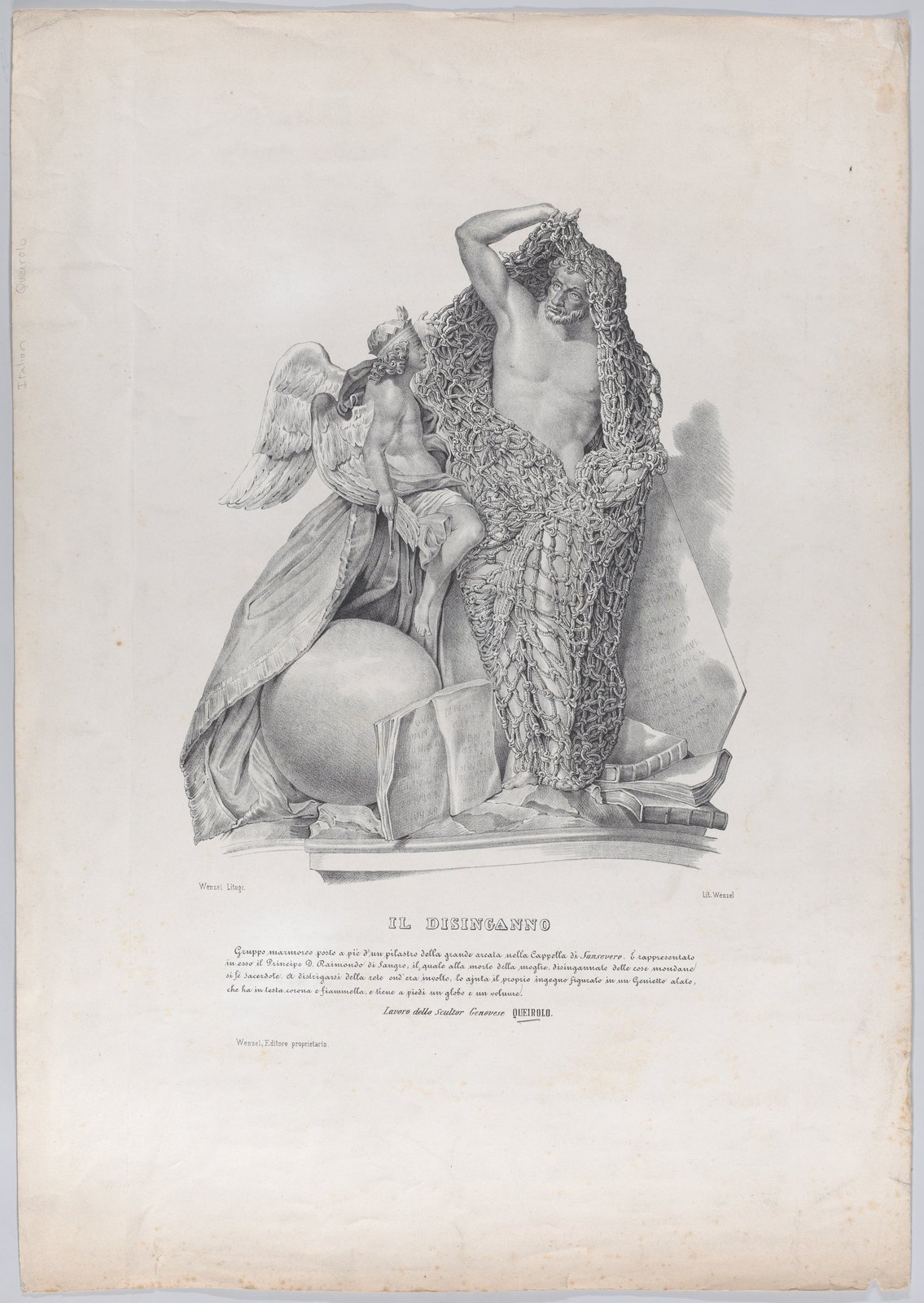
His marbles stand in a chapel museum in Naples, so the image below is a nineteenth-century lithograph of the Disinganno, credited to its printmaker. For more public-domain sculpture, prints and ornament, browse the MGD museum inspiration collection.
Who was Francesco Queirolo?
Queirolo was born in Genoa in 1704 into a family of modest means, according to Cristiano Giometti’s entry in the Dizionario Biografico degli Italiani (2016); the Deutsche Biographie index also gives his dates as 1704–1762. Giometti writes that he began an apprenticeship with the Genoese sculptor Bernardo Schiaffino at the age of eleven and later joined the Rome studio of Giuseppe Rusconi; the Italian museum guide MuseiOnline gives the same two teachers.
He spent roughly two decades in Rome. Giometti assigns him the statue of Saint Filippo Benizi for the façade balustrade of San Giovanni dei Fiorentini (1734–35), a stucco figure of Religion placed beside the papal throne in St Peter’s for the canonisations of 1737, a signed marble portrait bust of Pope Clement XII, and the upper statue of the fruits of autumn on the Trevi Fountain. The same entry records the tomb of Livia del Grillo in Sant’Andrea delle Fratte (1749–52).
The Sansevero Chapel years
The turning point came in Naples. Raimondo di Sangro, Prince of Sansevero, was rebuilding his family chapel as a programme of allegorical tombs. The Venetian sculptor Antonio Corradini, who had been working there, died in 1752, as both the chapel museum and Giometti record. Giometti writes that Corradini had left wax or terracotta models for almost all the figures, and that on 4 November 1752 Queirolo signed a contract to work exclusively for the chapel, using those models and making new ones. Museo Cappella Sansevero notes, for example, that his Sincerity follows a scale model by Corradini.
The partnership ended badly. Giometti records that the contract was terminated over missed deadlines, that the prince refused to pay the remaining fees, and that Queirolo won a court ruling for wages owed up to September 1759. He died in 1762, as Giometti and the Deutsche Biographie both record; Giometti adds that his model for an equestrian statue of Charles of Bourbon, chosen in a 1757 competition, was never executed.
Key works by Francesco Queirolo
Disinganno (Disillusion or Release from Deception), 1753–54
Museo Cappella Sansevero dates the group to 1753–54; Giometti gives 1753 and calls it Queirolo’s masterpiece. Raimondo dedicated it to his father, Antonio, Duke of Torremaggiore, who, the museum explains, left his young son in his grandfather’s care, travelled Europe and, repentant in old age, returned to Naples and became a priest. A bearded man struggles out of a net, which stands for sin; a winged genius with a small flame on his forehead, the sign of human intellect, helps him and points down to a globe, the symbol of worldly passions. An open Bible rests on the globe, and a relief on the pedestal shows Christ restoring sight to the blind.
Wenzel’s lithograph, shown above, is a useful document of how the group was read later. The Met catalogues it under a title naming the figure as Prince Raimondo himself, and its lettered Italian caption does the same, ending with a credit to the “Genoese sculptor Queirolo”. The Met dates the sheet to around 1840–50.
Education, 1753
Both the chapel museum and Giometti date this group to 1753 and connect it with the tomb of Girolama Caracciolo and Clarice Carafa di Stigliano, the two wives of Paolo di Sangro. A woman teaches a child, who holds Cicero’s De officiis, above the motto “Educatio et disciplina mores faciunt”.
Liberality, 1753–54
Dated 1753–54 by both sources and dedicated to Giulia Gaetani dell’Aquila d’Aragona, this life-size female figure holds a cornucopia of gold and jewels in one hand and coins with a compass in the other, beside an eagle.
Sincerity, 1754–55
Made for the tomb of Carlotta Gaetani, according to both Giometti and the museum, this figure holds a heart for love and charity and a caduceus for peace and reason, with a putto and two doves below.
What to look at: composition, line and light
Open against solid. In the Disinganno the net is the only part of the group you can see through. The globe, book and drapery are closed and smooth, and that contrast makes the net read even in a monochrome lithograph.
A diagonal of release. In Wenzel’s print, the man’s raised arm, the net lifting from his shoulders and the genius’s pointing hand set up a rising diagonal from the globe at lower left. The story, from entanglement to freedom, is told as a direction of movement.
Props as vocabulary. Queirolo’s allegories rely on a small, legible set of objects: net, flame, globe, book, cornucopia, compass, caduceus, heart and dove. Each figure has two or three attributes, held in the hands or placed at the feet, so the meaning can be read like a caption.
Lettering and inscription. Mottos and plaques are part of the design, and Wenzel’s print follows suit, with the title in outlined display capitals above a caption in flowing script. Education carries its Latin motto on the pedestal, the Disinganno relief bears the phrase “Qui non vident videant”, and the chapel museum records Bible passages engraved in the open book.
Light and palette. Measured from the Met’s scan of this impression of the lithograph, the sheet runs from a warm paper tone around #DFDCD8 through soft greys near #ACAAA9 to shadows around #706F6F. These are printing and paper values, not the colour of the marble, but they show how a narrow grey range can still separate net, flesh and drapery. You can sample your own scans with the image colour picker.
Technique: carving the net
The chapel museum records that Queirolo burnished the Disinganno with pumice himself, because the craftsmen refused to touch the delicate net for fear of breaking it. Giometti quotes the Genoese biographer Carlo Giuseppe Ratti, writing in 1762, who praised the net as so thin and finely worked that no greater marvel could be seen. Giometti also notes that his early skill in modelling clay led his master to move him on to marble.
Invention and execution were split: Giometti writes that Raimondo di Sangro devised the iconography, and the museum quotes Origlia calling the Disinganno “solely of the Prince’s invention”.
How designers can borrow from Francesco Queirolo
- Let texture carry the idea. The net is the meaning of the Disinganno, not decoration on it. In a logo, poster or package, choose one texture that tells the story and render it with care.
- Contrast open and closed shapes. A mesh, lattice or line pattern reads most clearly beside large smooth areas. Keep backgrounds and secondary forms quiet so the detailed element stands out.
- Build a small symbol set. Like his attributes, a brand or editorial series can use a short list of objects that always mean the same thing, two or three at a time.
- Tell the story as a direction. Arrange key elements on a diagonal or a clear path so the eye moves from problem to resolution.
- Work in one tonal range. The lithograph proves a grey scale can separate many materials. Test monochrome versions of a design before adding colour.
Queirolo’s career falls in the late Baroque and Rococo decades of Italian sculpture. For the wider context, see our guides to Baroque art and Rococo design, and for the printmaking process behind Wenzel’s sheet, our guide to lithography.
Where to see his work
The Disinganno, Education, Liberality and Sincerity are in the Sansevero Chapel in Naples, now run as Museo Cappella Sansevero. In Rome, Giometti locates works at San Giovanni dei Fiorentini, Sant’Andrea delle Fratte and the Trevi Fountain. Wenzel’s lithograph is in the Metropolitan Museum of Art.
Frequently asked questions
What is Francesco Queirolo known for?
He is known for the Disinganno (1753–54) in the Sansevero Chapel in Naples, a marble group in which a man frees himself from a carved marble net with the help of a winged genius.
Where is the Disinganno?
It is in the Sansevero Chapel in Naples, now Museo Cappella Sansevero.
What does the net in the Disinganno mean?
According to Museo Cappella Sansevero, the net stands for sin. The man freeing himself represents Raimondo’s father, Antonio di Sangro, who turned to religious life in old age, helped by a genius symbolising human intellect.
Is the image in this guide public domain?
Yes. The Met flags Francesco Wenzel’s nineteenth-century lithograph of the Disinganno as public domain in its open-access collection. It is a print after the sculpture, not a photograph of the marble.