Antonio Corradini made stone look like gauze. His veiled women, carved from a single block of marble, show a face and figure through a cloth that seems thin enough to breathe through. For designers who work with overlays, frosted glass, translucent type or any interface that hides one layer behind another, Antonio Corradini is a useful teacher: his whole method is about how much to show, how much to hold back, and where to let the edge go soft.
This guide uses two public-domain images from The Metropolitan Museum of Art; more works from the period are in the MGD museum inspiration collection.
Who was Antonio Corradini?
The Met, the Museo di Ca’ Rezzonico in Venice and the University of Innsbruck’s Architects and Artists archive all give his life as 1688–1752. Ca’ Rezzonico and the Italian Art Society name Este, near Padua, as his birthplace, while the Innsbruck archive records Venice. The Dizionario Biografico degli Italiani says he became the pupil of the Venetian sculptor Antonio Tarsia and married his daughter Maria; the Innsbruck archive also names Tarsia as his teacher and father-in-law.
His career was unusually international. The Innsbruck archive records busts and statues sent to Peter the Great for the Summer Garden in St Petersburg around 1716–17, and the Dizionario Biografico notes a veiled Religion sent there in 1722. Both sources list garden sculpture for Augustus II of Saxony, later placed in Dresden’s Grosser Garten. In Venice he carved decoration for the Bucintoro, the doge’s state barge, in the 1720s, according to both the Dizionario Biografico and the Innsbruck archive. The Dizionario Biografico adds that in 1723 he pushed for a separate college of sculptors, splitting them from the stonecutters’ guild.
In 1733 Emperor Charles VI made him court sculptor in Vienna, as the Dizionario Biografico, the Innsbruck archive and the Italian Art Society all record. By early 1743 he was in Rome, where both the Dizionario Biografico and the Innsbruck archive place him, and he then moved to Naples to work for Raimondo di Sangro, Prince of Sansevero. He died in Naples in 1752: the Dizionario Biografico gives 12 August, the Italian Art Society 29 June. The Innsbruck archive places his style within a late, provincial flowering of the manner of Gian Lorenzo Bernini.
Key works by Antonio Corradini
Veiled Woman (probably Purity), around 1720
Ca’ Rezzonico in Venice lists this carved marble bust, 54 centimetres high, as circa 1720; the Italian Art Society dates it 1717–25 and calls it Puritas.
Adonis, about 1723–25
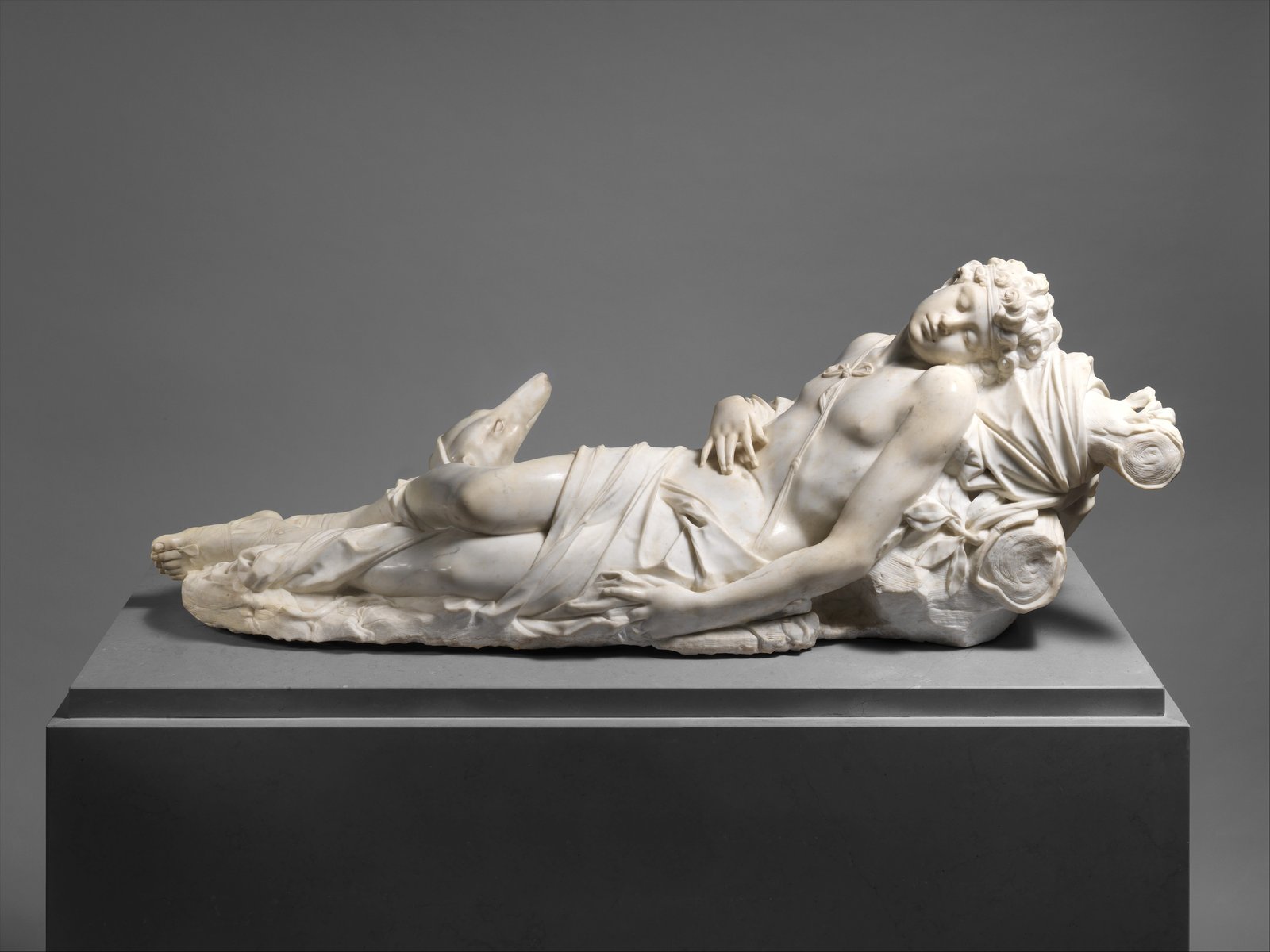
The Met bought this Carrara marble in 2013 and dates it about 1723–25. It is long and low, about 142 centimetres wide and only 53 tall, a sleeping youth stretched along a bed of drapery with his head resting on a tree stump and a hound at his feet. Here the cloth is not a veil but a sash, wrapped across the body in a few long folds.
Vestal Tuccia, Dresden and Rome
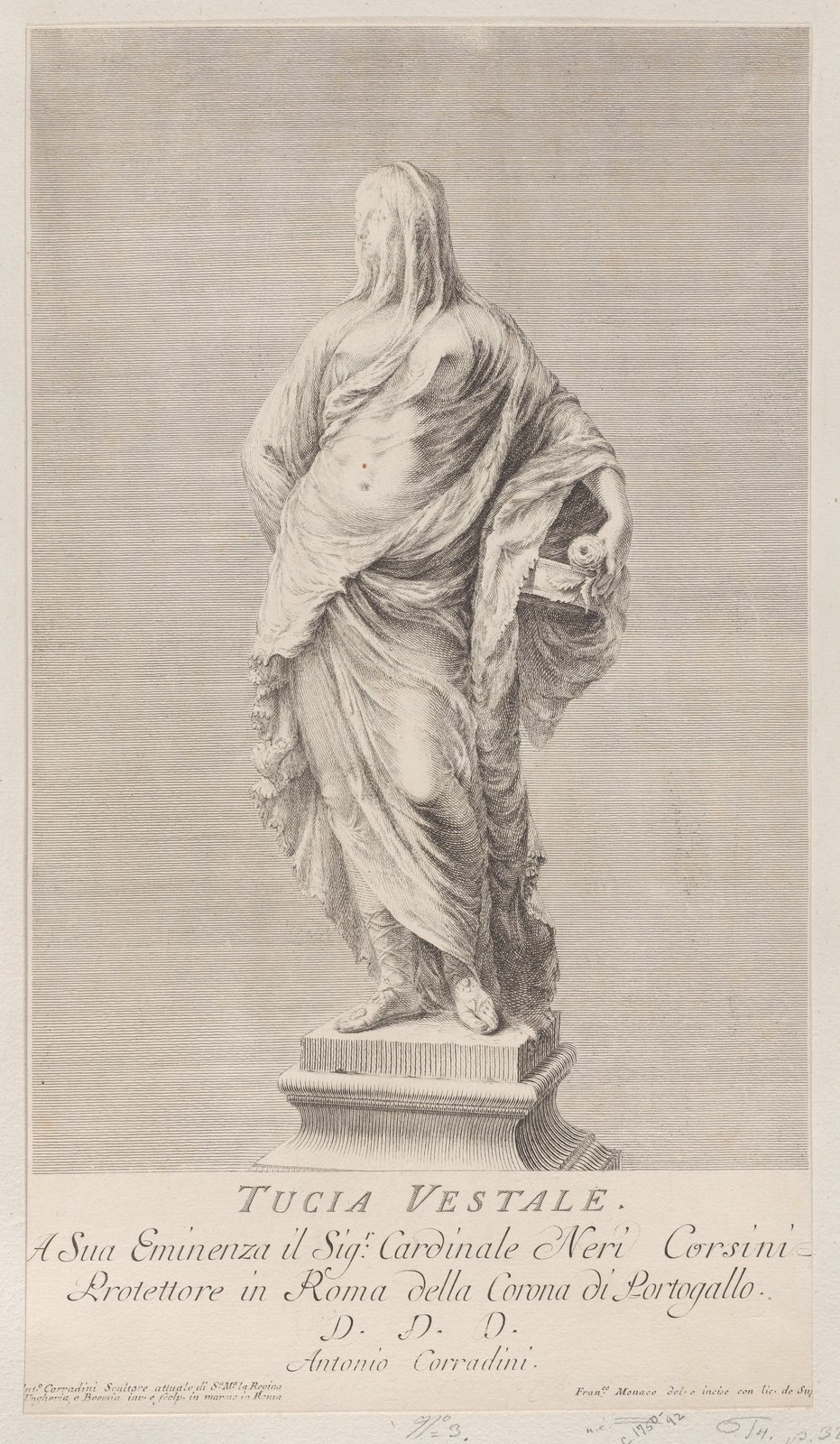
Tuccia was a Roman Vestal who proved her innocence by carrying water in a sieve. The Dizionario Biografico records a Tuccia for Dresden’s Grosser Garten dated 1732 on its plinth, and a second version begun in Rome in 1743 that failed to find a buyer and stayed at Palazzo Barberini. The Rome guide site Roma Non Per Tutti also describes the marble as made in Rome on spec, without a commission, and still on show at Palazzo Barberini. The etching above, by Francesco Monaco and dated by the Met to about 1748, records the statue with a dedication to Cardinal Neri Corsini lettered beneath it.
Modesty (Pudicizia), Sansevero Chapel, 1752
The Museo Cappella Sansevero dates Modesty to 1752; the Italian Art Society gives 1749–52. The museum describes it as a memorial to the prince’s mother, Cecilia Gaetani dell’Aquila d’Aragona, and the veil as clinging to the figure as if dampened. It also reports that the art historians Joseph Rykwert and Rosanna Cioffi have compared it with the veiled Truth on the frontispiece of the French Encyclopédie.
The model for the Veiled Christ
The prince wanted Corradini to carve a veiled dead Christ for the chapel. According to the Sansevero museum, he died after making only a terracotta model, now at the Museo di San Martino in Naples; Giuseppe Sanmartino carved the marble in 1753, largely setting the model aside. The Dizionario Biografico also records that this model is the one surviving clay study from his Naples work.
Technique: carving a veil
The Dizionario Biografico describes his veiled figures as drapery that reveals the modelling of the body beneath, and the Innsbruck archive singles out his illusionistic, veil-like treatment of marble. In practice, the veil is not a separate layer at all. The sculptor carves the face or figure and the cloth in the same stone, keeping the forms underneath slightly sharper than they would be and making the cloth’s folds thin, so the eye reads a skin of fabric over a solid form.
Three things make it work. First, the cloth follows the form tightly over high points, such as the brow, nose and knees, and pulls away only in the hollows. Second, the folds gather at the edges, where the veil hangs free, so the centre stays calm and readable. Third, polish varies: smooth, bright areas read as skin; finer, cut lines read as fabric. The Dizionario Biografico adds that he worked in marble, alabaster, lead and wood, and used clay models to plan large schemes.
What to look at: composition, palette and lettering
Composition. His standing figures are tall and narrow, with drapery spiralling around a central axis. Adonis is the opposite: a long horizontal that reads like a banner.
Palette. Marble is close to monochrome, so the colour is all in tone. Measured from the museum’s scan of the Adonis, the lit marble sits around #d5cdc4 and #c3bdb5, with shadowed folds near #8e8880 against a photographer’s grey of about #686867. Measured from the museum’s scan of this impression of the Monaco etching, the paper reads around #e6dbcd, with mid-tones near #c4b9ac and the darker hatched areas near #a89d91. These are values from modern photographs, not original materials. You can sample your own with the image colour picker.
Lettering. The Monaco print carries its title, Tucia Vestale, in spaced roman capitals, followed by a dedication in a flowing italic and the sculptor’s name centred beneath. It is a tidy model for a caption block: one strong title line, a softer secondary line, and a credit set small. For more on how prints like this were made, see our guide to etching.
How designers can borrow from Antonio Corradini
- Design the reveal, not the cover. A good frosted overlay or translucent panel, like a good veil, lets the most important shapes show through. Decide what must stay legible underneath before you choose the blur or opacity.
- Keep the top layer tight over the key points. Corradini’s cloth hugs the face. On a UI card or poster, the overlay can be most transparent where the key image detail sits and denser at the edges.
- Put texture at the margins. His folds gather where the veil hangs free. Concentrate pattern, grain or motion at the edges of a layout and keep the centre quiet.
- Work in tone. A near-monochrome palette of warm whites and greys, like the measured values above, can carry a whole identity if contrast is handled with care. Add one accent only where you need it.
To place him in the lighter, decorative art of the eighteenth century, see our guide to the Rococo.
Where to see his work
Modesty is in the Sansevero Chapel in Naples, and the terracotta model for the Veiled Christ is at the Museo di San Martino in the same city. The Vestal Tuccia is at Palazzo Barberini in Rome, the Veiled Woman bust at Ca’ Rezzonico in Venice, and Adonis at the Met in New York. The Italian Art Society also lists a gilded wooden hatch cover from 1722–28 at the Museo Correr in Venice, a reminder that he carved for objects as well as for monuments.
Frequently asked questions
What is Antonio Corradini known for?
He is known for marble figures under carved veils that seem transparent, including Modesty in the Sansevero Chapel in Naples, the Vestal Tuccia in Rome and the Veiled Woman bust in Venice.
Did Corradini make the Veiled Christ?
No. According to the Sansevero museum, Corradini made only a terracotta model before he died in 1752. Giuseppe Sanmartino carved the marble Veiled Christ in 1753.
Where did Antonio Corradini work?
He worked in Venice, for courts in St Petersburg, Dresden and Vienna, where he became court sculptor in 1733, and later in Rome and Naples, where he died.
Are images of his work public domain?
His sculptures date from the eighteenth century. The two images in this guide are scans The Metropolitan Museum of Art flags as public domain in its collection data: the Adonis and Francesco Monaco’s etching after the Tuccia.