Rembrandt Bugatti made animals look as if they had just moved. A panther stalks with its head low, an elephant lifts one foot and raises its trunk, and the clay surface still carries the quick pressure of his fingers. For logo designers, illustrators, product designers and anyone who works with silhouettes, Rembrandt Bugatti is a compact study in how to capture movement with few lines and keep the evidence of the hand.
His sculpture is public domain in the US because of its age, and the Cleveland Museum of Art releases its scan of one bronze as CC0. More public-domain sculpture and design references are collected in the MGD museum inspiration collection.
Who was Rembrandt Bugatti?
Bugatti was born in Milan in 1884, according to the Cleveland Museum of Art, the British Antique Dealers’ Association (BADA) and the Encyclopaedia Universalis; the National Museum of Wildlife Art gives 1885. BADA, Phillips and The Collector all record that he was the younger son of Carlo Bugatti, the Milanese furniture designer, and the younger brother of Ettore Bugatti, who founded the car company. BADA and The Collector both name the painter Giovanni Segantini as his uncle.
Universalis calls him self-taught, and the National Museum of Wildlife Art says he had no formal art training. BADA, Phillips, Universalis and The Collector all credit the sculptor Paolo Troubetzkoy, a friend of the family, with encouraging him to sculpt. The family moved from Milan to Paris in the early 1900s: BADA gives 1902, Phillips 1903 and The Collector 1904. BADA and The Collector both report that his work was shown at the Venice Biennale in 1903, when he was still a teenager.
In Paris he studied the animals of the menagerie at the Jardin des Plantes, as Cleveland, BADA, Phillips and the National Museum of Wildlife Art all record. From 1907 he worked at Antwerp Zoo, which, according to BADA and the Flemish Art Collection’s record for the Royal Museum of Fine Arts Antwerp (KMSKA), gave him space on its grounds; Universalis dates his Antwerp period from 1907 to 1914. BADA and the National Museum of Wildlife Art both record that he received the Légion d’honneur in 1911.
The First World War closed the zoo, and BADA and The Collector both report that many of its animals were killed. Bugatti returned to Paris and died there in January 1916, aged 31; Universalis gives the date as 8 January, and Universalis, BADA and the National Museum of Wildlife Art record that he took his own life.
Key works by Rembrandt Bugatti
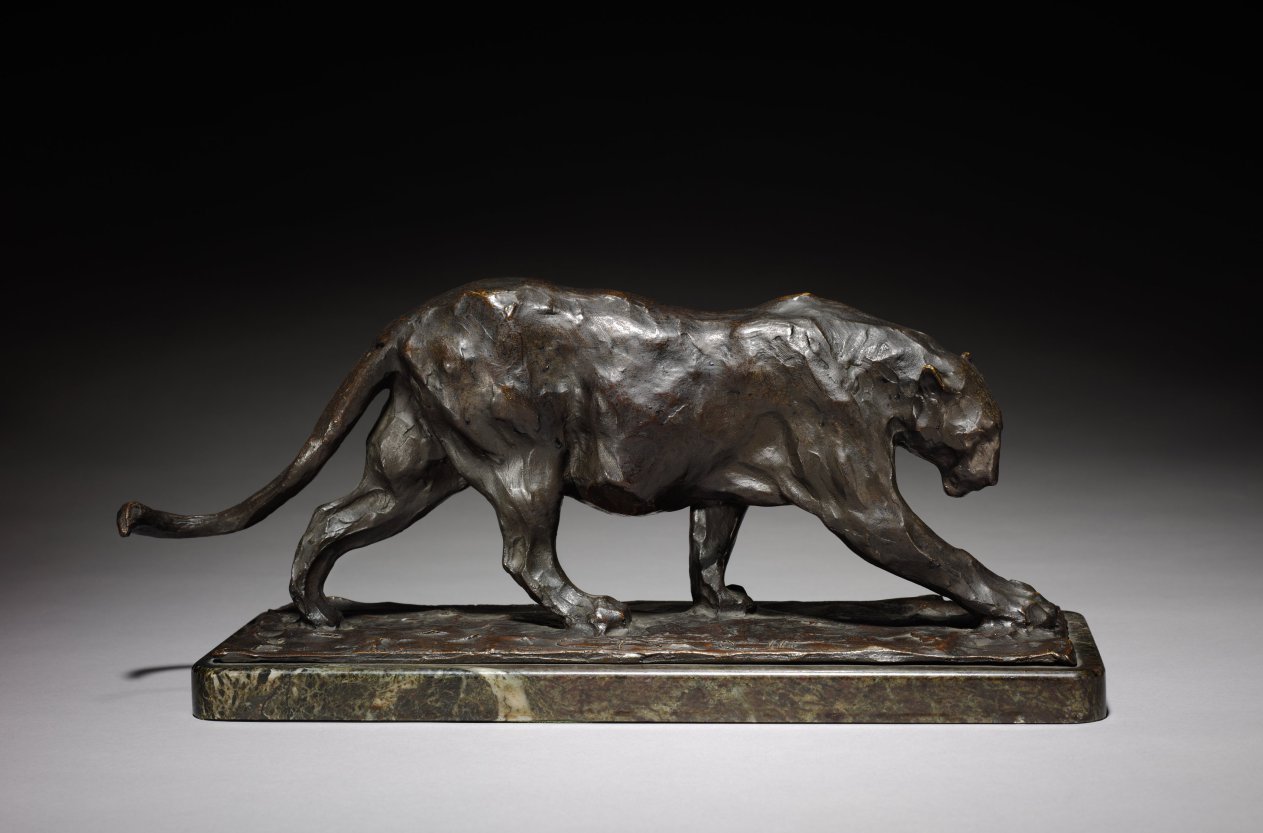
Walking Panther, 1903
The Cleveland Museum of Art dates this bronze to 1903 and records it at 17.8 by 42 by 15.1 centimetres, signed “R. Bugatti” and stamped “A. A. Hebrard”. Cleveland notes that panthers were among the first wild animals he depicted, after encountering them at the Jardin des Plantes. Look at the length: the body is more than twice as long as it is high, and the lowered head, level back and curving tail form one continuous line from end to end.
Elephant Begging, about 1908
The KMSKA holds a lost-wax bronze of a female elephant lifting her right front foot and raising her trunk, dated about 1908 and measuring 13.5 by 24.5 by 11 centimetres, according to the Flemish Art Collection record. That record says the elephant was modelled from life at Antwerp Zoo and that the zoo bought the first cast of the large edition in 1908.
Elephants in motion, about 1912
Phillips catalogued a Petit Éléphant en marche, conceived around 1912, as one of eleven known casts, with a letter “M” beside the foundry mark.
The elephant on the Bugatti Royale
BADA records that Ettore Bugatti unveiled the Type 41 Royale in 1926 with a dancing-elephant ornament replicating one of his brother’s designs, and The Henry Ford museum says the Royale’s radiator mascot was cast from Rembrandt’s work as a tribute to his memory. The car and brand name remain trademarks of their owners; what matters here is how a sculpture became a brand mark.
Technique: modelling from life, casting in bronze
Bugatti worked in front of the animals rather than in a studio. The KMSKA record says he watched for long periods, made no preparatory drawings and modelled quickly in clay or plasticine; BADA and Phillips both describe him modelling in plasticine on site. The National Museum of Wildlife Art adds that he abandoned any piece he could not finish in one sitting, which helps explain the fresh, unworked look of the surfaces.
Casting was handled in Paris by Adrien-Aurélien Hébrard. The KMSKA record dates his contract with Hébrard to 1904 and says Hébrard held annual exhibitions of the work until 1913; Phillips and the National Museum of Wildlife Art also date the Hébrard exhibitions from 1904. Universalis describes an exclusive contract that paid Bugatti a regular salary and a royalty on sales. BADA and Phillips both report that Hébrard strictly limited the number of casts, and the KMSKA record says bronzes were usually cast only after they were ordered. The KMSKA elephant is listed as lost-wax casting, a process that keeps the fine texture of the original model.
Universalis places his work between realism and stylisation and uses the phrase “sculptural impressionism”. The National Museum of Wildlife Art contrasts his calm, everyday scenes with the violent combats of earlier French animal sculpture.
What to look at: silhouette, surface and palette
Silhouette first. Seen side-on, Walking Panther reads instantly as a shape. The stretched legs and lowered head make a long, low triangle against the light background.
Faceted surface. Instead of smoothing the fur, Bugatti left flat, knife-like planes and finger marks across the shoulders and flanks. Each facet catches light differently, so the surface does the shading.
The base as a frame. The panther walks on a thin bronze ground set on a rectangular stone base, which works like a plinth line under a wordmark: it anchors the figure and sets the horizontal axis.
Signature and foundry mark. Cleveland records both the incised signature and the Hébrard stamp. Two small marks, one for the maker and one for the producer, sit quietly in the base, a good model for a discreet signature system on products and packaging.
A dark, restrained palette. Measured from the museum’s scan of this cast with a PIL quantize, the bronze shades include #27211C, #3A322B and #4F4841, with highlights around #84807C; the stone base reads as #4D4336 and #5F5546, and the studio backdrop as about #B3B1B4. These are the colours of the photograph, not a record of the original patina. You can sample your own values with the colour palette generator.
How designers can borrow from Rembrandt Bugatti
- Design for the side view. Test animal marks and mascots as solid silhouettes. If the profile reads as one gesture, as the panther does, detail becomes optional.
- Use the long format. His walking animals suit wide banners, website headers and horizontal packaging, where the eye follows the body from tail to head.
- Keep the hand visible. Faceted, uneven surfaces give illustrations and 3D renders warmth. Leave some brush, stylus or modelling marks rather than smoothing everything.
- Work from observation. He modelled in front of living animals. Reference photographs and life drawing still produce more convincing posture than copying other designers’ icons.
- Build a quiet palette around one material. Dark browns and greys with a single pale ground give a premium, museum-like tone for packaging or a product site.
For an earlier French animal sculptor to compare with, see our guide to Pierre-Jules Mêne. His uncle’s painting is covered in our Giovanni Segantini guide, and the furniture world of his father belongs to the era described in our Art Nouveau graphic design article.
Where to see his work
Walking Panther is in the Cleveland Museum of Art, which showed it in its 1999 exhibition Bugatti, according to the museum’s record. The KMSKA in Antwerp holds Elephant Begging, and the Flemish Art Collection record notes that another large cast went to the Galleria Nazionale d’Arte Moderna in Rome. The National Museum of Wildlife Art in Jackson, Wyoming, also lists him in its collection.
Frequently asked questions
What is Rembrandt Bugatti known for?
He is known for bronze sculptures of animals, modelled from life at the Jardin des Plantes in Paris and at Antwerp Zoo, and cast by the Hébrard foundry. Panthers and elephants are among his recurring subjects.
Was Rembrandt Bugatti related to the car maker?
Yes. He was the younger brother of Ettore Bugatti, founder of the car company, and the son of the furniture designer Carlo Bugatti. A dancing-elephant ornament based on his work was used on the Bugatti Type 41 Royale.
How did Rembrandt Bugatti make his sculptures?
He modelled quickly in plasticine or clay in front of the animals, without preparatory drawings, according to the KMSKA record. The models were then cast in bronze by Hébrard in limited numbers, including by the lost-wax process.
Are Rembrandt Bugatti’s sculptures in the public domain?
His sculptures date from before 1916 and are public domain in the US. The Cleveland Museum of Art releases its image of Walking Panther under CC0; photographs held by other collections may carry their own terms.