John Webber spent four years at sea drawing coastlines, harbours, canoes, houses and the people the expedition met, then spent much of the following decade turning those sketches into images that engravers could print. Webber’s Pacific reached European viewers not as drawings but as engravings, etchings and coloured prints, and his career shows how an image changes as it moves from sketchbook to plate to page.
His prints carry the outlook of a European expedition and record encounters from one side; this guide looks at how they were made and composed. For more public-domain prints from the period, browse the MGD museum inspiration collection.
Who was John Webber?
Webber was born in London in 1751, according to both the Dictionary of Canadian Biography and the Museum of New Zealand Te Papa Tongarewa; the Dictionary gives 6 October. His father, Abraham Wäber, was a sculptor from Bern who settled in London and anglicised the family name. Both sources record that Webber was sent as a young child to Bern to be brought up by his father’s sister, and that he trained there with the Swiss landscape and portrait painter Johann Ludwig Aberli.
He then studied in Paris. Te Papa says he spent four years there studying drawing and oil painting at the Académie Royale; the Dictionary of Canadian Biography dates his move to 1770 and names the engraver Johann Georg Wille as his teacher. Back in London by 1775, he showed work at the Royal Academy exhibition of 1776. Both sources record that the botanist Daniel Solander, who had sailed on Cook’s first voyage, noticed his work and recommended him for the third.
Artist on Cook’s third voyage, 1776–1780
The expedition left England in July 1776 and returned in August 1780, the Dictionary of Canadian Biography records. Cook himself wrote that Webber had been “pitched upon” to supply drawings of the voyage’s most memorable scenes. Te Papa describes the range of what he produced: quick field sketches, worked-up drawings and finished compositions in pen, crayon and watercolour.
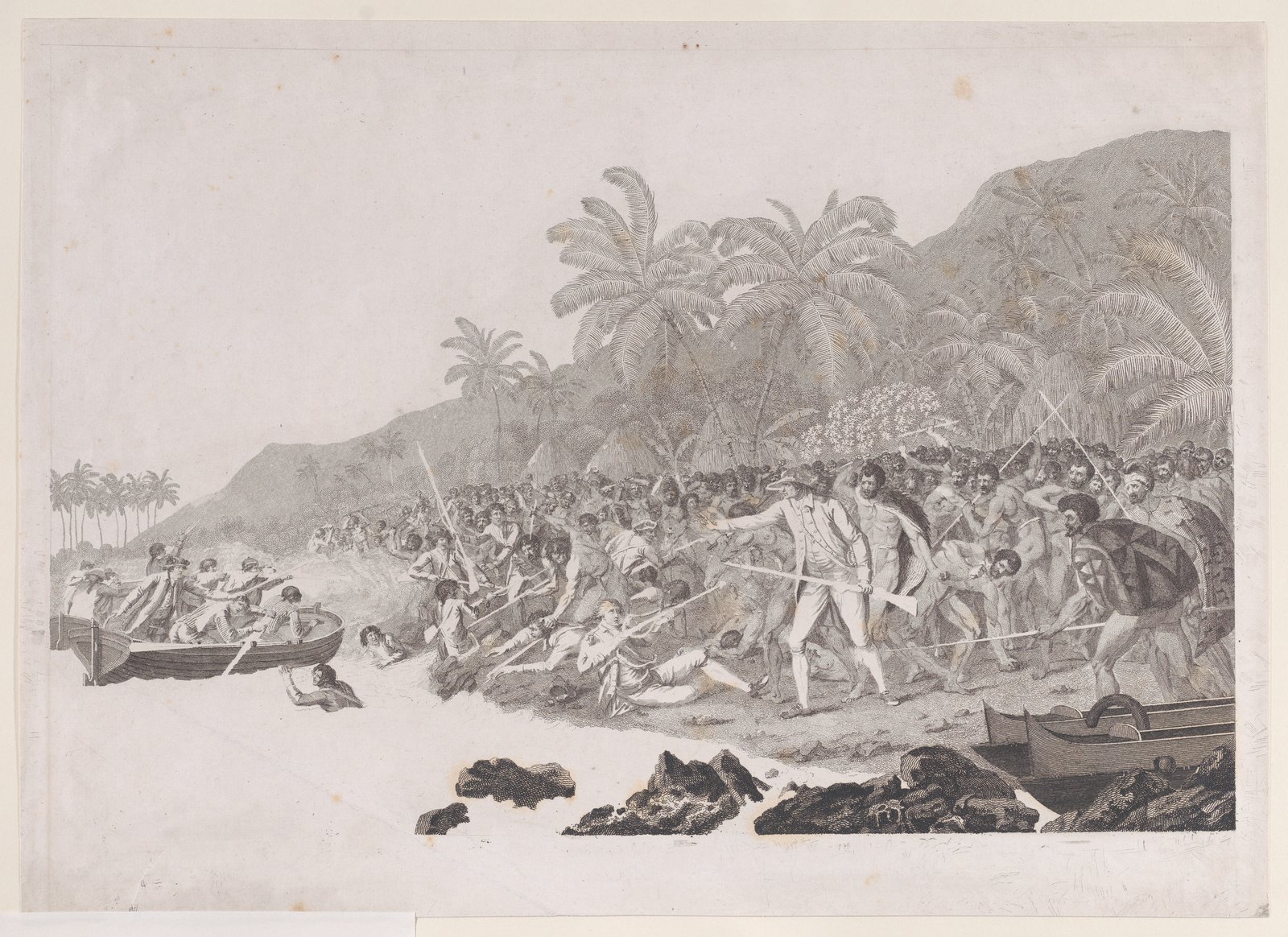
The route took the ships across the Pacific and up the northwest coast of North America. The Dictionary of Canadian Biography notes four weeks spent refitting at Nootka Sound, in present-day British Columbia, in 1778, and counts about 29 surviving Webber drawings from there. Cook was killed in Hawaiʻi in 1779, as Te Papa records and as the Metropolitan Museum’s print of the scene shows.
Back in London, according to the Dictionary of Canadian Biography, Webber showed about 200 sketches to George III and others, and was paid by the Admiralty to prepare drawings for engraving. Te Papa notes that he also made oil paintings from his drawings and supervised the engravers.
Key works and prints
The official account, 1784
Cook and James King’s A Voyage to the Pacific Ocean appeared in 1784 in three volumes with an atlas of plates, as the Dictionary of Canadian Biography records; the Metropolitan Museum holds a volume catalogued as probably the atlas to the third voyage, with illustrations after Webber. Here his work reached the public through other hands: professional engravers translated his drawings into line.
The Death of Captain Cook, 1785
The Met’s impression of this print, dated 1785 and catalogued as the first of three states, credits the figures to the engraver Francesco Bartolozzi and the landscape to William Byrne, after a design by Webber, who is also listed as a publisher. The Dictionary of Canadian Biography also records the print as engraved by Bartolozzi and Byrne. It is a large, crowded composition, and the division of labour is visible in it: figure work in one engraver’s hand, palms, hills and rocks in another’s.
Portraits of Cook, around 1780
Te Papa holds an oil portrait of Cook by Webber, dated around 1780 and possibly painted after Cook’s death, showing him in naval uniform on a shore with a telescope. The museum describes it as one of three known Webber portraits of Cook, with the others in the National Portrait Gallery, London, and in Canberra.
His own etched views, from 1788
Webber also issued voyage subjects as his own prints. The Dictionary of Canadian Biography records that he printed his own series of etchings of the voyage, and Te Papa notes that he was among the artists who made and sold prints of their own work. The National Gallery of Australia’s impression of View of Ulietea, inscribed “Drawn & Etch’d by J. Webber”, carries an imprint date of 1 February 1788 and the address 312 Oxford Street; the gallery catalogues it as etching and aquatint, hand-coloured, with the aquatint credited to Maria Catharina Prestel. Royal Museums Greenwich holds plates from a later edition titled Views in the South Seas, issued under John Boydell’s name and dated 1809, long after Webber’s death.
Technique: from sketch to plate
Webber’s working chain had three stages. In the field he drew quickly in pen, crayon and watercolour. In London he worked those sketches up into finished drawings and oils. Then they went to the copperplate, either through a reproductive engraver or, in his later prints, through his own etching needle with aquatint added for tone.
Etching and aquatint suit this kind of subject. Etched lines carry outline and foliage; aquatint adds areas of even tone for sky and water; hand-colouring then adds atmosphere on top. Museum catalogues describe the technique of individual plates slightly differently, for example as etching and aquatint at the National Gallery of Australia and as aquatint and etching, coloured, at Royal Museums Greenwich, so check the catalogue entry for any impression you study. Our guide to etching explains the process, and the engraving theme page collects public-domain line prints.
What to look at in John Webber’s prints
Layered depth. In The Death of Captain Cook, dark rocks sit across the bottom edge, the crowded beach forms a middle band, and palms and hills rise behind. Three distinct tonal planes do the work of perspective.
Foliage as texture. The palms are drawn as radiating strokes that read almost as pattern, a contrast to the soft hills behind and the solid blacks of the rocks.
Open space. In this first-state impression, the sky and parts of the foreground are left largely as bare paper, which makes the detailed band of the scene read more strongly.
Colour. Measured from the Met’s scan of this impression, the print sits in a narrow warm-grey range: paper around #e5dbd6, mid-tone hatching around #b1a8a2, foliage around #7a716d and the darkest rocks around #4b4849. These are values of the scan, not of the original inks. Try your own samples in the image colour picker.
How designers can borrow from John Webber
- Design for the reproduction, not the original. Webber reworked his drawings so they would survive engraving. Make illustrations with the final print process in mind, whether that is risograph, screen print or a small mobile screen.
- Build depth in bands. A dark foreground strip, a detailed middle and a pale distance give a flat layout instant depth.
- Use a restrained palette, then add one colour. The monochrome engraving reads clearly; Webber’s coloured etchings add washes over a printed base. A greyscale illustration with a single tint applied on top is a cheap, effective system.
- Caption with care. Voyage images record one side of an encounter. When you use historical material, write captions that name places and peoples accurately and say whose view the image shows.
For the engraver who cut the figures, see our guide to Francesco Bartolozzi, and for the wider tradition of topographical views, our guide to landscape painting.
Later career
Webber became an associate of the Royal Academy in 1785, the Dictionary of Canadian Biography records, and was elected a full Academician in 1791, a date given by both the Dictionary and Te Papa. Te Papa also notes that in 1785 he designed scenery and costumes for a London stage spectacle based on Cook’s voyages and the travels of Omai. The Dictionary records a return visit to Bern in 1787 and sketching tours in Derbyshire and Wales. He died in London in 1793 of kidney disease, according to both sources.
Frequently asked questions
What is John Webber known for?
He is known as the official artist of Captain Cook’s third voyage (1776–1780), whose drawings were engraved for the 1784 official account, and for his own hand-coloured etched views of Pacific places.
Did John Webber make the Death of Captain Cook print himself?
No. The 1785 print was engraved by Francesco Bartolozzi (figures) and William Byrne (landscape) after Webber’s design, according to the Metropolitan Museum’s catalogue record; Webber is listed as a publisher.
What technique did John Webber use for his prints?
His own views were etched, with aquatint tone and hand-colouring; the National Gallery of Australia credits the aquatint on one 1788 plate to Maria Catharina Prestel. Catalogue descriptions vary from plate to plate.
Are John Webber’s prints in the public domain?
The works themselves are centuries old and out of copyright. The Met flags its impression of The Death of Captain Cook as public domain; for other impressions, check the holding museum’s image rights.