Jōchō made one of the calmest images in Japanese art, and then made that calm repeatable. The Amida Buddha he carved for the Phoenix Hall of Byōdō-in in 1053 set the proportions, the soft surface and the even, rounded face that sculptors across Japan copied for generations afterwards. For type designers, product designers and brand teams, Jōchō shows how one carefully balanced master form can become a standard.
Only one of his works survives, so this guide pairs it with a CC0 sculpture in his style from the Cleveland Museum of Art. For more objects to study, browse the MGD museum inspiration collection.
Who was Jōchō?
Jōchō was a busshi, a professional sculptor of Buddhist images, working in Kyoto in the first half of the eleventh century. His birth date is not recorded; the Dictionary of Japanese Architectural and Art Historical Terminology (JAANUS), the Japan Tourism Agency and EBSCO’s scholarly biography all give his death as 1057. EBSCO’s biography, by Yoshiko Kainuma, dates his active career to roughly 1020–1057.
He grew up inside a workshop. The Buddhist-sculpture guide by Mark Schumacher at onmarkproductions names the court sculptor Kōshō as his father and says Jōchō inherited his Kyoto studio. EBSCO’s biography calls the master Kōjō, describes him as Jōchō’s teacher and says he may have been his father. EBSCO credits the older sculptor with already moving Buddhist carving towards softer, calmer modelling, which Jōchō then refined.
His patrons were the Fujiwara regents who dominated the court. EBSCO and onmark both connect him with Hōjōji, the temple in Kyoto founded by Fujiwara no Michinaga, which no longer stands, and both record that his work there earned him the Buddhist rank of hokkyō around 1022; onmark notes that the title had previously gone only to senior monks. EBSCO adds that he received the higher rank of hōgen in 1048 for restoring images at Kōfukuji in Nara after a fire, a project onmark also mentions.
Key work: the Byōdō-in Amida, 1053
Byōdō-in in Uji, south of Kyoto, was a Fujiwara villa that Michinaga’s son, Fujiwara no Yorimichi, turned into a temple in 1052, according to the Japan Tourism Agency and EBSCO. Its Amida Hall, better known as the Phoenix Hall, was built in 1053, and the seated Amida Buddha inside was completed the same year. Byōdō-in, the Japan Tourism Agency and JAANUS all describe the statue as Jōchō’s work, and the first two call it his only surviving one. EBSCO cites a court diary recording its enshrinement in 1053 and gifts given to Jōchō that day.
Byōdō-in gives the figure’s height as 277.2 centimetres and describes it as wood covered with gold leaf on lacquer; the Japan Tourism Agency’s text specifies Japanese cypress. Both the hall and the statue are designated National Treasures.
The statue was never meant to be seen alone. Byōdō-in describes a canopy over the Buddha, centred on a large octagonal bronze mirror that could have reflected light into the hall, and 52 small Bodhisattvas riding clouds on the upper walls, which the temple says Jōchō’s studio also made in 1053. They are arranged in two groups of 26, some playing instruments, some dancing, some praying. EBSCO adds that the Amida sits on a lotus pedestal before a boat-shaped mandorla decorated with clouds and celestial figures. The result is a complete designed environment built around one figure.
What to look at in the Jōchō style
JAANUS gives the clearest checklist of what it calls Jōchōyō, the Jōchō style. Look for:
- A low, wide base. The figure sits cross-legged with the knees spread wide and low, so the silhouette is close to a broad triangle. It reads as stable from across a hall.
- A flat, broad chest. There is no muscular drama. Volume is simplified into a few large, quiet planes.
- Shallow, parallel drapery. The folds of the robe are carved as low parallel ridges, not deep cuts. Light slides across them instead of falling into shadow.
- A round, serene face. JAANUS describes the ideal as fully rounded and lacking nothing; EBSCO quotes the comparison of the face to a full moon.
JAANUS also notes that this approach was admired for its simplicity and gentleness and came to stand for wayō, a Japanese manner distinct from Chinese-style images. EBSCO makes the same point.
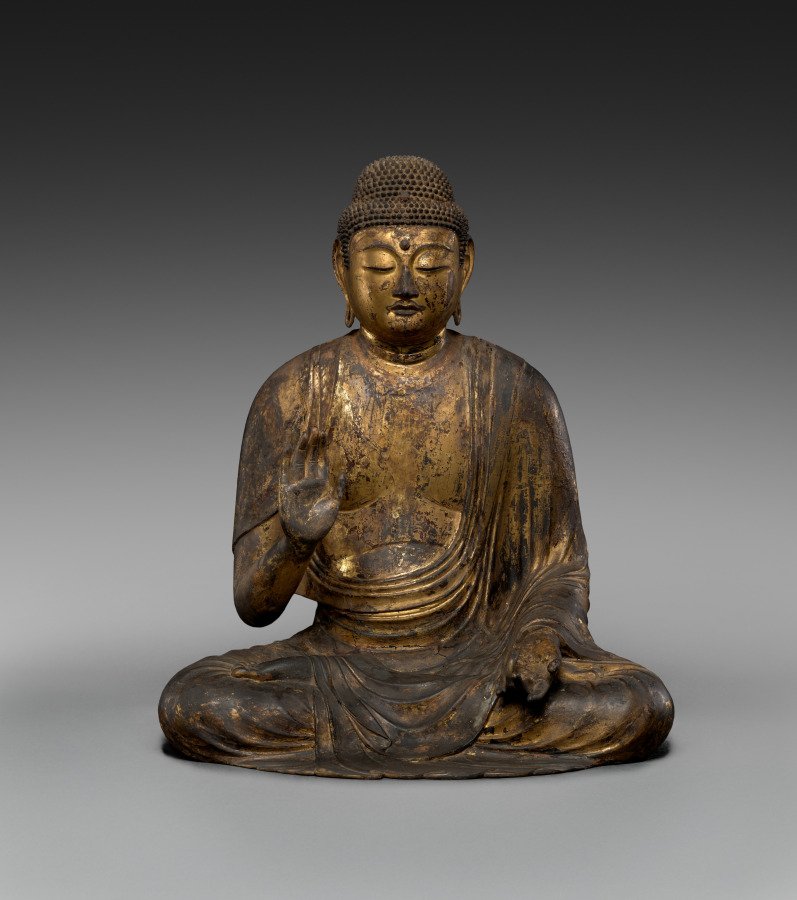
The Cleveland Museum of Art’s seated Buddha above, made in the 1100s, shows how these features travelled. The museum notes that it is sculpted in the Jōchō style and that it was assembled from several hollowed pieces of wood, then lacquered and gilded. It is not by Jōchō, but it shows his formula: wide knees, quiet folds, lowered eyes.
Technique: joined wood and the studio system
Jōchō’s method mattered as much as his look. Earlier Heian figures were often carved from a single block. Jōchō is credited with developing yosegi-zukuri, the joined-block or assembled-wood method, to its full potential, as JAANUS puts it; Byōdō-in and the Japan Tourism Agency both say he and his workshop built the Amida this way. The Japan Tourism Agency explains the process: separate cypress blocks are joined, then carved and shaped, and the seams are covered with layers of cloth, lacquer and gold leaf.
EBSCO lists the gains: less timber, lighter figures, less cracking and faster production. Thinner wood also forced shallower carving, which gave the surface its soft quality. Form followed the joinery.
The method also made a new kind of workshop possible. According to EBSCO, about a hundred sculptors worked under Jōchō on the Hōjōji images, organised into master sculptors and assistants with Jōchō supervising them all. The onmark guide likewise says the assembled-wood technique let his team plan the entire production before carving began. EBSCO adds that in 1134 two later sculptors measured more than sixty sections of another Amida by Jōchō to record its proportions.
Colour, in this tradition, is mostly gold over dark lacquer. Measured from the Cleveland Museum of Art’s scan of its seated Buddha, the main tones are a deep lacquer brown (#281a0d), a warm umber (#57422c), a worn gilt bronze (#6f573a) and a pale, rubbed highlight (#9f9485). These are values from the museum’s photograph of this sculpture, not the original surface colours. You can try them out in the colour palette generator.
Jōchō’s influence
The Japan Tourism Agency says the Byōdō-in Amida became a stylistic standard for Buddhist statuary for the next two centuries. JAANUS says his works set standards of style and proportion that later artists used as a model, particularly for seated Amida images, and that his influence spread from Kyoto workshops to the rest of the country from the eleventh and twelfth centuries onwards. JAANUS names Kyoto examples at Hōkaiji, Hōkongōin (1130) and Sanzen’in (1148).
EBSCO notes the downside: close imitators tended to produce stylised, lifeless figures, and the style faded with its aristocratic patrons. For an overview of that wider history, see our guide to Japanese art. For a later, European master of carved and assembled wooden figures, compare our guide to Tilman Riemenschneider.
How designers can borrow from Jōchō
- Design the master, then the rules. Jōchō’s Amida became a reference that others measured. Treat a hero logo, a key glyph set or a flagship product the same way: perfect one form, then write down its ratios so a team can reproduce it.
- Let construction shape the style. Joined blocks meant thinner wood and shallower carving, which produced the soft look. When a production method limits you, such as a laser cutter, a stitch, a pixel grid or an injection mould, look for the visual language it naturally creates.
- Use a wide, stable base. The low, triangular silhouette reads as calm at any distance; icons and posters built on a broad base feel grounded.
- Keep relief shallow. Low parallel folds catch light evenly. In illustration or UI, gentle tonal steps and fine repeated lines can suggest depth without harsh shadows.
- Design the whole room. The Phoenix Hall combined canopy, mirror, cloud-borne figures and paintings around one image. Exhibition, retail and digital landing pages work the same way: a central focus, with every surrounding element pointing back to it.
To sample your own tones from a public-domain photograph, use the image colour picker.
Where to see Jōchō’s work
The Amida Buddha remains in the Phoenix Hall at Byōdō-in in Uji, Kyoto Prefecture; the temple’s Hōshōkan Museum shows other National Treasures from the hall. The Cleveland Museum of Art holds the Jōchō-style seated Buddha shown here, which the museum says once served in a small temple near Kōfukuji in Nara.
Frequently asked questions
What is Jōchō known for?
He is known for the gilded wooden Amida Buddha completed in 1053 for the Phoenix Hall at Byōdō-in, his only surviving work, and for the Jōchō style of calm, evenly proportioned Buddhist sculpture that later workshops followed.
What is yosegi-zukuri?
It is the joined-block or assembled-wood method of making a statue from several pieces of wood. After carving, the joints were covered with cloth, lacquer and gold leaf. JAANUS credits Jōchō with developing it to its full potential.
When did Jōchō die?
JAANUS, the Japan Tourism Agency and EBSCO all give 1057. His birth year is not recorded.
Can I use images of Jōchō-style sculpture in my designs?
The Cleveland Museum of Art releases its photograph of the seated Buddha shown here under CC0. Photographs of the Byōdō-in Amida itself are a separate matter, so check the rights for any specific image before using it.