Peterbilt Brand Guidelines
The Oakland truck maker behind the red oval.
Aa
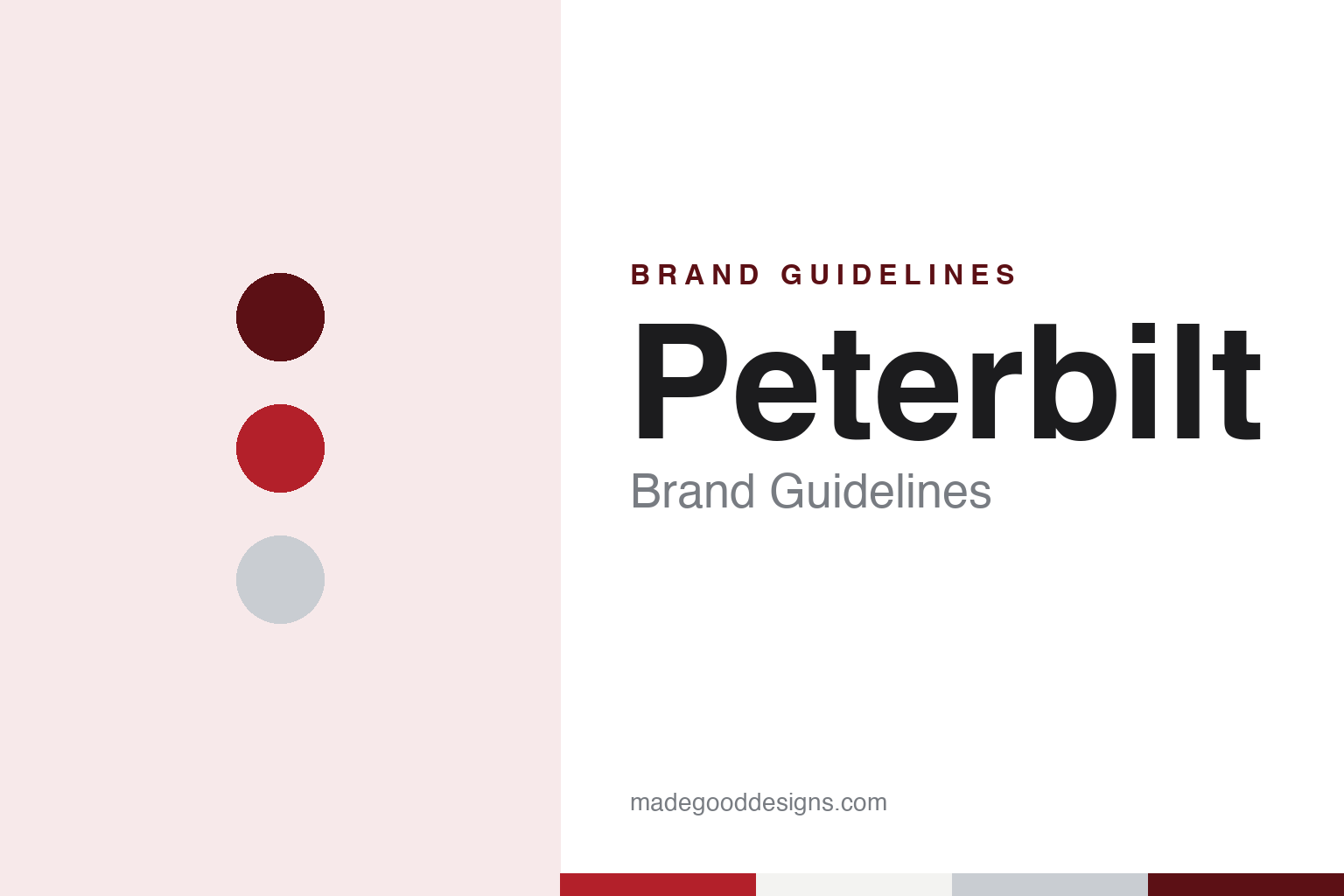
Two constants: an oval red, polished chrome and cab white palette and a wide badge sans register. Abstract homage — not a Peterbilt product or mark; no truck, oval or logo is reproduced.
From Fageol to Peterbilt
A lumberman, a bankrupt truck plant and a borrowed name.
Peterbilt grew out of the timber business of the Pacific Northwest. English Wikipedia and the Gale International Directory of Company Histories both describe T. A. “Al” Peterman as a lumberman based in Tacoma, Washington, who needed trucks to bring logs to his plywood and lumber mills. The Chronicle of Centralia, Washington, reported in January 2007 that Peterman had lived in the logging town of Morton from September 1934 until about 1940, cutting timber there for his Tacoma mills, and that before he made trucks of his own he rebuilt surplus Army trucks and modified old logging trucks for his operations in Tacoma and Morton.
The factory came from an older Oakland marque. The Gale history says the Fageol company had been started in Oakland, California, in 1915, first known for luxury cars and then for trucks, and that it passed through other hands in the 1930s before Sterling Motors bought its assets. Wikipedia says Peterman learned on a business trip to San Francisco in 1938 that Fageol was for sale, and that the purchase of the plant, its tooling and its parts was completed in 1939, when the Oakland site opened for business as Peterbilt Motors Company. Both sources say early plans for chain-drive logging trucks gave way to trucks for highway freight, and that the company kept itself busy in its first years by repairing and rebuilding trucks of other makes.
The name is a contraction of the founder’s own. According to the Gale history, “Peterbilt” came from a line of wood doors made at one of Peterman’s facilities, and early trucks carried another trace of the timber business in the plywood used to trim their cabs. Wikipedia says the first trucks offered for sale, in April 1939, were the single-axle Model 260 and the tandem-axle Model 334, and that the company began a habit, kept for about four decades, of numbering single rear-axle trucks from 2 and tandem trucks from 3.
After Peterman’s death — dated November 1944 by English Wikipedia and 1945 by the Gale history — the business passed to his wife, Ida Peterman. In 1947 she sold it to a group of managers and investors; the Gale history names company president Lloyd A. Lundstrom as the leader of that buyout, and Wikipedia says Ida Peterman kept the real estate under the plant.
Colour
Pacific Car and Foundry, a red oval and a move to Texas.
The land decided the next sale. Wikipedia and the Gale history both say the Oakland site was slated to become a shopping centre, and that rather than build a new factory the owners sold the company to Pacific Car and Foundry of Seattle, a maker of railway freight cars that already owned the rival truck maker Kenworth. HistoryLink, the Washington State history encyclopedia, gave the date in a 2004 essay on the parent company: from 24 June 1958 until late 1960 Peterbilt ran as a wholly owned subsidiary, after which it was dissolved and made a division of Pacific Car. The same essay records that the parent changed its name to PACCAR Inc on 25 January 1972, which is how Peterbilt and Kenworth became sister brands under one owner. The Gale history says PACCAR let its truck brands operate independently of each other.
The emblem settled early in the PACCAR years. Wikipedia says Peterbilt introduced its current brand emblem in 1953, replacing a rectangular border with the red oval still used on the trucks, and that a bird-style hood ornament made its debut on the Model 358 in 1965, serving partly as a grab handle and remaining in production in nearly the same form. The Gale history adds that from around 1959 Peterbilt’s print advertising began to lean on the word “Class”, a theme it kept for years, and that liberal use of polished chrome became part of how the trucks looked from one model refinement to the next.
Production moved east in stages. The Gale history and Wikipedia date the move from Oakland to a new plant in Newark, California, to August 1960, followed by a plant in Madison, Tennessee, near Nashville, in 1969, a Canadian operation in Sainte-Thérèse, Quebec, in 1975, and a factory in Denton, Texas, in 1980. Assembly at Newark ended in 1986, and in 1993, the Gale history says, Peterbilt moved its headquarters from Newark to a renovated office building in Denton. Wikipedia says the Madison plant closed in 2009 and that Peterbilt now builds trucks in Denton and at PACCAR facilities in Sainte-Thérèse and Mexicali, Mexico.
Typography
Design and documentation.
A truck maker’s identity lives in places a car badge rarely reaches. The mark on a heavy truck usually sits on or above the grille, where it has to read from a distance, from a mirror and from the cab of the vehicle behind, so badges on this kind of vehicle tend to be large, simple and often three-dimensional, in chrome, brushed metal or moulded plastic rather than in print.
Truck brands can also carry a nameplate or wordmark across the front of the cab or the hood, and a model name on the doors or the sleeper. On fleet vehicles, though, the maker’s mark shares the cab with the operator’s livery: the haulier’s colours, name and fleet number usually dominate the paintwork, and the manufacturer’s badge becomes the one constant from fleet to fleet.
The third surface is the dealer network. Pylon signs, service-bay fascias, parts counters and workshop uniforms repeat the mark at a scale closer to retail signage, and they are where a change of logo or owner tends to show first. For a designer, these three settings — grille, cab and dealership — are the useful test of any truck identity: does the mark hold up in metal, alongside someone else’s colours, and on a sign seen from the road?
Aa
A wide badge sans — the register of a grille emblem and a dealer sign. (Specimen set in Archivo, a sans-serif STAND-IN; NOT the Peterbilt logo.)
Peterbilt
An oval, a bird and a word in the advertising.
Peterbilt’s identity is built from a few fixed parts that have outlasted several generations of trucks. One is the name itself, which keeps the founder’s surname inside a single word. Another is the red oval, which Wikipedia dates to 1953 and which sits on the grille. A third is the bird on the hood, a three-dimensional mark that Wikipedia dates to the Model 358 of 1965 and that the company has kept in close to its original form.
Drivers shortened the name long ago. The Gale history refers to early trucks as “Petes”. The same history traces the word “Class” in Peterbilt’s print advertising to around 1959 and describes it as a longstanding theme.
Anniversaries have been marked through paint and trim rather than new marks. Wikipedia says that in 2014, to mark 75 years of production, Peterbilt released a 75th Anniversary Edition of the Model 579 finished in a two-tone exterior with a matching interior. The emblem and the bird stayed as they were.
The brand’s history is tied to place as well as to its owner. It began in Oakland, moved within the San Francisco Bay Area to Newark in 1960, and has been run from Denton, Texas, since 1993, all while sitting alongside Kenworth inside the same parent company.
For a design guide, Peterbilt shows how a small, consistent set of marks — a coined surname, a red oval and a hood ornament — can carry a brand through new owners, new plants and decades of new truck models. Compare it with Kenworth, its sister brand under PACCAR, and Ford, whose blue oval sits on another American badge. For this guide we use oval red, polished chrome and cab white with a sans, an unofficial interpretation; no product or logo is reproduced.
Explore & save
Keep Peterbilt’s identity on hand — save it to a board in the Made Good inspiration library.
Peterbilt identity set
Pin the Peterbilt oval red, polished chrome and cab white palette and the wide badge sans register to your own board.