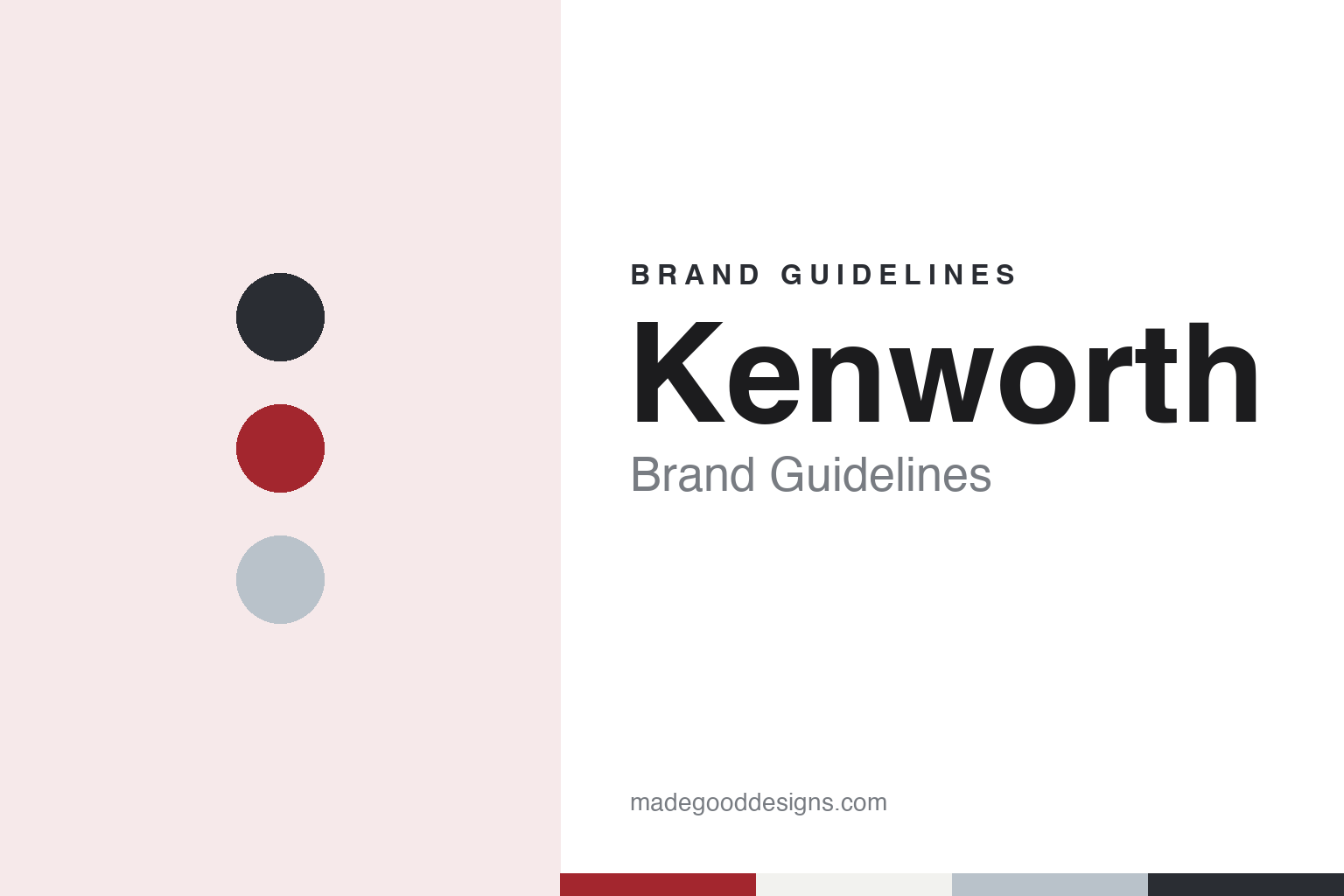
Kenworth Brand Guidelines
The Seattle truck name made from two partners.
Aa
Two constants: an emblem red, steel grey and graphite palette and a condensed plate sans register. Abstract homage — not a Kenworth product or mark; no truck, emblem or logo is reproduced.
Gersix to Kenworth
A Portland dealership, a six-cylinder truck and two surnames.
Kenworth’s story starts with a truck that carried another name. English Wikipedia traces the company to Gerlinger Motors, a car and truck dealership in Portland, Oregon, set up in 1912 by the brothers George T. Gerlinger and Louis Gerlinger Jr. In 1914, it says, the brothers moved into building vehicles and sold a truck called the Gersix, a name taken from its inline six-cylinder engine. The truck was framed in structural steel and found buyers among loggers in the Northwest, and in 1916 Gerlinger Motors moved from Portland to Tacoma, Washington, into a building leased from the Seattle businessman Edgar K. Worthington.
The Gerlingers did not keep the business for long. Wikipedia says Gerlinger Motors filed for bankruptcy in 1917 and was bought by Worthington with a business partner, Captain Frederick Kent, who renamed it the Gersix Motor Company to keep the link with the truck that had made its name. Kent retired in 1919, and his son, Harry Kent, took his place as Worthington’s partner. By the early 1920s the company was building Gersix trucks in Seattle, at a factory on Fairview Avenue.
The name came in January 1923, when Gersix was reincorporated as the Kenworth Motor Truck Company. Wikipedia says the new name combined those of the partners — Kent and Worthington — and that the company moved within Seattle to premises on Mercer Street. HistoryLink, the Washington State history encyclopedia, said in a 2004 essay on the parent company that Kenworth had been producing trucks in Seattle since that incorporation in 1923.
Wikipedia describes a way of working that set the tone for the brand: rather than an assembly line, Kenworth built trucks in individual bays and made them to each customer’s specification, a practice it says the company still offers. It also says the company began building buses in 1926, started manufacturing in Canada in 1927 and began building fire trucks in 1932. In 1929 Worthington retired and Harry Kent became company president.
Colour
Pacific Car and Foundry, PACCAR and a sister brand.
The family names left the ownership in the 1940s. Wikipedia says that after the death of company president Phil Johnson in 1944, ownership was split between three holders who did not want to run the company, and that a plan to sell it to employees fell through for lack of financing. HistoryLink’s 2004 essay says Pacific Car and Foundry, a Seattle-area maker of railway cars and steel, purchased the Kenworth Motor Truck Corporation in 1945. One Wikipedia article on the sister brand dates the purchase to 1944; the Kenworth article and HistoryLink both give 1945.
Wikipedia says Pacific Car housed all Kenworth manufacturing under one roof by the end of 1946, in a former Fisher Body factory in Seattle. HistoryLink records that Kenworth opened a Canadian division in 1956, and Wikipedia dates sales facilities in Mexico to 1959.
In 1958 the parent bought Peterbilt of Oakland, California, which HistoryLink describes as a major competitor of Kenworth; from that point the two rival truck names shared an owner. Pacific Car and Foundry changed its name to PACCAR Inc on 25 January 1972, HistoryLink says, and the two brands have continued side by side. Wikipedia notes joint projects between them, including a low-cab-over model for refuse work developed with Peterbilt and sold by Kenworth as the Hustler.
Kenworth’s factories spread from Seattle over the following decades. Wikipedia dates a plant in Chillicothe, Ohio, to 1974, and HistoryLink says a new Kenworth truck factory opened on PACCAR’s historic Pacific Car and Foundry site in Renton, Washington, on 4 June 1993, after the company cleaned up the land. Wikipedia lists current Kenworth plants in Chillicothe, Renton, Sainte-Thérèse, Quebec, Bayswater, Victoria, in Australia, and Mexicali, Mexico, and gives the company’s headquarters as Kirkland, Washington, a suburb of Seattle.
Typography
Design and documentation.
A truck maker’s identity lives in places a car badge rarely reaches. The mark on a heavy truck usually sits on or above the grille, where it has to read from a distance, from a mirror and from the cab of the vehicle behind, so badges on this kind of vehicle tend to be large, simple and often three-dimensional, in chrome, brushed metal or moulded plastic rather than in print.
Truck brands can also carry a nameplate or wordmark across the front of the cab or the hood, and a model name on the doors or the sleeper. On fleet vehicles, though, the maker’s mark shares the cab with the operator’s livery: the haulier’s colours, name and fleet number usually dominate the paintwork, and the manufacturer’s badge becomes the one constant from fleet to fleet.
The third surface is the dealer network. Pylon signs, service-bay fascias, parts counters and workshop uniforms repeat the mark at a scale closer to retail signage, and they are where a change of logo or owner tends to show first. For a designer, these three settings — grille, cab and dealership — are the useful test of any truck identity: does the mark hold up in metal, alongside someone else’s colours, and on a sign seen from the road?
Aa
A condensed plate sans — the register of a grille badge and a model plate. (Specimen set in Barlow Condensed, a sans-serif STAND-IN; NOT the Kenworth logo.)
Kenworth
Two partners in the name and in the model letters.
Kenworth’s identity carries its founders twice. The company name joins Kent and Worthington into a single word, and Wikipedia says the model prefixes adopted for the 1961 line-up came from the same two partners: W for Worthington, on the conventional W900, and K for Kent, on the cab-over K900, later renamed the K100. The W900 brought a tilting hood and replaced a conventional cab design that dated from 1939, Wikipedia says, and it remains part of the model line more than six decades later.
Wikipedia says the later T range, beginning with the T600 of 1985, introduced a sloped hood and a set-back front axle, and the W990, introduced in 2018, became the flagship conventional, sharing a wide cab with the T680 and T880.
Heritage is used directly in the product. Wikipedia describes a Legend Series of limited-production trucks that revive the styling of earlier models with modern equipment: the T950 Legend of 2015, based on a model built from 1992 to 2007; the T900 Legend of 2017, inspired by the 1991 T900; and in 2021 the SAR Legend, a homage to the W900 SAR built from 1975 to 1987. In each case Wikipedia says the engine was painted in a period colour scheme to match the original trucks.
The company has been run from the Seattle area since 1923, and its parent, PACCAR, is headquartered in nearby Bellevue, according to HistoryLink.
For a design guide, Kenworth shows how a brand can be built from its founders’ names, first compressed into one word and then split back into the letters of its model names. Compare it with Peterbilt, its sister brand under PACCAR, and Chevrolet, another American vehicle name taken from a person. For this guide we use emblem red, steel grey and graphite with a condensed sans, an unofficial interpretation; no product or logo is reproduced.
Explore & save
Keep Kenworth’s identity on hand — save it to a board in the Made Good inspiration library.
Kenworth identity set
Pin the Kenworth emblem red, steel grey and graphite palette and the condensed plate sans register to your own board.
